

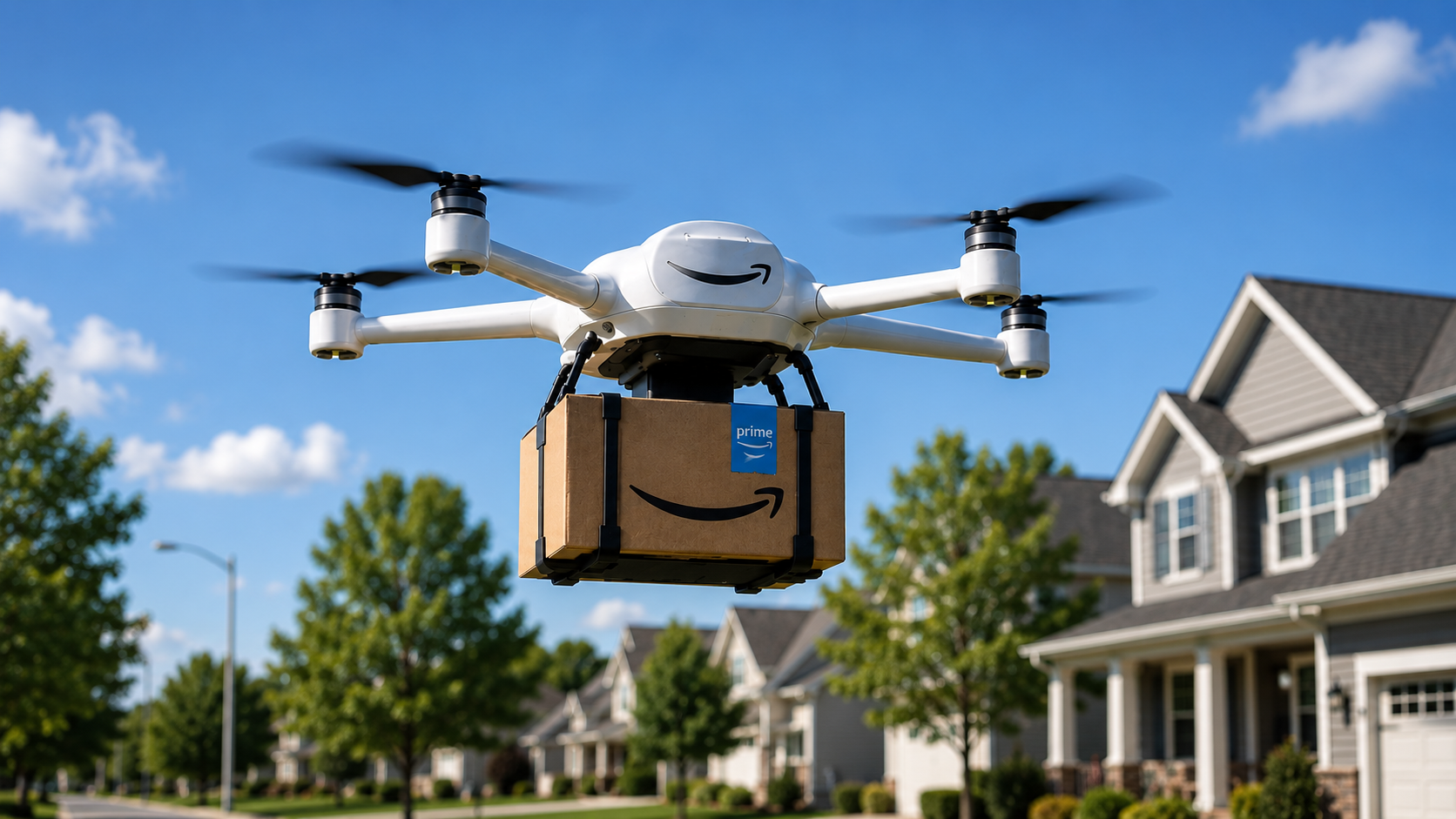
When a customer receives allergy medicine or a pint of ice cream from the sky within minutes, it is no longer merely an experiment. It is the beginning of a new chapter in global logistics.
The United States is entering one of the most significant transformations the delivery industry has seen in decades. Behind the expanding drone networks of Walmart, Amazon, and Alphabet lies more than a battle for consumer convenience.
At stake is leadership in a technology that could reshape the economics of the last mile and give the United States a strategic advantage in its competition with China.
That is why Washington is preparing to remove the regulatory barrier that has constrained commercial drone delivery for years.
The FAA Prepares to Open the Skies to Large-Scale Drone Operations
The Federal Aviation Administration has proposed new regulations that would allow certified drone operators to fly beyond the visual line of sight without having to obtain a separate waiver for each individual operation.
Until now, this restriction has made many commercial drone programs difficult, expensive, and, in some cases, economically impossible to scale.
One example is Kroger’s drone delivery pilot in Ohio. The grocery retailer began testing drone deliveries in 2021, but the program was suspended after just eight months.
The reason was straightforward: federal rules required personnel to maintain visual contact with the drones along their flight paths. Instead of operating an automated delivery network, the company would have needed to deploy teams of human observers throughout the service area.
That staffing requirement undermined the economics of the entire project.
Drone developer Dexa is now reportedly exploring the possibility of reviving the program. This time, however, the regulatory environment could be dramatically different.
Walmart and Amazon Move From Testing to Expansion
While federal regulators continue to finalize the proposed rules, America’s largest retailers are already accelerating the expansion of their drone delivery networks.
Walmart says drone delivery is currently available at 70 stores across the United States. By the end of 2027, the retailer plans to expand the service to more than 270 locations, transforming drone delivery from a localized experiment into a more established component of its logistics infrastructure.
According to the company, Walmart is approaching 2 million drone deliveries, with the majority of those flights completed during the program’s recent period of rapid expansion.
The most common drone orders are not major grocery purchases. They are urgent, everyday items that customers need immediately, including:
- medication;
- pet food;
- last-minute cooking ingredients;
- household essentials;
- small convenience items.
Depending on the aircraft, Walmart’s drones can carry payloads ranging from approximately 3 to 8 pounds. That limited capacity makes the technology particularly well suited to small, time-sensitive orders.
Amazon is also expanding its Prime Air network. The company recently opened its tenth U.S. drone delivery location in Baton Rouge, Louisiana, and plans to make Prime Air available to 30 million customers by the end of 2026.
Amazon says its drones can deliver eligible orders in less than 30 minutes. Walmart has reported completing some deliveries in under five minutes.
The Last Mile Becomes the Industry’s Main Battleground
For years, competition among major retailers centered on the cost of delivery. Increasingly, the decisive factor is becoming speed.
A drone can travel directly to its destination, bypass road congestion, and complete repeated trips with minimal human involvement.
According to Dexa, eliminating visual-line-of-sight restrictions could allow a single operator earning approximately $25 per hour to monitor as many as 40 drones at once.
Together, those aircraft could potentially complete around 160 deliveries per hour.
That level of automation could radically change the economics of the last mile, traditionally one of the most expensive and operationally complex parts of the supply chain.
Researchers at PwC estimate that the cost of an individual drone delivery could fall to approximately $2 by 2034, potentially undercutting many traditional courier and vehicle-based delivery models.
The Race Extends Far Beyond the U.S. Retail Market
For the U.S. administration, the growth of commercial drones is part of a much broader strategic contest.
Washington has openly connected the development of the domestic drone industry with the need to preserve American technological leadership against China.
China is already considered a global leader in what it calls the low-altitude economy — a commercial aviation sector operating primarily below 3,000 meters and encompassing drones, autonomous aircraft, logistics services, and other forms of aerial mobility.
According to estimates from Chinese research institutions and aviation authorities, the country’s low-altitude economy could exceed 2 trillion yuan, or approximately $280 billion, by 2030.
Drone delivery activity is already concentrated in major technology and manufacturing centers such as Shenzhen and Guangzhou.
Companies including JD Logistics have tested drone networks across several Chinese provinces. JD Logistics says its aircraft can reduce delivery times for customers in rural areas by as much as 70%.
For Washington, this means the competition is no longer limited to e-commerce. It is increasingly about leadership in the next generation of autonomous logistics.
Drone Delivery Moves Beyond the Experimental Stage
Significant challenges remain. Communities have raised concerns about noise, privacy, safety, and the presence of autonomous aircraft above residential neighborhoods.
Yet the industry is steadily moving from experimental trials toward large-scale commercial deployment.
Engineers say each new generation of drones is becoming lighter, quieter, more reliable, and capable of flying longer distances.
The most important developments are no longer happening only inside laboratories. They are happening during real deliveries, in real neighborhoods, under real operating conditions.
Every completed flight generates data that can be used to improve navigation systems, battery performance, route planning, autonomous control, and overall reliability.
That is why many industry executives describe the current moment as a turning point.
Only a few years ago, drone delivery was widely viewed as an expensive technology demonstration. Today, it is becoming a practical component of modern logistics.
If the FAA’s proposed regulations are adopted, that transition could accelerate dramatically. By the end of the decade, delivery drones may become as familiar in American suburbs as courier vans and express delivery vehicles are today.
