

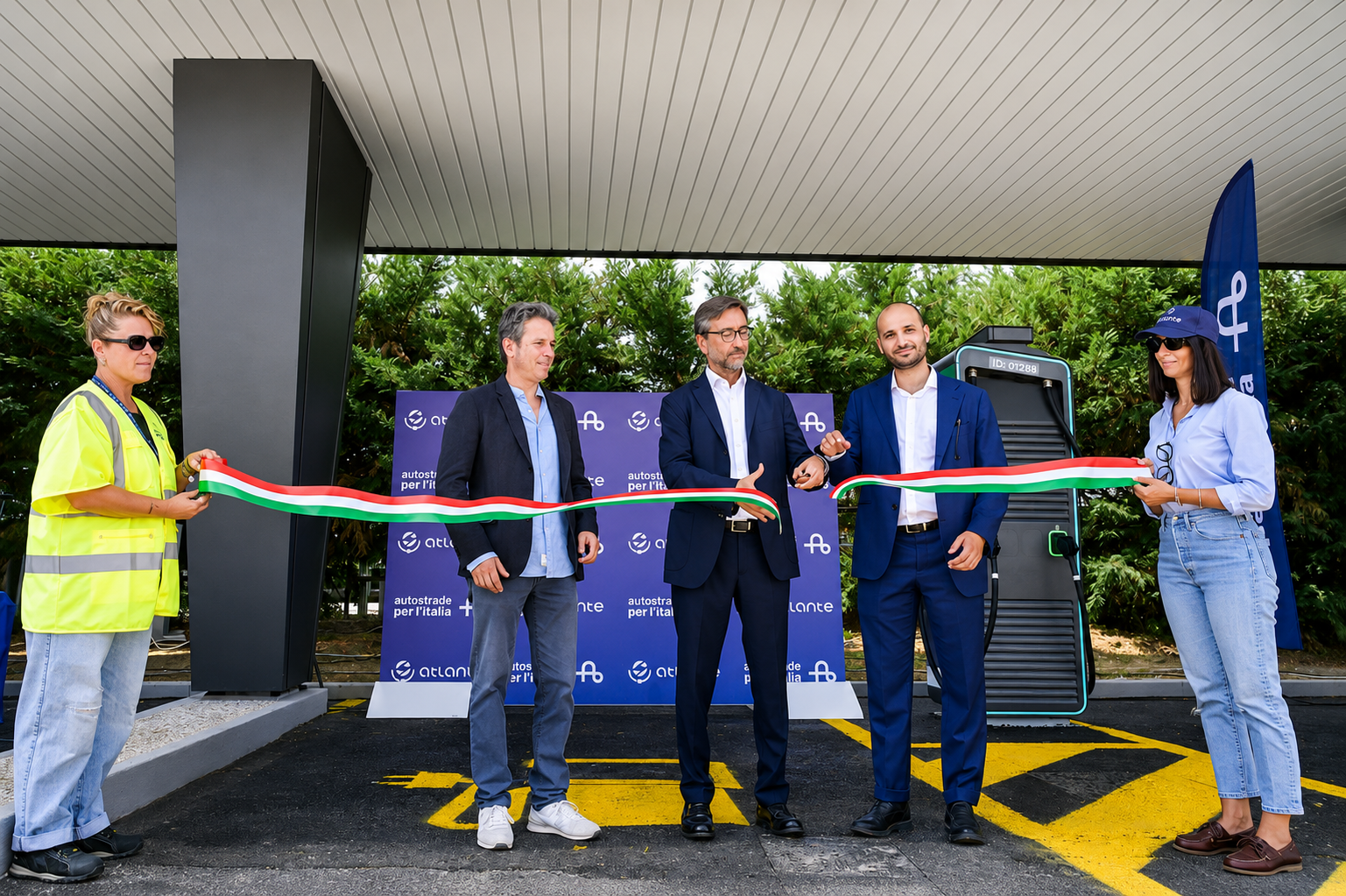
Italy is expanding electric mobility infrastructure on its motorway network. Autostrade per l’Italia and Atlante have completed the installation of 82 new high-power charging points, distributed across seven charging stations in seven service areas.
The announcement was made with the opening of the new charging station at the Montepulciano Est service area. The new infrastructure is part of a broader plan to make long-distance electric travel more practical on Italian motorways, reducing range anxiety and improving service availability along major transport corridors.
The newly activated stations are located at Montepulciano Est and Montepulciano Ovest in the province of Siena, San Pelagio Est near Padua, San Nicola Ovest in Caserta, Teano Est in Caserta, and Le Saline Est and Le Saline Ovest in the province of Foggia. The San Nicola Ovest station is temporarily closed for renovation works.
For users, the key feature is speed. The stations offer ultra-fast charging systems with power of up to 400 kW, allowing compatible electric vehicles to charge up to 80% in around 20 minutes. The sites also use battery energy storage and photovoltaic canopies, while the electricity supply is based on 100% renewable energy.
As K2Cargo News previously reported in Europe Introduces Summer Truck Driving Restrictions for 2026, motorway infrastructure increasingly shapes how transport operators plan routes, stops and travel times. Charging availability is becoming another part of that infrastructure equation.
From Seven Stations to a Wider Network
The 82 new charging points do not stand alone.
Autostrade per l’Italia says the wider plan has already brought the network to 107 active charging stations. The company has also completed tender procedures for another 61 stations, which are expected to be activated in the coming months in partnership with leading operators in the sector.
When the full programme is completed, the network should include 168 charging stations. The average distance between charging locations is currently just over 50 km, but the target is to reduce it to 30 km.
That number matters. For electric mobility, the question is not only how many charging points exist, but how evenly they are distributed. A dense network gives drivers more flexibility, reduces queues and makes long-distance planning easier.
For motorway users, the goal is to make charging feel less like a special operation and more like a normal travel stop.
Why Ultra-Fast Charging Matters
High-power charging is essential for motorway travel.
Slow charging may be acceptable at home, at workplaces or during long parking periods. But on motorways, users need short stops and predictable charging times. A 20-minute stop to restore up to 80% battery capacity can fit into a typical rest break, coffee stop or meal stop.
This is especially important for long-distance drivers. If charging takes too long or stations are too far apart, electric vehicles become less attractive for intercity travel.
Ultra-fast chargers also help support higher utilization. More vehicles can be charged in the same period, reducing waiting times and improving the commercial viability of the stations.
For logistics, the impact will be gradual. Most of today’s motorway EV charging infrastructure is focused on passenger cars and light commercial vehicles. But as electric vans and future electric trucks become more common, high-power corridors will become more important for freight as well.
Renewable Energy and Grid Management
The project is not only about chargers. It is also about how energy is managed.
The new stations are powered by electricity from renewable sources and supported by battery storage and photovoltaic systems. These solutions can help reduce pressure on the local grid, stabilize peak loads and make energy flows more efficient.
This is important because high-power charging creates concentrated demand. If many vehicles charge at the same time, the load on the grid can rise sharply. Storage systems can absorb energy when demand is lower and release it when charging demand increases.
Photovoltaic canopies add another layer. They do not replace the full grid connection, but they can contribute renewable electricity directly at the site and improve the environmental profile of the station.
For motorway operators, this type of infrastructure is becoming part of a broader transition: service areas are turning from fuel-only stops into energy hubs.
Accessibility and Payment
The new charging stations are designed to be easy to use.
They are available 24 hours a day, accessible for users with reduced mobility and interoperable with major mobility service providers and roaming platforms. Users can also pay directly by credit card, which is important for occasional drivers and foreign users who may not have a specific charging app.
A multilingual customer support service is available around the clock, and a remote availability-check system allows users to verify whether chargers are free before arrival.
These details are not minor. One of the biggest barriers to EV adoption is not only charging speed, but usability. Drivers need to know whether a charger works, whether it is available, how to pay and what to do if there is a problem.
A strong motorway charging network must therefore combine power, reliability and customer service.
What It Means for Italian Mobility
The expansion shows that Italy’s motorway system is preparing for a more electric vehicle fleet.
For consumers, the new stations make longer electric trips easier. For service areas, they create new demand and a new business model. For the energy system, they require smarter load management. For logistics, they form part of the future infrastructure that will eventually support more electric commercial vehicles.
The plan also gives a signal to automakers and fleet owners. Charging availability is one of the main conditions for switching to electric vehicles. If drivers can rely on fast chargers along motorways, the practical barrier to adoption falls.
Still, challenges remain. Italy will need not only more stations, but also consistent maintenance, transparent pricing, real-time availability data and enough capacity during peak holiday travel. The motorway network must also prepare for future charging needs from vans, buses and heavy vehicles.
For now, the activation of 82 new high-power charging points is a concrete step. It brings Italy closer to a motorway charging network where electric travel becomes routine rather than exceptional.
Read also: Europe Introduces Summer Truck Driving Restrictions for 2026