

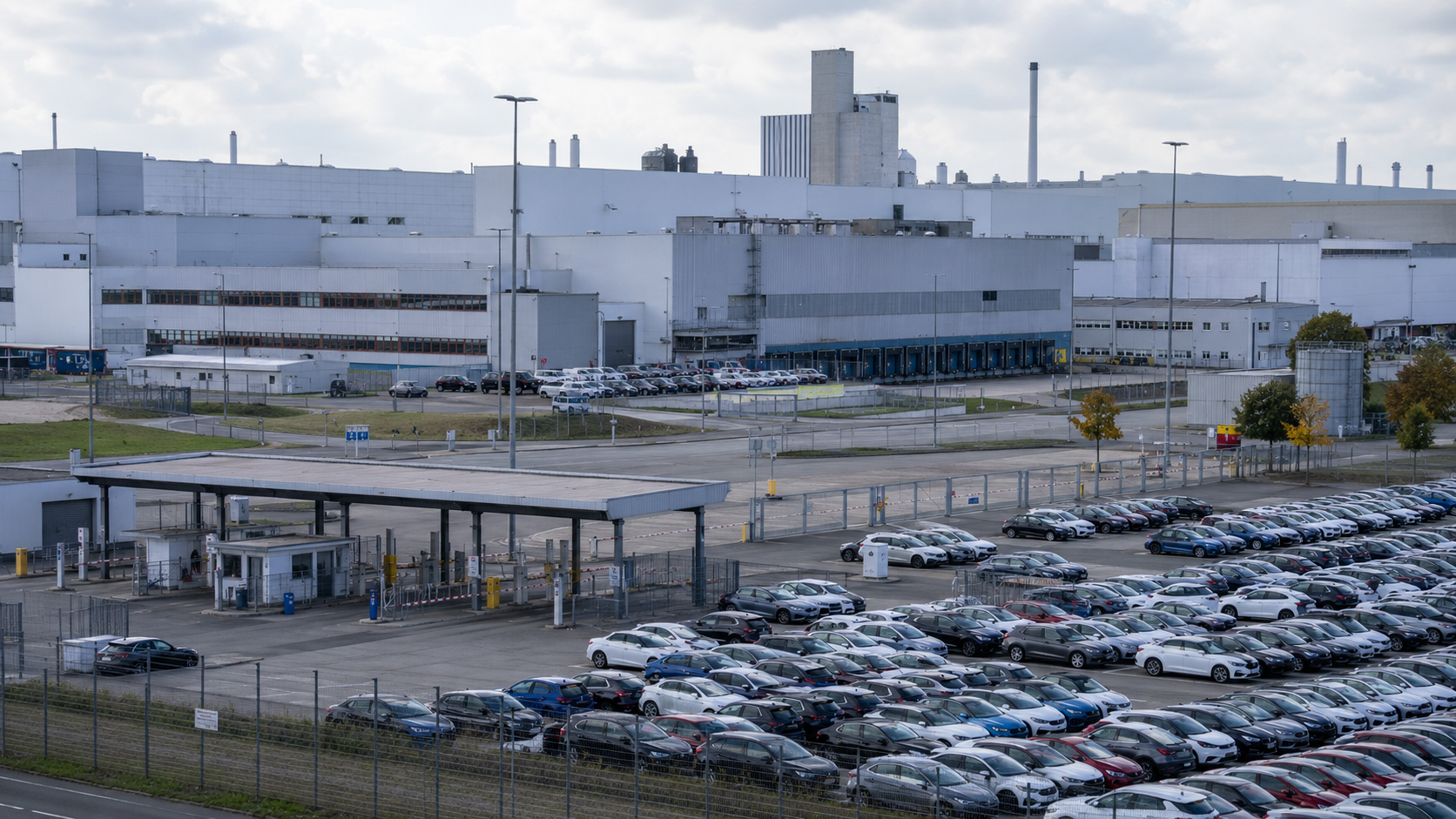
Volkswagen Deliveries Fell to 4.13 Million Vehicles
Volkswagen Group delivered approximately 4.13 million vehicles worldwide during the first half of 2026, down 6% from the same period of 2025.
The decline accelerated during the second quarter, when deliveries fell 8.6% to 2.077 million vehicles. It was Volkswagen’s sharpest quarterly decrease since 2022.
Growth in several markets was not sufficient to offset the losses elsewhere:
- South America — up approximately 8%
- Western Europe — up approximately 3%
- Central and Eastern Europe — up approximately 7%
- China — down approximately 26%
- North America — down approximately 3%
Volkswagen delivered around 971,000 vehicles in China. The decline there largely erased the gains recorded in Europe and South America.
China Has Become the Main Source of Pressure
Volkswagen has relied on China as a major source of sales and earnings for decades. The structure of the Chinese automotive market is now changing rapidly.
Domestic manufacturers are producing affordable electric vehicles, updating software more quickly and offering advanced digital features. Demand is also shifting away from combustion-engine cars, where German manufacturers traditionally held stronger positions.
Volkswagen’s Chinese deliveries fell 36.6% in the second quarter of 2026. The group plans to launch more than 20 electrified models under its In China, for China strategy, but the new products have not yet reversed the market decline.
Volkswagen’s difficulties are part of a broader challenge facing foreign automakers in China. Chinese brands are gaining domestic share while expanding exports to Europe, Latin America, the Middle East and Southeast Asia.
Four Plant Closures Were Considered but Not Approved
Claims that Volkswagen has already decided to close four German factories are premature.
Management considered reducing and eventually ending production at plants in Hanover, Zwickau and Emden, as well as Audi’s Neckarsulm factory.
Closing the four sites could directly place more than 45,000 plant jobs at risk. Volkswagen also considered eliminating up to 50,000 additional positions beyond previously planned reductions, potentially bringing total group-wide cuts close to 100,000.
However, Volkswagen’s supervisory board did not approve the original proposal involving four closures. The factories remain operational, although their utilisation, production programmes and long-term future remain under review.
The claim that 120,000 jobs are already directly threatened is therefore not officially confirmed. The publicly reported scenario involved as many as 100,000 positions across the group, including reductions that had already been planned.
Volkswagen Wants to Reduce Production Capacity
Volkswagen is struggling with excess manufacturing capacity in Europe.
The group’s production network was previously designed for approximately 12 million vehicles annually. Restructuring proposals would reduce that level to around 9 million.
Even without formal plant closures, individual factories may receive fewer models, shifts and production orders.
For workers, the consequences could include shorter working hours, fewer temporary employees, early retirement, voluntary severance and gradual workforce reductions.
For suppliers, lower plant utilisation can be almost as damaging as a complete closure.
Thousands of Supplier Jobs Are Exposed
Large industrial clusters have developed around Volkswagen’s German factories.
Suppliers manufacture body components, seats, glass, tyres, electronics, wiring, batteries, braking systems, interior parts and packaging. Many deliver directly to assembly lines under just-in-time arrangements.
Lower vehicle production reduces demand not only for major international component groups but also for smaller regional businesses.
Even if a factory remains open, removing one production shift can reduce:
- daily component deliveries
- demand for road freight
- warehouse utilisation near the plant
- industrial packaging volumes
- reusable packaging flows
- employment among logistics contractors
The employment impact could therefore extend far beyond Volkswagen’s own workforce.
Vehicle Carriers May Lose Cargo Volumes
Lower production means fewer finished vehicles requiring transport from factories to dealers, export terminals and ports.
This affects road-based car carriers, specialised rail services and vehicle-storage terminals.
If output is reduced in Emden, Zwickau or Hanover, logistics companies may have to redeploy equipment to other production or import locations.
Growing imports of Chinese vehicles could partly replace lost intra-European volumes. However, the transport geography would change: instead of collecting vehicles from German factories, carriers would increasingly operate from seaports receiving cars from Asia.
The sector could gradually shift from factory-based export logistics toward port-based import distribution.
Emden Is Important for Maritime Vehicle Logistics
Emden is both a Volkswagen production site and one of Europe’s largest vehicle-handling ports.
The port manages major import and export flows. Lower local production could reduce the number of vehicles moving directly from the adjacent factory into its terminals.
Available capacity could instead be used to handle imported vehicles from other manufacturers, including Asian brands.
Such a change would require adjustments to rail schedules, vehicle-storage areas, pre-delivery inspection systems and distribution networks serving European dealers.
Port operators would become less dependent on the production schedule of the nearby Volkswagen plant and more dependent on shipping schedules and foreign automakers.
Zwickau Shows the Difficulty of the EV Transition
Volkswagen converted its Zwickau factory entirely to electric-vehicle production and promoted it as a model for transforming traditional manufacturing.
Slower-than-expected electric-vehicle demand in parts of Europe has nevertheless created utilisation problems.
A plant dedicated to electric models cannot quickly compensate for weaker EV demand by increasing combustion-engine production.
Zwickau illustrates the risk of highly specialised factories during a period when the pace of electrification differs significantly between countries.
The logistics impact extends to batteries, electric motors, power electronics and other components designed specifically for electric platforms.
Hanover Matters to Commercial Vehicles
Volkswagen’s Hanover site is associated with commercial vehicles and production of the electric ID. Buzz.
Lower utilisation could affect supply chains serving vans and light commercial vehicles.
This market is directly connected to last-mile logistics, courier delivery, service companies and urban freight.
Changes to the production programme could influence vehicle availability and delivery times for corporate fleets.
Businesses planning fleet renewals may face revised production schedules, postponed deliveries or the transfer of models between factories.
Neckarsulm Supports Complex Audi Supply Chains
Audi’s Neckarsulm factory produces premium vehicles and forms part of Volkswagen Group’s complex supply network.
Premium models require specialised components, individual configurations and more complex internal logistics.
Lower output could heavily affect suppliers that depend on one manufacturer or a limited number of vehicle programmes.
Moving production to another plant would not simply transfer volume. Suppliers may need to alter transport routes, establish new warehouses or relocate production closer to another assembly site.
Rail Freight Would Also Be Affected
The automotive sector is an important customer for European freight railways.
Trains transport finished vehicles, body parts, metals, engines, batteries and components between factories, ports and distribution terminals.
Lower production may reduce the number of regular services connected to Volkswagen plants.
Restructuring could also create new routes where models or components are transferred to other regions.
Rail operators would have to adjust schedules, wagon capacity and contracts. Routes heavily dependent on a single automotive cluster would face the greatest exposure.
Warehousing Will Have to Adapt
Automotive plants depend on warehouses for temporary storage of components, spare parts, packaging and finished products.
Lower manufacturing output could leave some existing facilities underused. At the same time, more fragile global supply chains are encouraging companies to increase safety stocks of critical components.
The result may be a divided market:
- warehouses near shrinking factories may lose business
- import hubs near ports may receive additional volumes
- manufacturers may hold larger inventories of critical electronics
- demand may rise for storage of Chinese vehicles and parts
- unused industrial property may be converted into logistics facilities
For warehouse operators, Volkswagen’s crisis therefore represents both a loss of existing demand and a shift in its geographical distribution.
European Logistics Becomes More Dependent on Imports
Continued reductions by Volkswagen and other European manufacturers would increase the share of imported vehicles and components.
This could raise demand for ro-ro shipping, vehicle ports, customs warehousing and inland distribution.
At the same time, transport volumes between European suppliers and assembly plants would decline.
For Germany, the change would gradually weaken its role as an export-oriented manufacturing centre and increase its dependence on imported vehicles, components and technology.
Positive Signals Remain
Volkswagen’s position should not be described only as an irreversible collapse.
Deliveries increased in South America, Western Europe and Central and Eastern Europe. The company’s European order backlog for fully electric vehicles also grew by more than 50%.
Volkswagen’s new family of affordable urban electric cars received more than 54,000 orders.
Demand has not disappeared, but it is shifting between regions and vehicle segments.
Volkswagen’s main challenge is to align its manufacturing capacity and product portfolio with the changing market without dismantling its European industrial base.
Plant Decisions Remain Political
Closing Volkswagen factories in Germany cannot be treated as a purely corporate decision.
Workers and trade unions hold significant representation on the supervisory board, while the state of Lower Saxony is also a major shareholder.
Closing some plants requires a qualified majority that management cannot achieve without employee representatives. This is why the original restructuring proposal met strong opposition.
A prolonged negotiation process is therefore more likely than immediate closures. Volkswagen may seek savings through lower utilisation, workforce reductions, consolidated functions and redistribution of models.
For logistics companies, this means a long period of uncertainty. Changes may be gradual, but they could affect suppliers, carriers, ports, railways, warehouses and regions economically dependent on the automotive industry.
Read also: Volkswagen Leadership Admits Deep Business Model Crisis
