

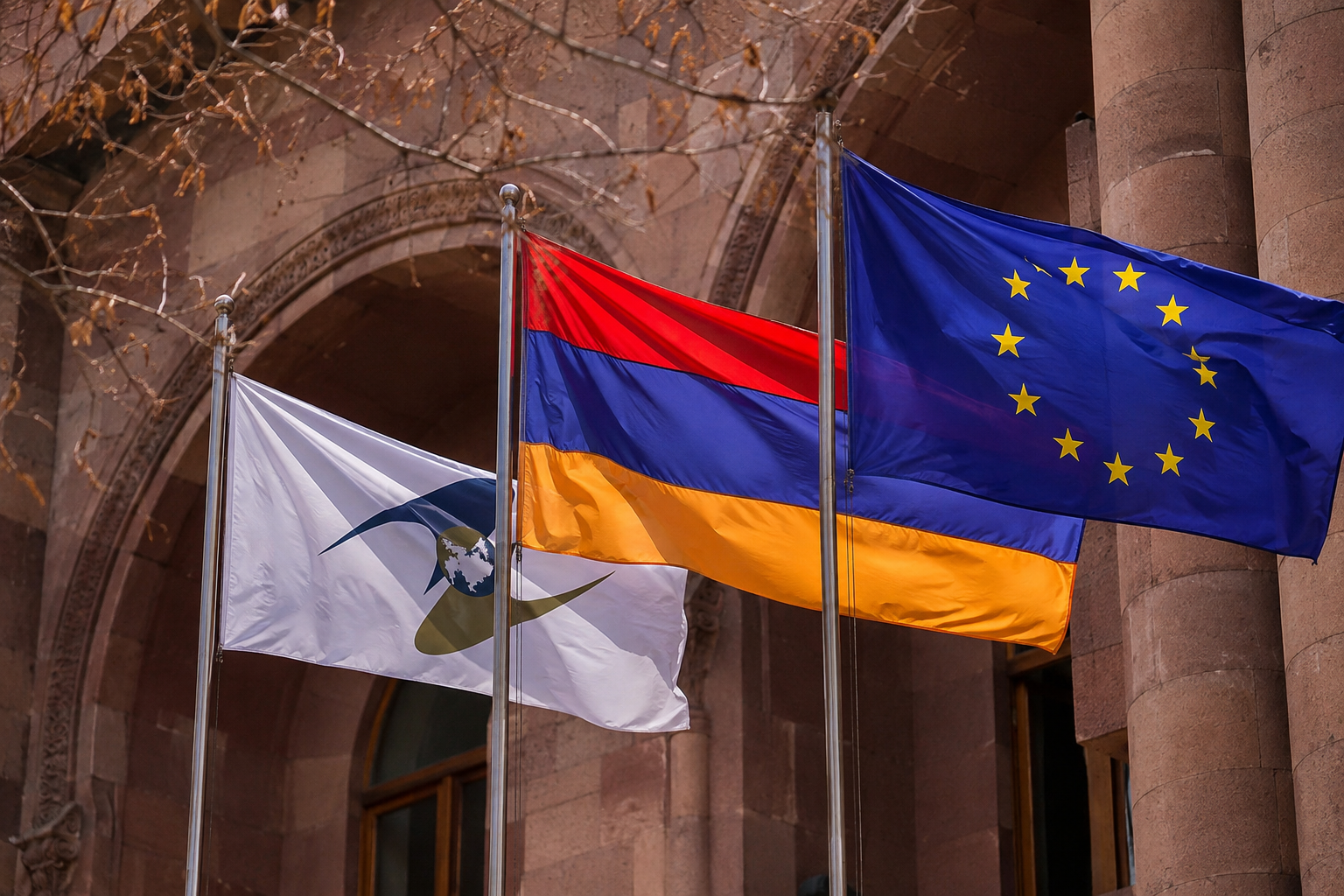
Pashinyan Says Dual EU-EAEU Membership Is Impossible
Armenia has given one of its clearest statements yet on the choice it could eventually face between two economic integration systems.
Speaking on August 7 at an expanded meeting of the Eurasian Intergovernmental Council in Cholpon-Ata, Prime Minister Nikol Pashinyan said Armenia understands that simultaneous membership in the European Union and the Eurasian Economic Union is impossible.
That does not mean Armenia is preparing to leave the EAEU now.
Pashinyan said strengthening cooperation with other EAEU member states remains one of Armenia’s foreign and foreign-economic policy priorities and that this approach will also be reflected in the programme of the new government.
Yerevan is therefore separating two objectives: preserving the economic mechanisms available through its current EAEU membership while developing a possible European alternative for the future.
Armenia’s EU Law Does Not Mean Membership Is Imminent
In 2025, Armenia adopted a law launching the process of accession to the European Union.
Pashinyan stressed that adopting the legislation does not mean Armenia currently has the ability to become an EU member. He described the strategic purpose of the law as creating an alternative for the country.
Even if Armenia eventually becomes institutionally ready for accession, membership would not happen automatically.
The country would still need to submit a formal application, go through further procedures, obtain candidate status and eventually secure both the consent of EU member states and approval from Armenian citizens.
For that reason, an immediate Armenian withdrawal from the EAEU is not currently on the table.
Pashinyan also argued that Armenia’s existing relationship with the EU contains no legal, economic or political obligation that currently contradicts its status inside the EAEU.
The EAEU Remains Economically Important for Armenia
The government’s position is closely connected to existing trade flows.
According to figures presented by Pashinyan, Armenia imported approximately $5 billion worth of goods from EAEU member states in 2025, while Armenian exports to the bloc amounted to around $3.2 billion.
Armenia also transferred about $319 million in import customs duties into the EAEU’s common distribution mechanism while receiving approximately $175 million in allocated revenues.
Yerevan used the figures to argue that Armenia is not simply receiving unilateral economic benefits from membership: it is also a major buyer of goods produced elsewhere in the bloc and contributes substantially to common customs revenues.
Any future shift from the EAEU toward the EU would therefore carry major consequences for trade, customs policy and supply chains.
Pashinyan Also Criticized Barriers Inside the EAEU
While reaffirming Armenia’s interest in the bloc, Pashinyan criticized the way parts of the common market currently operate.
He said the fundamental principles of free movement of goods, services, capital and labour are not being fully implemented and that administrative restrictions continue to reduce predictability for businesses.
The remarks came amid recent trade disagreements between Armenia and Russia.
In July, Pashinyan asked Russian President Vladimir Putin to help resolve restrictions affecting several Armenian exports. Yerevan argued that some of the measures were inconsistent with EAEU rules.
Armenia’s position is therefore that it wants to preserve access to the common market while also demanding that the rules of that market be applied consistently.
Armenia Gets Another 5,000 Duty-Free EVs
Against this political backdrop, Armenia has received an additional practical benefit within the EAEU customs framework.
Armenian Economy Minister Gevorg Papoyan announced that the Eurasian Economic Commission Council had approved an additional duty-free quota for 5,000 electric vehicles in 2026.
Armenia already had a quota covering 15,000 vehicles, meaning the new decision increases the total annual allowance to 20,000 units.
At the time of the announcement, approximately 1,900 vehicles remained available under the existing quota.
Details on how the additional 5,000 units will be distributed are expected to be announced separately.
The concession therefore increases Armenia’s 2026 allowance by one-third.
The Measure Does Not Cover Every Type of NEV
There is also an important distinction in terminology.
In December 2025, the Eurasian Intergovernmental Council agreed that Armenia could import 15,000 battery-electric vehicles and series hybrids duty-free during 2026. Kyrgyzstan received the same quantity, while Belarus was allocated 20,000 battery-electric vehicles.
It is therefore not entirely accurate to describe the Armenian measure as a blanket exemption for all New Energy Vehicles, or NEVs.
NEV is a broader industry category that can include several forms of electrified vehicles. The EAEU decision applies to specifically defined customs categories covering pure electric vehicles and series hybrids.
For Armenia, the measure is particularly significant given the country’s reliance on imported vehicles and the growing presence of Chinese electric cars.
Duty-Free Armenian EVs Cannot Simply Be Resold Into Russia
The quota does not provide a legal backdoor for large-scale duty-free imports into Russia.
The EEC imposed explicit restrictions on vehicles imported under the concession. Rights of ownership, use or disposal cannot be transferred to people who are citizens or permanent residents of Russia or Kazakhstan.
Additional restrictions apply to series hybrids in relation to Belarus.
The different import regimes inside the EAEU therefore do not mean Russian buyers can simply use the Armenian quota to bypass Russian rules.
Any broader Russian incentive for imported electric vehicles or other NEVs would require a separate regulatory decision.
Russia Is Not Included in the 2026 Preferential Quota
The 2026 EAEU concession covers Armenia, Belarus and Kyrgyzstan. Russia and Kazakhstan are not included in the list of beneficiaries.
That produces noticeably different market conditions inside the same economic union.
Armenia can increase the supply of imported EVs by eliminating one of the customs costs, while Russia operates under a different industrial and customs policy that places greater emphasis on domestic production and localization.
From a consumer perspective, the difference can be significant because removing an import duty directly affects the landed cost of a vehicle.
Should Russia Reconsider Its EV Import Policy?
Armenia’s decision inevitably raises a wider question about whether different approaches to electric mobility inside the EAEU remain justified.
Russia has faced pressure in its domestic fuel market in 2026 and has used export restrictions and other measures to protect local supply. That can strengthen the case for discussing greater diversification of the country’s vehicle-energy mix.
However, claims that Russia is experiencing widespread distribution of lower-quality petrol or diesel should not be treated as established fact without reliable official evidence.
A temporary reduction in barriers for electric cars or series hybrids could increase competition, expand consumer choice and reduce part of the transport sector’s dependence on conventional fuels.
At the same time, such a policy would affect domestic manufacturers, budget revenues and Russia’s localization strategy.
The real policy choice is therefore broader than simply setting an import tariff to zero. Authorities would have to decide whether incentives should primarily make imported finished vehicles cheaper or be tied to domestic manufacturing and component production.
Armenia is currently taking the more import-friendly route.
The EV Quota Shows the Practical Value of EAEU Membership
The timing of the additional quota is politically significant.
Almost simultaneously, Pashinyan acknowledged that eventual EU membership would be incompatible with EAEU membership while Armenia secured another economic concession through the existing Eurasian framework.
That illustrates the complexity of the choice facing Yerevan.
The European direction represents a potential strategic option for the future, while the EAEU already shapes a large share of Armenia’s trade, customs rules and concrete benefits available to businesses and consumers today.
Moving from one integration system to another would therefore require much more than a political declaration. Customs rules, trade agreements, technical regulation and established supply chains would all have to change.
Yerevan Is Choosing “EAEU Now, Alternative Later”
That is the core of Pashinyan’s current strategy.
Armenia accepts that genuine progress toward EU membership would eventually require a choice. But the government considers such a decision premature while the country has not yet submitted a formal application, obtained candidate status or received any guarantee of future EU membership.
Until then, Yerevan intends to continue working inside the EAEU, press for the removal of internal trade barriers and simultaneously deepen economic relations with the European Union and other partners.
The increase in Armenia’s duty-free EV quota from 15,000 to 20,000 vehicles is a relatively small but highly visible example of the practical economic mechanisms available under its current integration model.
The central question is therefore not whether Armenia must choose between Brussels and the EAEU today, but how long it can continue developing both directions before the legal and economic requirements of the two systems actually become incompatible.
Read also: Transport Corridor in Armenia: A Strategic Highway Still Under Construction
