

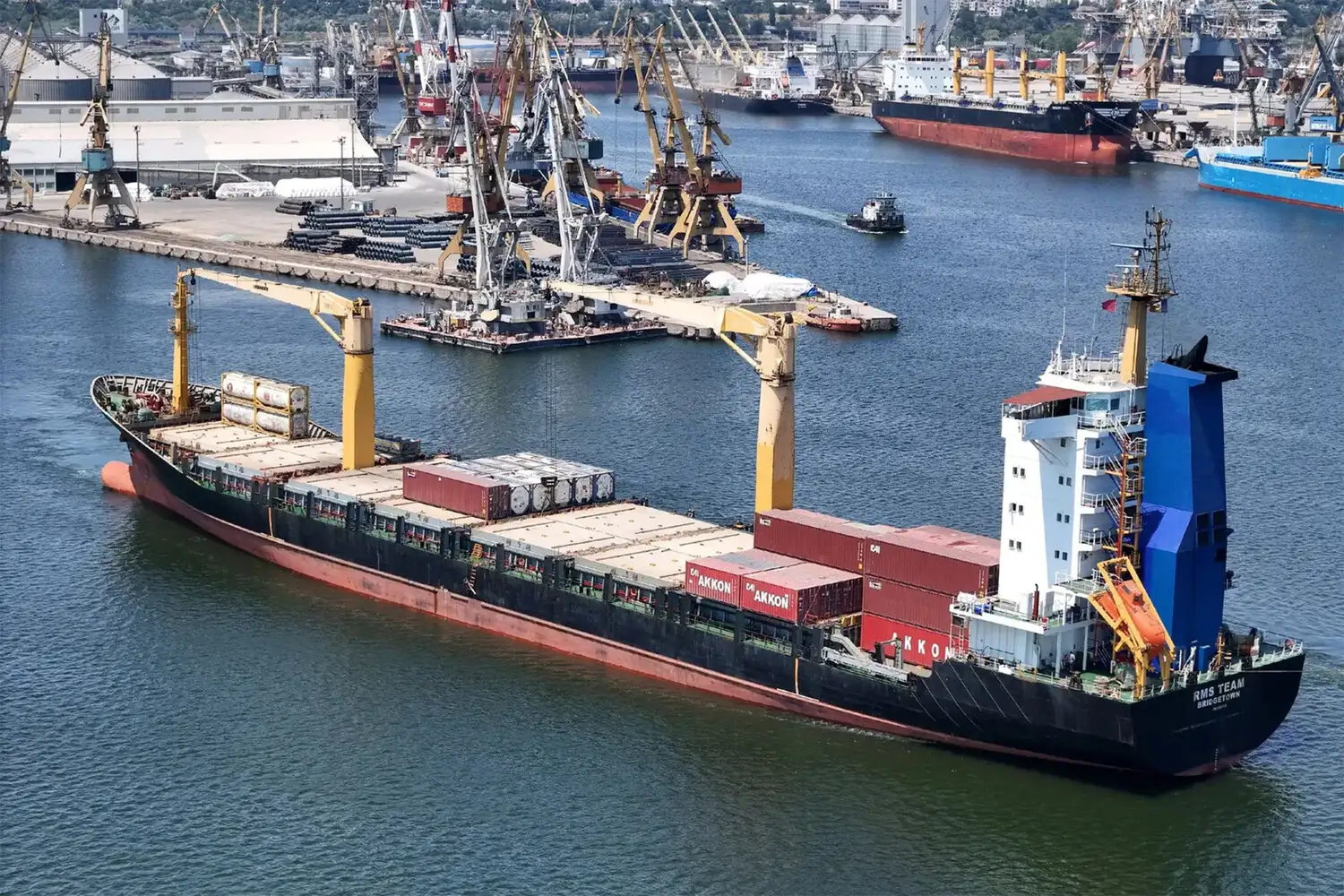
The Turkish container operator is turning vessels around and returning cargo after reassessing risks to crews, ships and container supply chains
Turkish container carrier Akkon Lines has suspended calls at all Russian ports for an indefinite period following a reassessment of maritime security conditions in the Black Sea and Baltic routes.
The operator issued a customer notice dated August 27, 2026. According to PortNews, partners were informed by August 28, while some vessels heading for St. Petersburg were turned back toward Türkiye.
The measure is a suspension with no announced resumption date, rather than a confirmed permanent withdrawal from the Russian market.
“Further escalation creates heightened risks to the crew, vessel and cargo,” Akkon Lines said in its customer notice
Akkon said cargo accepted for transportation, including containers already at sea, would be returned to its port of origin or discharged at designated loading ports.
Cargo owners must now wait for individual instructions, arrange storage and identify alternative transportation. One customer said a shipment that had been moving from Türkiye toward St. Petersburg could be unloaded in Klaipėda. The actual handling port for each consignment will depend on the vessel’s location and the carrier’s operational decisions.
The disruption could increase transit times and expose shippers to additional handling, storage, documentation and onward-transport costs. Empty-container returns and responsibility for expenses resulting from the diversion will also require clarification.
Before suspending all Russian port calls, Akkon had repeatedly adjusted its network. In August, the carrier temporarily stopped serving Novorossiysk and redirected some cargo through St. Petersburg.
The revised arrangement reportedly included an additional charge of up to $2,500 per container. Other carriers continuing to operate between Turkish ports and Novorossiysk were applying average war-risk surcharges of approximately $1,000 per container.
These additional charges could exceed the basic cost of the maritime leg, making Black Sea shipments increasingly unpredictable in both price and transit time.
Akkon had been operating the Türkiye–Russia container trade with two vessels. Removing even a small number of ships therefore has a significant effect on the line’s available capacity.
A major factor in the decision was the August 21 attack on the containership RMS Team, which was managed by Akkon Lines. Some initial reports incorrectly referred to the vessel itself as Akkon Lines, although that is the operator’s name.
A fire broke out in the accommodation and engine-room areas before spreading to containers on deck. Eleven of the 12 crew members were rescued, while one seafarer was reported missing. The exact circumstances of the incident and the origin of the drone require independent confirmation.
Earlier in August, the FESCO-operated containership Yanina sank after being struck by maritime drones. The Russian side said the vessel was carrying civilian cargo, including frozen food and construction materials. All 17 crew members abandoned the ship and were rescued.
FESCO subsequently stopped accepting new bookings for its Black Sea service. The withdrawal initially increased the importance of Turkish carriers such as Akkon, but the deteriorating security environment has now forced those operators to reconsider their own exposure.
Industry reports indicate that another Turkish carrier, Arkas, has also halted services to Russian ports. Detailed official terms and a possible date for resuming operations have not been announced.
MSC suspended new bookings to and from Novorossiysk on August 26 following a reported drone attack involving the containership MSC Ulsan III. However, MSC’s measure applies to Novorossiysk and should not be described as a complete withdrawal from every Russian port. Some cargo may be redirected through St. Petersburg or other terminals.
The scope of the carriers’ decisions therefore differs. Akkon has suspended all Russian port calls, while MSC has stopped new bookings specifically for Novorossiysk.
Turkish ports remain important transshipment points for cargo moving to Russia from the Mediterranean, Europe, Asia and North Africa. Fewer direct container services could increase the number of transshipments, extend delivery times and concentrate demand among the remaining carriers.
Urgent and temperature-controlled cargo will be particularly exposed. Longer and less predictable journeys create additional risks for food, industrial inputs, components and other time-sensitive goods.
Shippers must verify existing bookings, confirm the actual discharge port and calculate the cost of onward transportation. Until Akkon announces conditions for a possible return, its Russian services cannot be included in reliable logistics planning.
Transbosphor Deniz Taşımacılığı Chairman Mustafa Can has warned that prolonged disruption to Black Sea shipping could cost the Turkish economy as much as $20 billion over three months. This is a forecast of potential losses rather than confirmed damage already incurred.
The estimate includes possible declines in Turkish Straits traffic, lost transportation revenue and repair costs for damaged vessels. The final impact will depend on the duration of the disruption and the ability of carriers to redirect cargo.
Akkon’s suspension indicates that risk surcharges and port substitutions are no longer sufficient to offset the perceived danger. The next stage will depend on conditions for commercial navigation and decisions made by carriers, insurers and port authorities.
Read also: 57 Ships Hit Since June 20 as Attacks Reshape Black Sea Logistics