

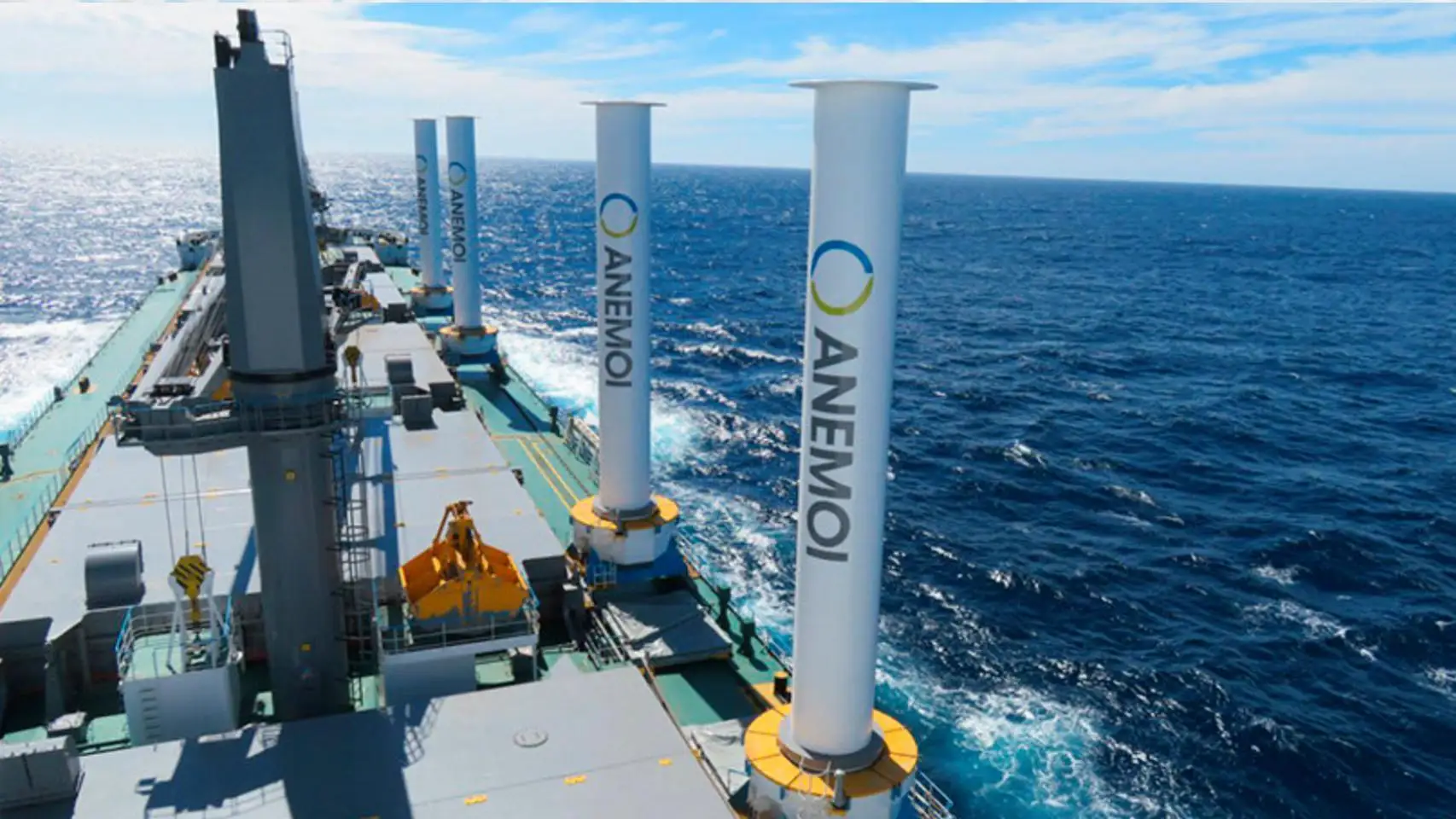
The pilot project will test whether wind-assisted propulsion can reduce fuel consumption and emissions costs on scheduled container services
Danish shipping group Maersk has signed an agreement to install a 35-metre Anemoi rotor sail on a medium-sized container ship. It will be the company’s first use of the technology aboard a container vessel.
According to the Financial Times, the equipment will be retrofitted near the bow of an existing ship. The rotor will remain fixed in an upright position, although some other Anemoi systems can be lowered before entering port.
Maersk has not disclosed the vessel’s name, operating route, installation schedule or total project cost. The agreement should therefore be regarded as a pilot rather than a decision to deploy rotor sails across the wider container fleet.
A rotor sail is a tall rotating cylinder that uses the Magnus effect to generate additional thrust as wind moves around it. This assistance allows the vessel’s main engine to operate at a lower load under suitable conditions, reducing fuel consumption.
The International Maritime Organization’s GreenVoyage2050 technology guidance says Flettner rotors can be fitted to both new and existing ships. Their performance, however, depends on unobstructed wind and sufficient free deck space.
Those requirements present a particular challenge for container ships because most of their exposed deck area is used for cargo. A rotor installation must avoid reducing container capacity, obstructing gantry cranes or complicating loading and unloading. Positioning one unit near the bow should allow Maersk to assess the technology without substantially changing the vessel’s cargo arrangement.
Anemoi chief commercial officer Nick Contopoulos said the regular nature of container services could work in favour of wind-assisted propulsion. Operators know their routes, sailing speeds and seasonal weather patterns, allowing them to deploy suitable ships on trades with favourable wind conditions.
“They are on very dedicated routes, so knowing the predictability of wind and the vessel’s operating speed, you can target the high-wind-profile routes, which improves the business case and return on investment,” Nick Contopoulos said
Anemoi says its rotor sails can operate in heavy seas and wind speeds of up to 35 metres per second. The company estimates that one rotor can save approximately one tonne of fuel and avoid around three tonnes of CO₂ emissions per day. Actual performance will depend on the vessel, route, weather, speed and operating profile.
One rotor sail costs between $600,000 and $1.2 million before installation, according to the company. Although the systems are commonly installed in groups, the Maersk pilot will use a single unit to collect operational data before any wider deployment is considered.
Ole Graa Jakobsen, head of fleet technology at Maersk, said the project would provide practical experience and help determine whether the system could be relevant to the company’s fleet.
“We see the project as a valuable opportunity to build practical experience and assess its relevance for our fleet and for container shipping more broadly,” Ole Graa Jakobsen said
Maersk has previously tested rotor sails on tankers, but container vessels have different requirements involving deck capacity, crane access, schedules and terminal operations. The latest project will therefore test commercial integration as well as fuel performance.
Interest in wind propulsion is increasing as fuel costs and carbon-related expenses become more important to voyage economics. Ships calling at European ports face growing exposure to the EU Emissions Trading System and FuelEU Maritime requirements.
Rotor sails do not replace a vessel’s primary engine. They provide supplementary propulsion that can reduce engine load and fuel use when wind conditions are favourable.
As K2Cargo.News previously reported, Colombia is assessing two green shipping routes to Europe, combining lower-emission operations with future alternative-fuel infrastructure. Maersk’s pilot represents another approach: part of the required energy can be captured during the voyage without relying on the availability of a new fuel at every port.
The trial’s results will determine whether rotor sails could be suitable for additional Maersk container ships. The carrier has not yet announced a fuel-saving target for the selected vessel or a programme for fleet-wide installation.
Read also: Core Power Proposes 50-Ship Nuclear Merchant Fleet for the US