

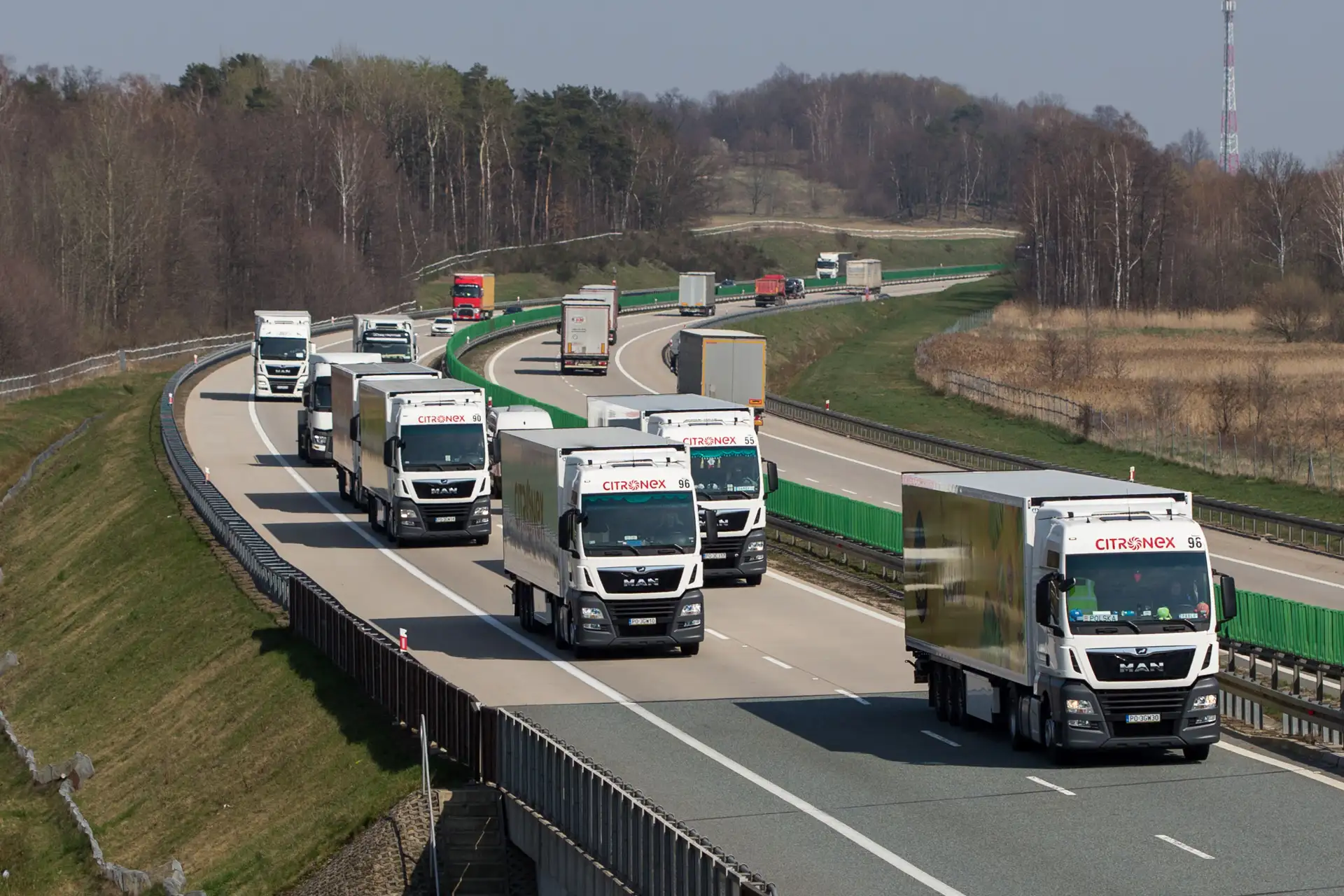
Polish-registered vehicles generated 381 billion tonne-kilometres and accounted for 20.2% of total EU road freight performance in 2025
Poland remains the European Union’s largest road freight market when measured by transport performance. According to the latest Eurostat road freight statistics, vehicles registered in Poland completed 381 billion tonne-kilometres in 2025, representing 20.2% of the EU total.
Overall EU road freight performance reached 1,886 billion tonne-kilometres, an increase of 0.9% compared with 2024. The physical weight of goods transported rose by 1.8% to 13.3 billion tonnes.
Germany ranked second with 277.4 billion tonne-kilometres, followed by Spain with 272.6 billion, France with 172.9 billion and Italy with 161.7 billion. Together, these five countries accounted for 67.1% of all EU road freight performance.
International transport, cross-trade and cabotage collectively generated approximately 60% of Poland’s road freight performance. Domestic transport accounted for the remaining 40%.
Cross-trade refers to a haulage operation between two countries carried out by a vehicle registered in a third country. A Polish carrier, for example, may move a load from Germany to France without entering Poland. Cabotage occurs when a Polish-registered vehicle performs a domestic delivery inside another EU member state.
This structure shows that Poland’s leading position is not based solely on domestic freight demand or the country’s foreign trade. A substantial share of its transport performance comes from Polish carriers operating on routes that do not directly involve Poland.
As K2Cargo.News previously reported, domestic operations accounted for 62.2% of total EU road freight performance in 2025. Conventional international transport represented 24.4%, cross-trade 10.7% and cabotage 2.7%.
An analysis of the EU’s 20 largest bilateral road freight flows further illustrates the international reach of the Polish haulage sector. Among carriers registered outside the countries of loading and unloading, Polish operators formed the largest group on ten of these routes.
Polish fleets therefore operate as part of a wider European network, shifting vehicles between markets and combining outbound loads with return freight. This model can reduce empty running and help companies move capacity towards corridors with stronger demand.
However, it also exposes operators to freight rates, tolls, fuel costs, employment expenses and regulatory requirements in multiple countries. Changes to cabotage, driver-posting or vehicle-return rules can directly affect operating costs and margins.
The largest bilateral road freight flow in 2025 was recorded between Germany and the Netherlands, where 86.9 million tonnes of goods were transported. Germany–Poland ranked second with 68.4 million tonnes, followed by Belgium–France with 55.9 million tonnes.
Germany was either the loading or unloading country in six of the ten largest EU flows. This confirms its continuing role as the principal industrial and distribution hub in the European road freight network.
The German market remains one of the most important sources of international freight for Polish hauliers. Nevertheless, a large aggregate cargo volume does not guarantee equal demand across every segment. Load availability depends on direction, trailer type, seasonality, driver capacity and the number of vehicles competing for orders.
TIMOCOM data indicate that freight-offer activity increased on several major European routes during the second quarter of 2026. Offers on the Poland–Germany lane rose by 31% compared with the same period of 2025, while the Germany–Poland direction recorded growth of 22%.
Larger increases were reported between Belgium and France, where the number of offers rose by 107%. The Netherlands–Belgium route recorded growth of 105%, while France–Netherlands increased by 81%.
These figures cannot be directly compared with Eurostat data. Eurostat measures transport that has actually been performed, while the TIMOCOM barometer tracks freight offers posted on a spot-market platform. The same shipment may also be advertised more than once, meaning growth in offers does not necessarily translate into an equivalent increase in physical freight volumes.
Leadership in tonne-kilometres does not mean that Polish road transport companies are financially secure. Carriers continue to face rising expenses, extended payment periods, working-capital shortages and pressure on freight rates.
K2Cargo.News previously covered the departure of 1,234 Polish transport companies from the market during the first quarter of 2026. Smaller operators are particularly exposed because they must pay for fuel, tolls, leasing, wages and vehicle maintenance long before receiving payment from customers.
The decisive indicator for a carrier is therefore not the number of available orders but the margin remaining after all operating expenses. Combining outbound and return loads, reducing empty kilometres and controlling payment risks can be more important than simply increasing the number of completed journeys.
Poland entered 2026 with the largest share of EU road freight performance. Whether it can maintain that position will depend on the ability of its carriers to convert the scale of their international networks into sustainable profit.
Read also: Poland Loses 1,234 Transport Companies in Three Months as Cash Flow Crisis Deepens
