

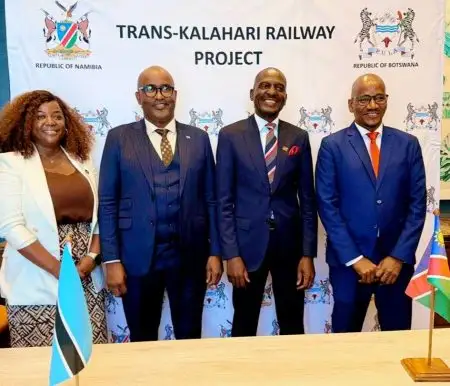
The proposed 1,850 km railway could establish a new Southern African freight corridor for copper, coal, iron ore, fuel, cement and containerised cargo
Project Moves Towards Procurement
Botswana and Namibia are advancing the Trans-Kalahari Railway towards the financing and procurement stage following the completion of its feasibility study. The project’s updated estimated capital cost is approximately $8 billion, while the proposed corridor would extend for about 1,850 km.
The Copperbelt Corridor has been selected as the preferred route. It is intended to connect Botswana’s copper, coal and iron ore producing areas with Namibia’s railway network, providing another route for mineral exports and containerised freight.
Procurement and construction have not yet been formally launched. According to information attributed to Botswana’s Ministry of Transport and Infrastructure, further progress depends on regulatory approvals, an agreed financing structure and final arrangements between the two governments.
Cost Estimate Was Revised After the Study
The estimated cost of the Trans-Kalahari Railway has changed as planning has progressed. In March 2026, Botswana’s transport and infrastructure minister told Parliament that the project could cost approximately $16 billion. At that stage, completion of the feasibility study had been extended until June.
Following the study, a revised estimate of $8 billion was reported. The difference may reflect changes to the preferred alignment, construction scope and infrastructure requirements, although a detailed public cost breakdown has not yet been released.
The $8 billion figure should therefore be treated as the current preliminary estimate rather than a final approved construction budget.
Concession Model Under Consideration
Botswana and Namibia are considering delivering the railway through a public-private partnership. Under a possible concession model, a private investor or consortium could be responsible for designing, financing, building, operating and maintaining the infrastructure.
This approach could reduce the immediate burden on public budgets, but investors will require a credible long-term cargo base. Expected freight volumes, tariffs, construction risks and the length of the concession will be central to determining the project’s commercial viability.
The corridor is expected to carry copper, coal, iron ore, fuel, cement and containerised freight. Mining and industrial companies in Botswana would provide much of the initial cargo demand, alongside operators serving regional supply chains.
A New Option for Southern African Freight
For landlocked Botswana, the Trans-Kalahari Railway would create an additional rail route through Namibia. It could reduce shippers’ dependence on congested South African corridors and provide more flexibility for moving mineral commodities to international markets.
Namibia could benefit from higher transit volumes and additional demand for terminals, locomotives, wagons, maintenance facilities and inland storage. The eventual impact, however, will depend on the capacity of the existing network and the quality of connections between the proposed line and operational railway infrastructure.
As K2Cargo.News previously reported, South Africa has granted 11 private freight operators access to its national rail network. That reform is intended to increase capacity, but it also gives Botswana and Namibia an incentive to develop alternative regional corridors.
Construction Has Not Started
No definitive construction date has been confirmed. The two governments must first agree on financing, risk allocation, concession terms and regulatory procedures.
In March, Botswana’s authorities identified 2027 as a possible construction starting point. Following the revised cost estimate and completion of the feasibility study, that timetable still requires confirmation.
The Trans-Kalahari Railway therefore remains at the pre-procurement and financing stage. If implemented, it could reshape mineral and container freight flows across Southern Africa, but progress will depend on private investment and coordinated decisions by Botswana and Namibia.
Read also: South Africa Opens Its Rail Network to Private Operators