

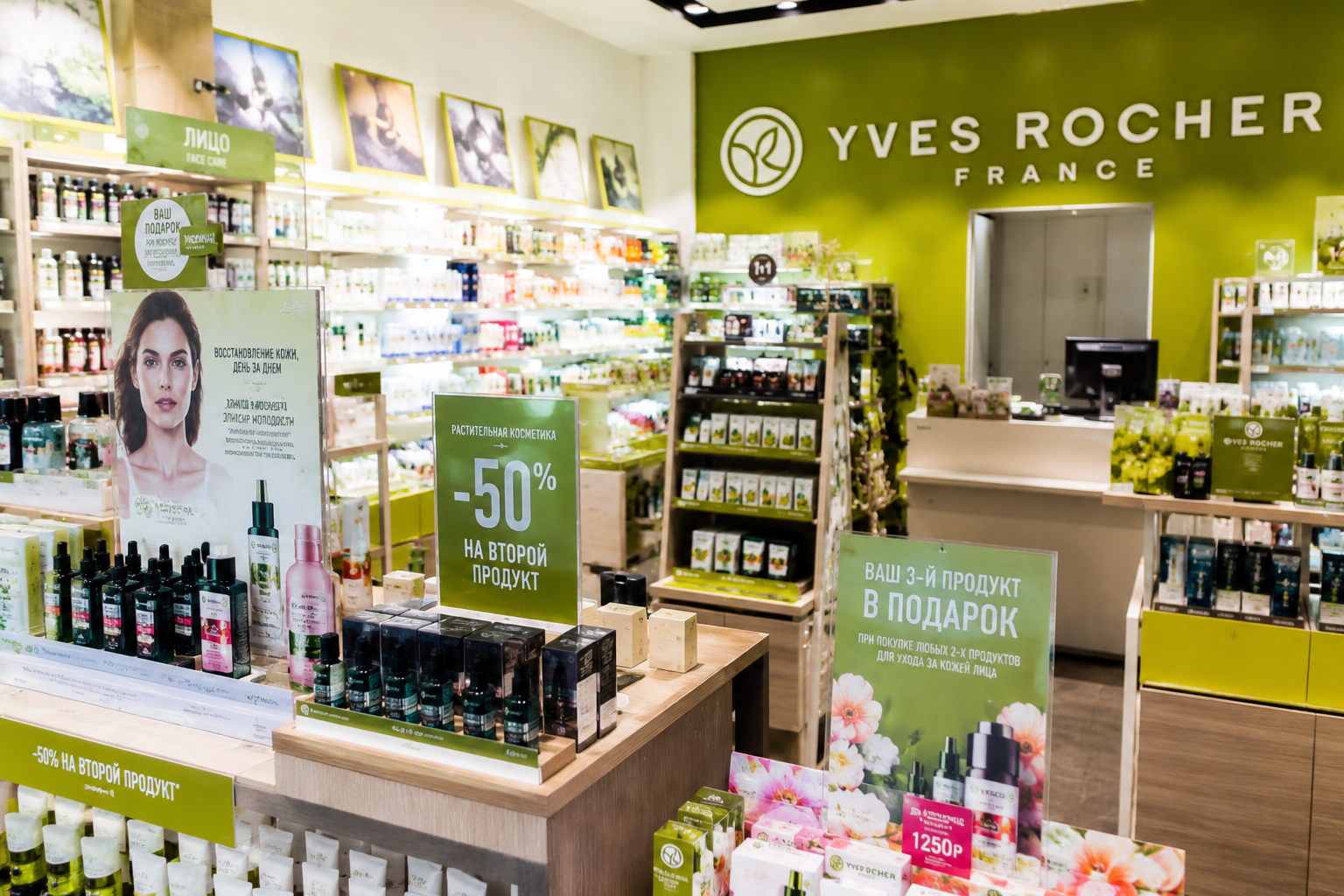
Marketplaces have become the primary online sales channel for Yves Rocher. Their share of the company’s online revenue has reached 52%, overtaking its own e-commerce platform.
The figures were presented by Yves Rocher’s E-commerce Director, Sergey Pleshakov, during the ECOM Expo’26 conference.
According to him, the growing dominance of marketplaces was not a strategic decision but rather a necessary response to changing consumer behavior and declining external traffic.
Traffic Has Nearly Halved
Over the past two years, Yves Rocher’s website traffic has fallen from 24 million to 13 million sessions. Despite this sharp decline, the company’s online revenue has continued to grow.
The increase was achieved through more efficient promotional campaigns, reallocation of marketing budgets, and the rapid expansion of marketplace sales.
Since entering marketplaces in 2019, the company has turned these platforms into its primary customer acquisition channel.
From the 1P to the 3P Model
Initially, Yves Rocher operated under the 1P model, in which marketplaces purchase products directly from suppliers and resell them under their own name.
However, this approach created pricing conflicts with distributors, who complained that products were being sold on Wildberries at lower prices than through traditional wholesale channels.
As a result, the company switched to the 3P model, allowing Yves Rocher to sell directly to customers through marketplace platforms.
Today, the company uses automated repricing tools to maintain consistent pricing across marketplaces and its own website while remaining competitive during promotional campaigns.
Promotions Remain the Strongest Sales Driver
According to Sergey Pleshakov, participation in marketplace promotions remains the company’s most effective sales tool.
Promotional campaigns improve product visibility, increase conversion rates, and help maintain competitive positioning.
Internal testing showed that increasing discounts by 20% generates an additional 3–4% in revenue, offsetting lower margins through higher sales volumes.
Redirecting Customers to Proprietary Channels Remains Difficult
Yves Rocher has also experimented with redirecting marketplace customers to its own digital channels.
One test involved inserting printed promotional leaflets with discount offers into product packages. The results were disappointing: 15,000 leaflets generated only 150 scans and five completed orders, while costing approximately 55 rubles per leaflet.
A second experiment placed QR codes on product packaging that directed customers to the company’s Telegram channel. With a budget of around 20,000 rubles, the campaign generated 100 visits and 30 orders.
According to the company, the results suggest that direct customer engagement is possible, although more efficient digital communication tools are required.
Proprietary Logistics Becoming More Cost-Effective
Logistics has also become a key area of transformation.
According to Pleshakov, developing the company’s own logistics infrastructure under the 1–3 model is becoming more economically attractive than relying on marketplace fulfillment centers. Greater control over logistics costs, delivery times, and service quality is the primary advantage.
For brands increasingly dependent on marketplaces, investing in proprietary logistics offers a way to reduce operational risks while maintaining greater control over profitability.