

For decades, the center of global shipbuilding has steadily shifted toward Asia. China, South Korea, and Japan have emerged as the dominant producers of commercial vessels, while the United States has largely maintained its strength in the construction of warships.
Now Washington is attempting to change that balance. And it is placing its bets not only on traditional shipyards, but also on technologies that, until recently, were considered experimental.
That is the broader context surrounding the decision by American startup Saronic Technologies to build a new shipyard in Texas. The facility, called Port Alpha, brings together two strategic U.S. priorities: rebuilding the country’s shipbuilding capacity and expanding the production of autonomous maritime platforms.
The company plans to develop the shipyard on approximately 850 acres in Brownsville, Texas, near the Gulf Coast. If construction proceeds according to schedule, vessel production is expected to begin in 2028.
But this will not simply be an assembly plant for small uncrewed boats.
According to the company, Port Alpha will be capable of constructing vessels measuring up to 1,200 feet in length, or approximately 366 meters. That would give the facility the ability to produce not only military autonomous platforms, but also large commercial ships.
The project therefore represents something larger than the expansion of a defense technology startup. It is part of a broader effort to return major shipbuilding capacity to the United States.
Shipbuilding as a Matter of National Security
Washington has been moving in this direction for several years. The administration of President Donald Trump has repeatedly argued that America’s dependence on foreign shipyards is no longer merely an economic concern. It has become a question of national security.
While the overwhelming majority of the world’s container ships, tankers, and bulk carriers are built in Asia, the United States is searching for ways to restore its own industrial base and reduce its dependence on overseas production.
Against this backdrop, Saronic has emerged as one of the fastest-growing companies in the American defense technology sector.
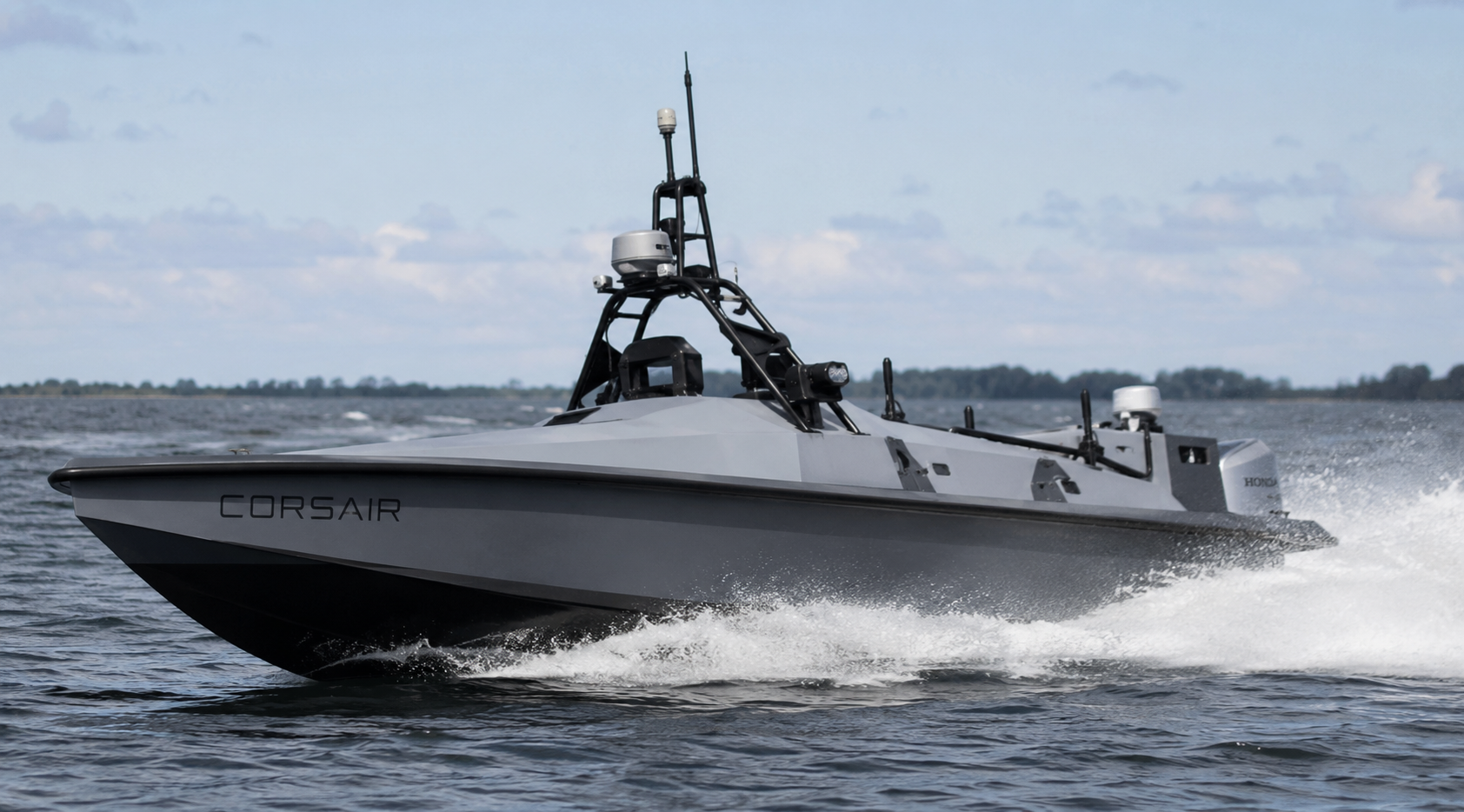
Only a few years ago, the startup was known primarily for its Corsair uncrewed surface vessel. The diesel-powered platform measures 24 feet in length and can reportedly reach speeds of up to 35 knots.
Today, the company holds a $392 million contract with the U.S. Navy. In March 2026, Saronic announced that it had raised another $1.75 billion in investment, bringing its valuation to approximately $9.25 billion.
But the most important development is not the company’s valuation. It is the speed at which Saronic’s technology appears to be moving from testing grounds into real military operations.
From Experimental Technology to the Battlefield
In June, the U.S. military reportedly deployed a Saronic uncrewed vessel during a rescue operation involving the crew of an AH-64 Apache helicopter that had been brought down off the coast of Oman.
Only a few weeks later, autonomous maritime platforms developed by the company were reportedly used in an attack against an Iranian naval base. According to available information, it marked the first known use of American uncrewed surface vessels in a combat operation of this kind.
These events illustrate how rapidly the philosophy of naval warfare is changing.
For generations, aircraft carriers, destroyers, and submarines have been the defining symbols of maritime power. Today, they are being joined by smaller autonomous platforms capable of conducting surveillance, rescue, reconnaissance, and strike missions without placing a crew on board.
That is why the construction of Port Alpha reaches far beyond the boundaries of a conventional industrial project.
A New Model for American Shipbuilding
Port Alpha is becoming part of a much broader transformation in which industrial policy, national security, and technological development are increasingly operating as a single system.
For the United States, the project represents an attempt to regain lost ground in global shipbuilding. For the maritime industry, it sends a clear signal that future competition will not be measured only by the number or size of vessels produced.
It will also be defined by who controls the technologies required to build and operate autonomous fleets.
If the project succeeds, Brownsville could become one of the starting points for a new era of American shipbuilding—one in which large commercial vessels and uncrewed military platforms are built side by side, and where some ships leaving the yard may be capable of carrying out complex operations without a single person on board.
