

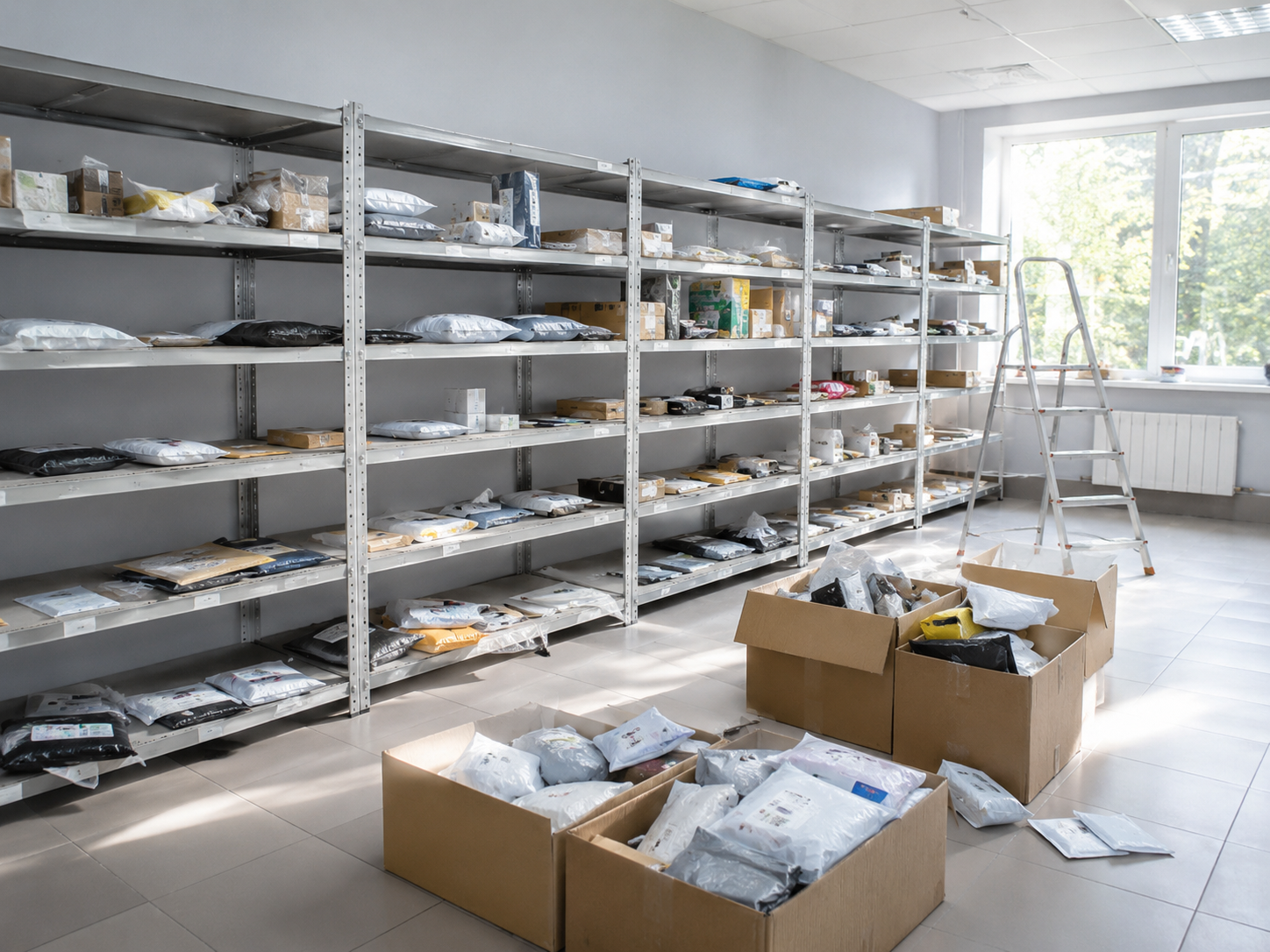
The classic pickup point may disappear in its current form within the next few years. The model in which an employee searches for a parcel in a storage area, brings it to the counter and confirms delivery manually is gradually being replaced by automation, smart terminals and new logistics partnerships.
This forecast was presented at Ecom Expo’26 by Kirill Khalipovsky, Commercial Director of 5Post. According to him, the transformation of pickup points will be driven by changing customer behavior, the growth of e-commerce and the need to reduce operating costs.
The Russian market is already highly saturated. By spring 2026, the number of marketplace pickup points in Russia exceeded 231,000, but the next stage of competition will not be only about opening more locations. It will be about making each point faster, denser, cheaper to operate and more convenient for customers.
As K2Cargo News previously reported in AI Is Transforming Europe’s Logistics Industry, logistics companies are increasingly using automation and data to reduce manual work and improve delivery efficiency. Pickup points are becoming part of the same digital shift.
Why the Classic Pickup Point Is Reaching Its Limit
The traditional pickup point is simple, but not always efficient.
A customer arrives, gives an order number or QR code, waits while an employee searches for the parcel, checks the documents or app confirmation and hands over the order. When traffic is low, this model works. But during peak hours, sales seasons or heavy marketplace campaigns, the system quickly becomes overloaded.
The main bottleneck is human labor. The employee must receive parcels, store them, find them, issue them, handle returns, answer questions and sometimes process payments or disputes. As order volumes rise, this model requires either more staff or more space.
Both are expensive.
For logistics operators and retailers, the challenge is clear: how to process more orders in the same physical area while reducing queues and labor dependency. This is where the “pickup point 3.0” concept becomes relevant.
The Chinese Model: Scan and Go
5Post points to China as the market where the future format is already visible.
In the Chinese model described by Khalipovsky, the customer uses an app to find the parcel on a shelf, scans it independently and leaves without contacting staff. The pickup point becomes closer to a self-service logistics zone than a staffed retail counter.
For Russia, this scenario is not simply a technological experiment. It reflects a broader shift in consumer behavior. Customers no longer choose delivery only by speed. They choose depending on the situation.
In the morning, a buyer may want to pick up an order near the office as quickly as possible. In the evening, the same person may choose a point near school, home or a grocery store. This situational behavior forces logistics companies to build more flexible delivery networks.
The winner will not necessarily be the operator with the largest number of points. It may be the operator that can combine density, speed, convenience and low operating cost.
Three Stages of Pickup Point Automation
According to 5Post, the transformation can be divided into three stages.
The first stage is the self-service checkout model. It is already partly used in X5 stores. The customer scans and collects the parcel through a terminal, while an employee only confirms the delivery. This reduces the amount of manual work, but does not remove staff from the process completely.
The second stage is the “station 2.0” model. In this format, the traditional in-store warehouse is replaced by a terminal with cell-based storage. Instead of an employee searching for the parcel on shelves, the system identifies the correct storage cell and the customer interacts with the terminal directly.
This sharply increases storage density and reduces search time. For pickup points located inside retail stores, this is especially important because every square meter competes with the main retail business.
The final stage is a fully automated pickup point without staff. In this model, the customer enters, identifies the order through an app, finds or receives the parcel, scans it and leaves. The functions of cashier, clerk and warehouse worker are transferred to software, terminals, sensors and mobile applications.
Wildberries Is Already Testing Automation
Russia is not starting from zero.
Wildberries & Russ is already testing automated pickup formats. In 2026, the company continued developing smart pickup points and smart issue systems, where a customer can receive an order through a QR code and an automated cell.
This shows that the market is moving in the same direction from different sides. 5Post sees the future through the lens of retail infrastructure and logistics partnerships. Wildberries is testing automation inside its own marketplace ecosystem.
The formats may differ, but the logic is similar: remove unnecessary manual operations, shorten pickup time and make the customer journey more predictable.
For consumers, the benefit is speed. For marketplaces and logistics operators, the benefit is lower labor pressure and higher throughput. For landlords and retailers, the benefit is better use of space.
Why Sellers May Return to External Pickup Networks
One of the most important points in Khalipovsky’s forecast concerns sellers.
He expects an aggressive outflow of sellers from marketplaces to their own online storefronts. The reason is simple: many sellers no longer want to depend completely on platforms that can change commissions, rules and visibility algorithms.
If more sellers develop their own websites and independent sales channels, they will need external logistics networks. They will still need pickup points, returns handling, storage, last-mile delivery and customer service infrastructure.
This may create a new role for pickup point aggregators. Instead of one platform controlling one closed delivery network, the market may see networks that combine pharmacies, grocery chains, retail stores and other non-specialized partners.
In this model, a pickup point becomes not only a marketplace extension, but a shared logistics node serving many online sellers.
Pickup Points Become Logistics Infrastructure
The example of London, cited by Khalipovsky, shows where the market may go. On one street, dozens of shops, cafes and service points can act as pickup locations for different online orders.
For Russia, this model could be especially important because the country already has a large physical retail network. Grocery stores, pharmacies, convenience stores, service centers and small retail outlets can become part of a distributed logistics system.
But to make this work, the process must be standardized and automated. Staff in a pharmacy or supermarket cannot spend too much time searching for third-party parcels. The system must allow customers to collect orders quickly and independently.
This is why automation is not only a technology trend. It is a condition for scaling pickup networks beyond traditional marketplace points.
What This Means for Logistics Companies
The transition to pickup point 3.0 will change the economics of last-mile delivery.
First, storage density will become more important. Operators will try to place more parcels in smaller areas through cells, terminals and smart shelving.
Second, labor costs will fall as more operations move to customers and automated systems. This will be attractive for operators, but may reduce demand for traditional pickup point staff.
Third, software will become the core of the pickup point. The system must know where the parcel is, who can collect it, whether payment is completed, how the return is processed and when the storage period expires.
Fourth, partnerships will become more important. Logistics companies will need agreements with retailers, pharmacies and service networks that can host pickup infrastructure.
Not Every Pickup Point Will Become Fully Automatic
Automation will not replace every format at once.
Some customers will still need help with returns, damaged goods, bulky items or payment questions. Certain product categories may require identity verification or inspection. In smaller towns, the economics of fully automated points may be weaker than in large cities.
Therefore, the likely future is not one universal format, but a mix.
Large urban areas may see fully automated points and smart terminals. Retail stores may use hybrid self-service systems. Traditional staffed pickup points may remain for complex orders, oversized goods and customer service functions.
The main trend, however, is clear: the employee will gradually move away from routine parcel search and delivery. Human work will remain where judgment, service or problem solving is needed.
The Pickup Point Becomes a Digital Node
The pickup point of the future will no longer be just a counter with shelves.
It will become a digital logistics node connected to marketplaces, independent online stores, payment systems, customer apps, warehouse systems and transport operators. The customer will see only a simple action — scan and collect. Behind it will be a complex data infrastructure.
For Russia’s e-commerce market, this transformation may be one of the most important changes of the next few years. The country already has a large number of pickup points. The next challenge is to make them more efficient.
If the Chinese model is adapted successfully, the pickup point 3.0 may become faster, cheaper and more convenient than the current format. But the transition will also raise questions: who pays for automation, how secure the process is, what happens to staff and whether customers are ready to collect parcels without human assistance.
One thing is already clear: the pickup point is moving from a small service desk toward an automated last-mile platform. In this model, the cashier and the warehouse clerk are no longer the center of the process. The center becomes the customer, the app and the logistics system behind it.
