

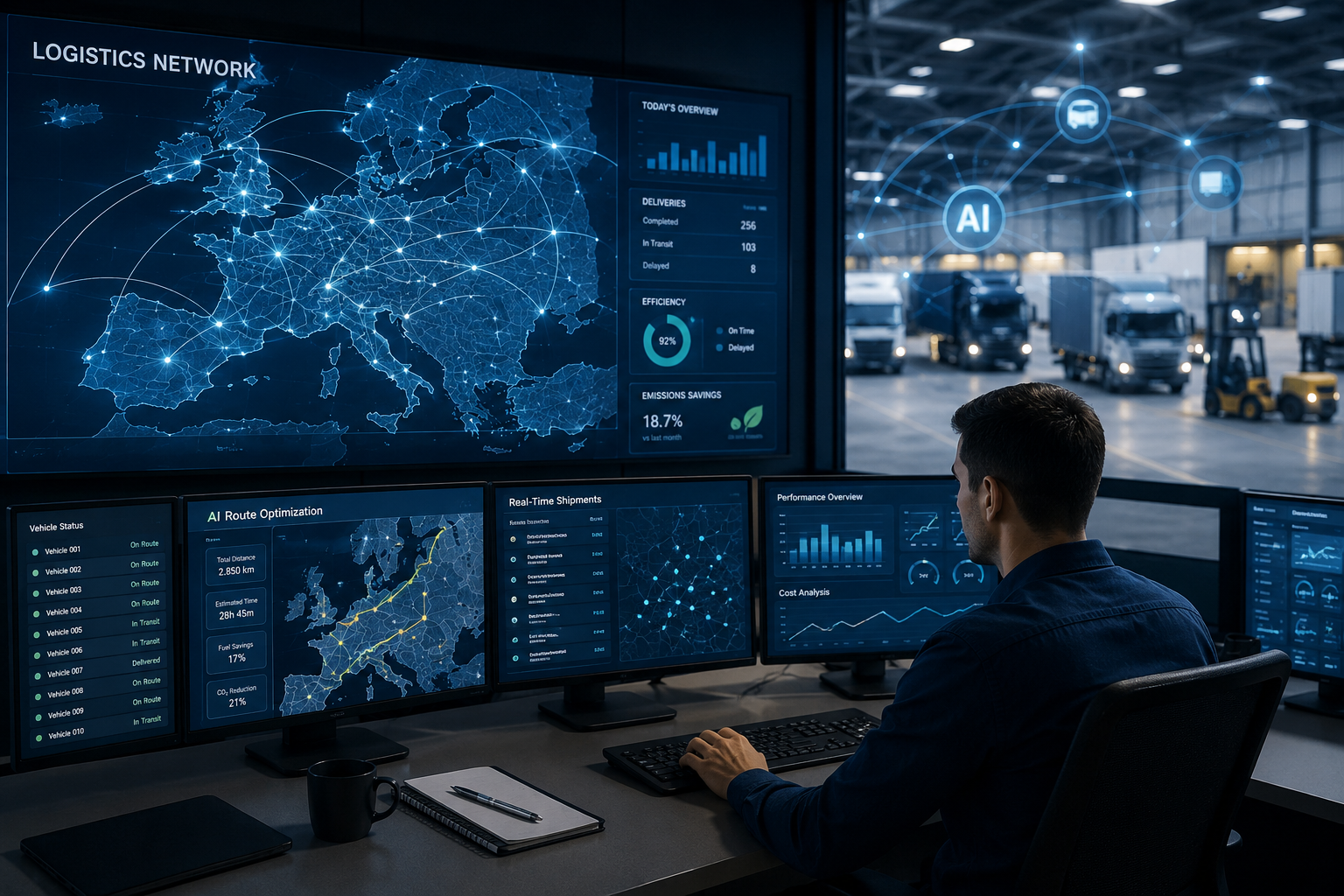
Europe’s transport and logistics industry is entering a new phase of digital transformation, with artificial intelligence becoming one of the key drivers of operational efficiency. While AI was once viewed as a technology of the future, it is now increasingly integrated into the daily operations of freight carriers, freight forwarders, and logistics providers across the continent.
According to a recent study by DataM Intelligence, the global market for artificial intelligence solutions in transportation and logistics is projected to grow from approximately $23 billion today to more than $300 billion by 2032. These figures position logistics among the fastest-growing technology investment sectors of the next decade.
The impact of AI is particularly visible in road freight transport, where thousands of decisions related to route planning, load allocation, driver scheduling, and shipment monitoring must be made every day. Advanced algorithms can process vast amounts of data in real time and recommend optimal solutions far more quickly than traditional manual methods.
From a Conservative Industry to Smart Logistics
For many years, transportation was considered one of the most conservative sectors when it came to adopting new technologies. According to data from the Organisation for Economic Co-operation and Development (OECD), only 5% to 15% of transport and logistics companies had implemented artificial intelligence technologies by 2024. By comparison, AI adoption exceeded 40% in the IT sector and reached 35% in professional and technical services.
However, this situation is changing rapidly. Growing competition, rising transport costs, driver shortages, and the need for more resilient supply chains are encouraging logistics companies to accelerate digital transformation.
Today, artificial intelligence is being used across the industry for:
- route optimization and mileage reduction;
- traffic forecasting and delay prediction;
- automated load planning;
- fleet management;
- fuel consumption analysis;
- document automation;
- real-time shipment monitoring.
These technologies enable companies to reduce operating costs, improve planning accuracy, and respond more effectively to market changes.
According to Tomasz Sardanowski, CEO of TransLogistica, the most significant transformation is taking place at the level of everyday decision-making by freight forwarders and logistics coordinators.
“Each of these decisions may seem minor on its own, but together they have a direct impact on the efficiency of logistics companies. Across Europe, we are seeing more carriers using AI for route planning, load optimization, and even predicting potential delays before they occur,” says Tomasz Sardanowski.
Industry experts believe the role of artificial intelligence in European logistics will continue to expand over the coming years. Beyond improving operational efficiency, AI could help the industry address labor shortages, enhance sustainability performance, and strengthen the resilience of international supply chains.
As digitalization accelerates across the European economy, transport and logistics are increasingly positioned to become one of the biggest beneficiaries of the technological revolution already transforming the way goods move across the continent.
