

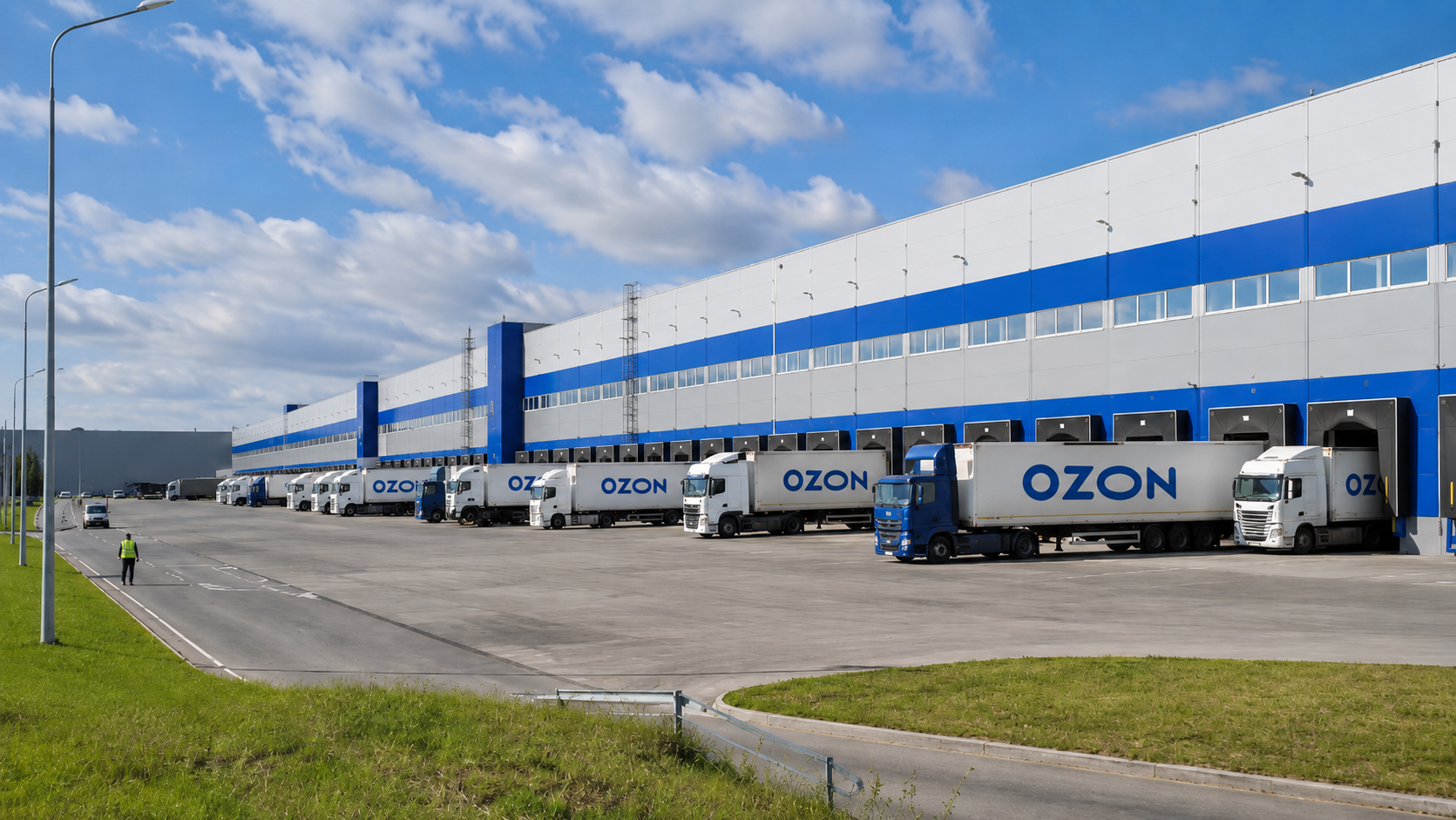
Ozon has started a preliminary selection of developers for the construction of new warehouse facilities across Russia. According to tender documentation cited by market sources, the marketplace wants to secure at least 3.8 million sq m of logistics space in the regions within the next two years.
The programme is planned in several stages. By October 2026, Ozon expects to receive smaller facilities of around 6,000–10,000 sq m in cities such as Alexandrov, Kaspiysk, Miass and Rossosh. The main volume is scheduled for autumn 2027, when about 2.5 million sq m of warehouse space is expected to be delivered.
The geography of the plan is broad. Ozon is looking at sites from Yuzhno-Sakhalinsk and Petropavlovsk-Kamchatsky in the east to Derbent in the south and Bryansk in the west. This shows that the company’s logistics strategy is moving deeper into the regions, beyond the largest metropolitan hubs.
As K2Cargo News previously reported in Russia’s Warehouse Market Reshapes Delivery Chains, warehouse infrastructure is becoming a central part of delivery speed, regional coverage and cost control in Russian logistics.
A New Scale for Regional Logistics
The largest part of Ozon’s programme is planned for 2027.
By that time, the tender documents reportedly include about 2.5 million sq m of space, much of it in large complexes of 80,000 sq m or more. In the Moscow region alone, Ozon plans to occupy about 260,000 sq m along major transport corridors, including Kaluzhskoye, Novoryazanskoye and Novorizhskoye highways, as well as Khimki.
Another 80,000 sq m is planned in eastern St. Petersburg. Large warehouse complexes of about 120,000 sq m each are expected in Samara, Kazan and Tula. The largest single facility listed before 2027 is a 180,000 sq m warehouse in Krasnoyarsk.
A second phase, planned through autumn 2028, adds another 1.3 million sq m. In total, the programme reaches at least 3.8 million sq m.
Why Smaller Cities Matter
One of the most important details is the number of smaller cities in Ozon’s plan.
Experts note that many locations have populations of around 50,000–100,000 people. This suggests that Ozon wants to shorten delivery distances, reduce transport costs and improve service in regional markets.
For e-commerce, warehouse location is no longer just a real estate question. It directly affects delivery time, last-mile costs, transport planning and customer retention. The closer goods are stored to buyers, the easier it is to offer fast and predictable delivery.
This is especially relevant in Russia, where long distances can make transport expensive and sensitive to fuel prices, driver availability and infrastructure constraints.
Market Demand May Be Recovering
Ozon’s plans appear against the background of a weaker warehouse market.
According to NF Group estimates cited in the source material, warehouse transactions in Russia reached only 634,000 sq m in the first half of 2026. In 2025, the market closed at about 3.2 million sq m, while in 2024 it reached 5 million sq m.
Analysts link the slowdown to high rental rates, expensive borrowing and pressure on consumer purchasing power. At the same time, the business models of marketplaces and food retailers are still built around long-term logistics expansion.
For companies such as Ozon, X5 and RVB, delaying warehouse development for too long may create future risks. If logistics capacity does not grow, delivery speed, regional coverage and turnover may suffer.
This is why Ozon’s tenders are seen as a possible signal that the period of very weak demand is ending.
Financing Becomes the Key Question
The main challenge is not only construction, but financing.
Under high interest rates, many build-to-rent projects become less attractive for developers. Developers may prefer build-to-suit projects with later sale or buyout, while marketplaces and retailers often prefer long-term leasing because it keeps capital available for their core business.
Ozon has historically used the rental model. The company previously owned several warehouses but later sold them through sale-and-leaseback deals, remaining in the properties as a tenant. This approach has become common in Russian commercial real estate because it allows companies to free up capital without leaving strategic sites.
However, sources cited in the market material suggest that Ozon may buy around 1 million sq m of the planned space and then package these assets into closed-end real estate funds.
Ozon May Build Its Own Fund Model
This could become the most important innovation in the plan.
Ozon registered its own asset management company in 2025. If the marketplace uses this structure to package owned warehouses into closed-end funds, it may become one of the first major end users in Russia to build such a model around logistics real estate.
The logic is clear. Ozon needs large warehouse assets, but it does not necessarily want to freeze huge amounts of capital in real estate. A fund structure can help return money faster and reinvest it in the core business, while keeping control over strategic logistics infrastructure.
This approach also reflects a broader trend. Closed-end real estate funds are becoming an increasingly important financing mechanism in Russian commercial property, especially at a time when bank borrowing remains expensive.
Developers Face a Difficult Balance
For developers, the situation remains complicated.
Demand from marketplaces can support the market, but high financing costs continue to pressure project economics. Speculative warehouse development may shrink in the coming years, especially as projects launched during the strong 2024 market are completed.
If new large projects are not started, the market may later face a shortage of quality space, even if vacancy temporarily increases. Consultants therefore expect more controlled formats to dominate: build-to-suit, build-to-rent and fund-backed projects with large tenants.
Ozon’s expansion could become one of the anchors of this new stage. But the success of the programme will depend on how quickly the company can sign contracts, how developers finance construction and whether investor demand for warehouse funds remains strong enough.
What It Means for E-Commerce Logistics
Ozon’s plan shows that warehouse infrastructure is now one of the main battlegrounds in Russian e-commerce.
Fast delivery depends on regional density. Cost control depends on shorter transport legs. Growth depends on the ability to serve smaller cities without overloading major hubs.
If the programme is implemented, Ozon will strengthen its regional network and may reduce the logistics gap between large urban centres and smaller markets. It could also push competitors to accelerate their own warehouse strategies.
The plan is ambitious, and the economic environment remains difficult. But one point is clear: marketplaces cannot pause logistics expansion indefinitely. In e-commerce, warehouses are not just buildings. They are the physical foundation of delivery speed, customer loyalty and future turnover.
Read also: Russia’s Warehouse Market Reshapes Delivery Chains
