

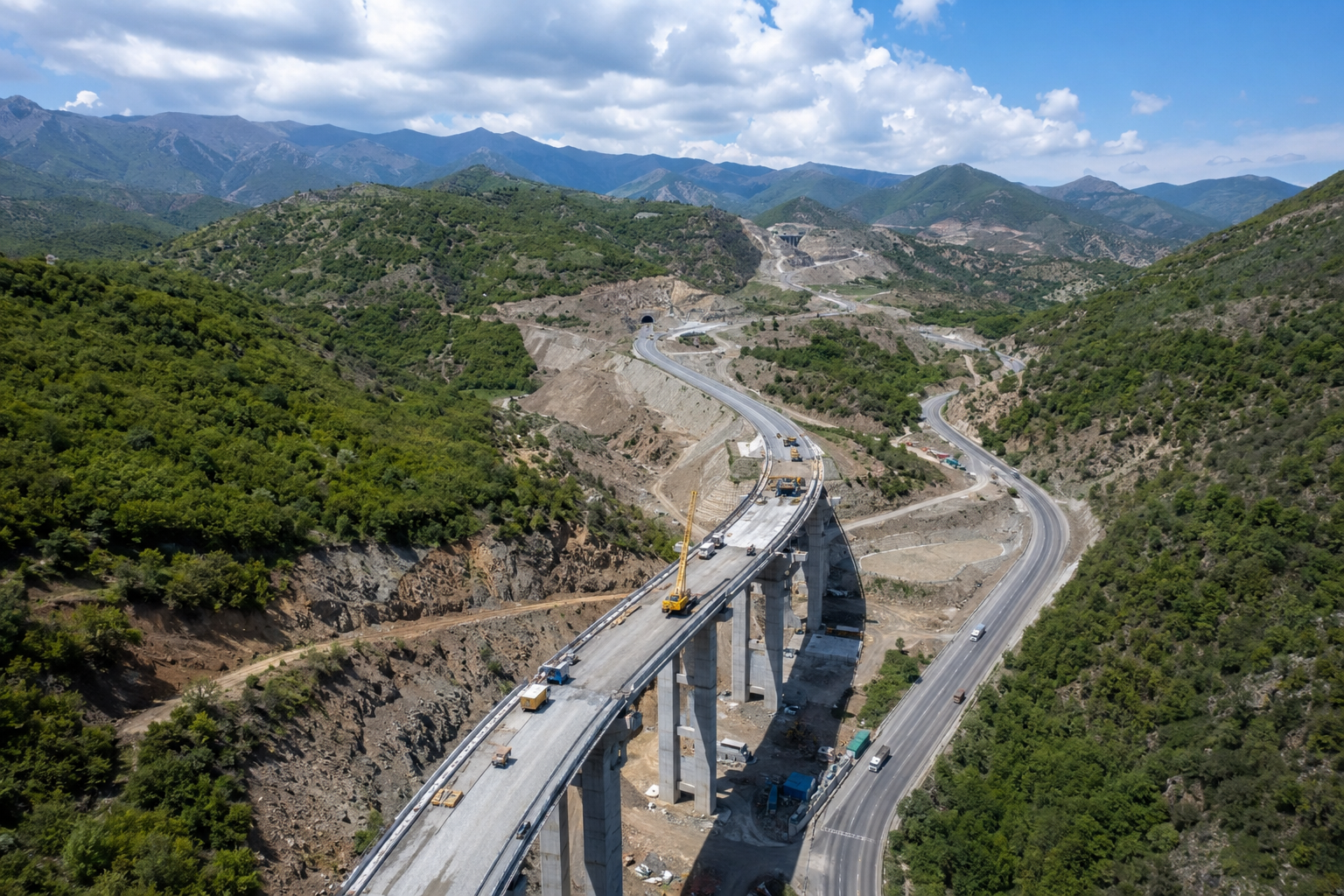
The North–South International Transport Corridor (ITC) is widely regarded as one of the most ambitious infrastructure projects in modern Armenian history. Once completed, the highway will connect Armenia’s southern border with Iran to its northern border with Georgia, creating a faster and more efficient route for freight transportation between the Persian Gulf, the Black Sea region, and European markets.
Despite its strategic significance, the project has been under development for more than ten years, with completion deadlines repeatedly postponed.
What Is the North–South Corridor?
The project involves the construction of a modern highway stretching approximately 550 kilometers across Armenia, from the Meghri border crossing with Iran in the south to Bavra on the Georgian border in the north.
The route passes through several major transport hubs, including:
- Meghri
- Kapan
- Goris
- Sisian
- Yerevan
- Ashtarak
- Gyumri
- Bavra
Upon completion, the highway is expected to significantly reduce travel times between the northern and southern parts of the country while improving road safety through modern engineering solutions.
Why Is the Project Important?
As a landlocked country, Armenia relies heavily on efficient transport infrastructure for international trade and economic development.
The North–South Corridor is designed to become part of a broader international logistics network connecting:
- Iran and the Persian Gulf region;
- Armenia;
- Georgia;
- Black Sea ports;
- European markets;
- Member states of the Eurasian Economic Union.
For transport and logistics companies, the new highway could become an important alternative route for international road freight traffic between Asia and Europe.
When Did Construction Begin?
The project officially started in 2010.
Funding has been provided through loans from international financial institutions, including the Asian Development Bank and the Eurasian Development Bank, among others.
Initially, authorities expected construction to be completed within a few years. However, numerous obstacles have significantly slowed implementation.
Why Has the Project Been Delayed?
Industry experts point to several key reasons behind the delays.
Challenging Terrain
Armenia’s mountainous geography makes highway construction considerably more complex and expensive than in flat regions.
Many sections require the construction of:
- tunnels;
- bridges;
- viaducts;
- retaining structures.
The southern sections in Syunik Province are considered particularly difficult due to the rugged terrain.
Funding Challenges
Project costs have steadily increased due to design revisions, inflation, and rising construction expenses.
According to various estimates, total investment requirements may exceed several billion dollars, creating additional pressure on public finances and increasing the need for external funding.
Contractor and Design Issues
Over the years, several construction contracts have been revised, while some contractors failed to complete work within the agreed timelines.
In addition, certain sections required redesign after further engineering studies revealed new technical challenges.
Regional developments in the South Caucasus have also affected implementation.
Changes in trade routes, security considerations, and shifting regional logistics priorities have periodically influenced construction progress.
Which Sections Have Already Been Completed?
Several parts of the highway have already been completed or are nearing completion.
The most visible progress has been achieved in central Armenia, particularly around Yerevan and Ashtarak.
Meanwhile, construction continues on the more technically demanding southern sections, where significant engineering work remains necessary.
Official completion dates have been revised multiple times.
In recent years, Armenian authorities have pledged to accelerate work on key sections. However, full completion of the entire corridor is still expected to take several more years.
Many analysts believe the most realistic scenario involves the gradual opening of remaining sections as funding becomes available and construction progresses.
Once completed, the North–South Corridor could significantly strengthen Armenia’s position in regional and international transport networks.
Potential benefits include:
- shorter delivery times;
- lower transportation costs;
- improved route reliability;
- increased transit traffic;
- greater investment in logistics infrastructure;
- development of new warehousing and distribution centers.
As international trade routes between Asia and Europe continue to evolve, Armenia’s North–South Corridor is increasingly viewed as one of the most important transport infrastructure projects in the South Caucasus. However, realizing its full potential will depend on successfully completing a highway that has remained under construction for more than a decade.
Read also: Russia & Kazakhstan Launch First Driverless Truck Route