

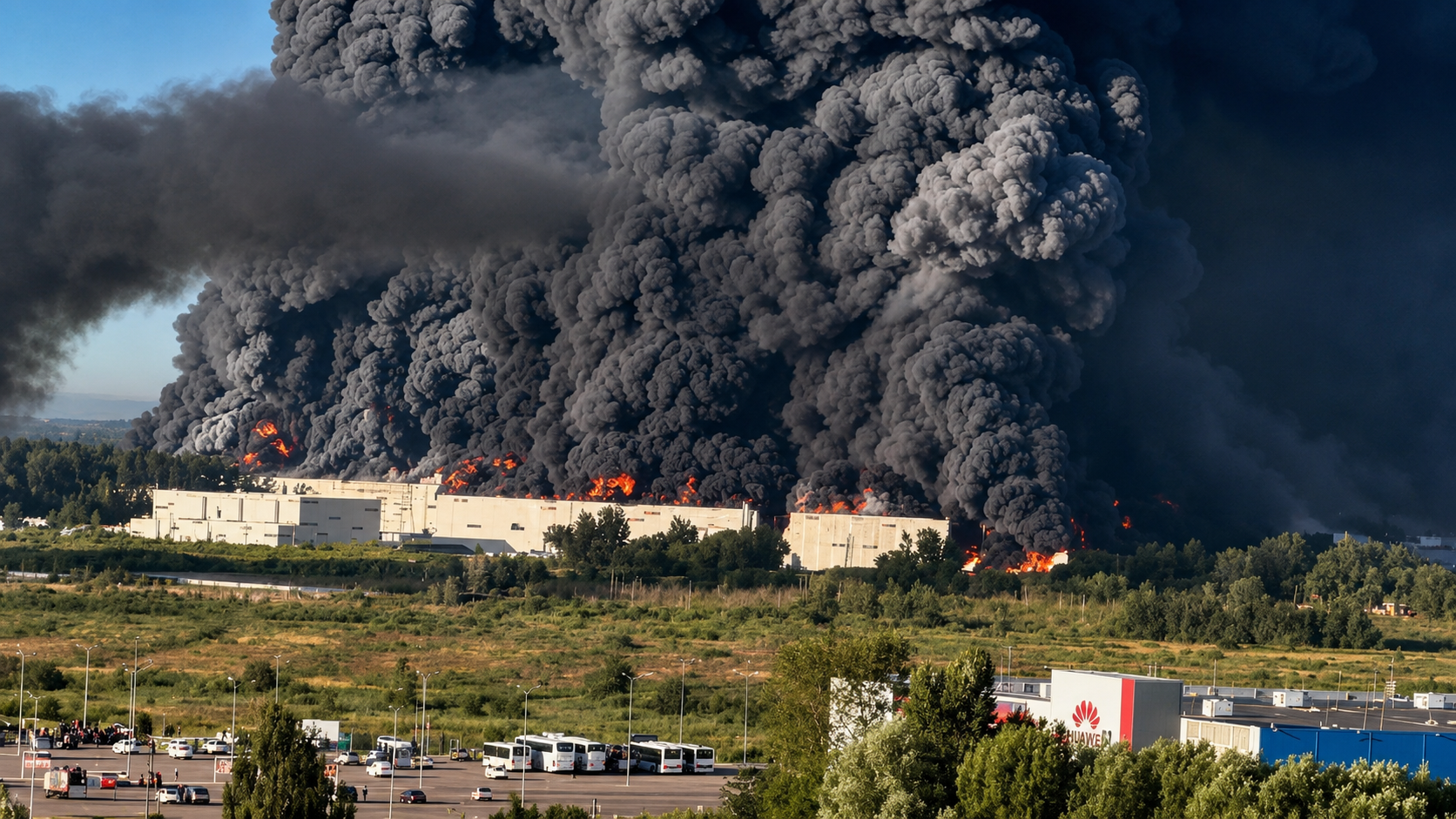
Two Logistics Facilities Were Hit in One Night
Drones attacked Wildberries logistics facilities in Elektrostal, Moscow Region, and Kotovsk, Tambov Region, during the night of July 18, 2026. Major fires broke out at both locations.
Seven night-shift employees were killed in Kotovsk and another 25 people were injured. Authorities in the Moscow Region reported one death and dozens of injuries following attacks on several locations.
Ukraine said the strikes targeted logistics facilities connected to supplies of drone components and navigation equipment. Wildberries has not publicly confirmed that such cargo was stored at its warehouses.
For the Russian e-commerce market, the incident became both an emergency and a major test of warehouse-network resilience. Two facilities handling seller inventory, regional orders and significant road freight volumes were affected almost simultaneously.
The attacks came as Russia’s warehouse market was already reshaping delivery chains, moving from a period of severe space shortages toward a more complex environment in which tenants must choose between concentrating inventory and distributing operations across several facilities.
The Exact Damage Is Still Unknown
Wildberries must determine how much of the buildings, equipment and seller inventory was destroyed, damaged or temporarily made inaccessible.
Preliminary estimates reported by the media range from tens of billions to more than RUB 100 billion. These figures have not been confirmed by a final company inventory and may include property, equipment, seller goods, interrupted sales and additional logistics expenses.
The economic impact therefore cannot be measured only through the value of the damaged buildings. It may also include site clearance, restoration of sorting and information systems, rerouted shipments, seller compensation and temporarily reduced network capacity.
The incident has been compared with the January 2024 fire at Wildberries’ Shushary warehouse. That event affected one major facility, while the latest disruption involved two sites in different regions at almost the same time.
Sellers Risk Losing Working Capital
A substantial share of the inventory stored at marketplace facilities belongs to independent merchants. A large brand may survive the loss of one shipment, while the same event can stop a small seller’s entire operation.
Merchants using the FBO model are particularly exposed. They send their goods to Wildberries in advance, after which the marketplace receives, stores, picks and delivers the products.
The seller nevertheless remains responsible for supplier invoices, loans, taxes, advertising and the production of replacement inventory.
Problems also arise when goods survive physically but access to the warehouse is restricted. Until their condition is confirmed, products may be unavailable for sale. The merchant loses daily revenue, listing visibility and the benefits of previous advertising spending.
This dependence on marketplace infrastructure is becoming more significant as marketplaces turn into the primary sales channel for both major brands and smaller merchants. The larger the share of revenue generated through one platform, the greater the impact of disruptions inside that platform.
Compensation Will Require Detailed Reconciliation
The procedure for compensating affected sellers remains one of the main unresolved issues.
Wildberries must compare records for warehouse acceptance, internal transfers, sales, returns and orders that had already been picked. Physical counting may be impossible in areas that were completely destroyed or remain unsafe.
Disputes may also emerge over inventory valuation. Compensation could be calculated using purchase price, production cost or retail value minus marketplace fees and other expenses.
The difference matters greatly to sellers. Reimbursement at purchase cost may finance a replacement shipment, but it does not cover lost profit, advertising expenditure, interest payments or interrupted sales.
The company may also use non-cash support measures, including reduced storage tariffs, preferential financing or special conditions for replacement deliveries. Such measures reduce future expenses but do not replace compensation for goods that have already been lost.
Cargo Flows Are Being Redirected
The shutdown of the two facilities forced Wildberries to redistribute incoming shipments and order processing across other locations.
Available floor space does not automatically mean that another warehouse can replace the damaged center. Capacity depends on loading gates, sorting lines, staffing, truck parking, access roads and available delivery slots.
Alternative facilities receive additional vehicles and inventory. This increases the risk of entrance queues, longer unloading times and delays before accepted products become available for sale.
Carriers must change delivery addresses, recalculate mileage and adjust driver schedules. When the replacement facility is farther away, fuel and labor costs also rise.
The disruption demonstrates why distributed warehouse capacity is becoming a central element of supply-chain resilience. Concentrating goods in one mega-facility lowers routine processing costs but dramatically increases the consequences of one major failure.
Why the Marketplace Continues to Operate
Damage to two facilities did not stop Wildberries nationwide because the company operates a broader network of warehouses, sorting centers and pickup points.
Goods stored at unaffected locations continue to move. A customer may notice no change when the required product is available in another region or has already been handed to a carrier.
Wildberries said it had adjusted its logistics processes and that operating services and pickup points continued to function.
However, the amount of spare capacity across the network has declined. If neighboring centers begin operating close to their limits, another evacuation, accident or technical failure may have a greater impact on delivery times.
Network resilience therefore depends not only on how quickly one warehouse can process a maximum volume, but also on whether the entire system can continue operating after losing a major node.
Customers May See Isolated Delays
Customer-facing consequences are more likely to appear through individual orders than through one nationwide marketplace shutdown.
Some buyers may encounter changing delivery dates, cancellations, unavailable products or automatic refunds. At the same time, parcels handled by other warehouses may continue to arrive normally.
Goods stored at the affected facilities or picked shortly before the attack face the greatest risk.
When the condition of a specific item cannot be confirmed, the marketplace may need to cancel the order or wait until the inventory review is completed.
Even a full refund may not completely solve the customer’s problem. During the waiting period, the product may become more expensive, disappear from sale or lose the discount available when the order was placed.
Pickup Points Become Part of the Crisis-Response Network
Rerouted orders affect not only long-haul transport but also final-mile operations.
Pickup points may start receiving parcels from different distribution centers. This increases transport distances, changes vehicle-arrival schedules and makes shipment volumes less predictable.
Accurate digital tracking becomes particularly important. The system must show where the product was stored, whether it had been picked, transferred to a carrier or delivered to a pickup point.
This requirement is becoming more important as pickup points evolve into automated digital logistics nodes connected to marketplaces, warehouses, carriers and customer applications.
As fewer processes are handled manually, data quality becomes more critical. An incorrect status after a major warehouse incident can cause an unnecessary cancellation, an inaccurate compensation payment or the reshipment of an order that has already been lost.
Final-Mile Delivery Could Become More Expensive
When orders must be dispatched from more distant facilities, the distance between the warehouse and the pickup point increases.
This leads to higher spending on fuel, driver hours, sorting and intermediate transport. Vehicles may also need to serve modified routes with lower parcel density.
Such disruptions add pressure to a segment in which the last-mile delivery market is already heading toward $333 billion while operators attempt to increase speed and reduce the cost of each delivery.
Wildberries may absorb the additional expense in the short term. If cargo redistribution continues, however, some of the cost may be transferred to sellers through logistics and storage tariffs.
Merchants may eventually include part of these expenses in product prices.
Prices Will Not Rise Across the Entire Platform
Wildberries does not set one universal price for most products. Sellers generally control their own pricing, meaning that the incident will not automatically increase prices across the whole marketplace.
Affected merchants may nevertheless reduce discounts or raise prices to finance replacement inventory and more expensive transport.
Seasonal categories are especially vulnerable. When a summer shipment is destroyed in the middle of the season, a seller may not be able to manufacture or import a replacement before demand declines.
Prices may also rise temporarily in categories where a substantial share of available inventory was stored at the affected sites. When offers disappear, competition between sellers weakens.
The impact will vary by region and product. Goods distributed across several warehouses may remain available, while inventory concentrated entirely at one site may disappear from sale.
Mega-Warehouses Are Becoming Systemic Risk Points
A major fulfillment center can process enormous volumes of goods at a relatively low cost per operation.
Automated lines, shared inventory, concentrated staffing and high order density make the model highly efficient under normal conditions.
The same facility also becomes a single point of failure. One fire or attack can simultaneously affect thousands of merchants, large numbers of customers, transport companies and pickup points.
Wildberries and other marketplaces will now need to assess not only the size and productivity of new facilities but also the resilience of the overall network.
This could accelerate the development of regional warehouses, reserve capacity and the distribution of identical goods across several centers.
For sellers, such a strategy is more expensive because they must manage additional shipments and maintain inventory in different regions. It nevertheless reduces the risk of losing an entire product line in one incident.
Carriers Face Additional Waiting Time
A truck scheduled to deliver goods to Elektrostal or Kotovsk cannot simply be redirected to any other facility.
Documents must be changed, a new address agreed, a delivery slot secured and the receiving location must confirm that it has enough capacity.
When alternative centers become congested, carriers wait longer for unloading. As a result, one vehicle completes fewer weekly trips and the cost of each shipment rises.
Demand for inter-warehouse transport may increase at the same time. Wildberries must move packaging materials, equipment, returns and selected inventory between operating facilities.
The extra workload may create temporary demand for third-party carriers while also increasing requirements for rapid response, digital documentation and the ability to change a route after a truck has already departed.
Wartime Risk Enters Warehouse Planning
Large logistics facilities in Russia must now be assessed not only for fires, accidents, power interruptions and infrastructure congestion.
Risk models also need to include drone attacks, extended evacuations, damaged access roads and temporary suspension of operations across industrial areas.
This may increase spending on security, fire protection, backup communications, insurance and business-continuity planning.
No large logistics center can be completely protected from every threat. The main defense is therefore the ability of the wider network to continue operating after losing one facility.
Instead of maximum concentration of goods and equipment, companies may shift toward a more expensive but resilient system based on reserve sites, alternative routes and distributed inventory.
The Full Impact Will Emerge After the Inventory Review
The immediate consequences are already clear: deaths, dozens of injuries, major fires and the suspension of operations at two logistics facilities.
Customers face a risk of isolated cancellations and delays. Carriers face route changes and warehouse queues. Sellers face possible losses of inventory, revenue and working capital.
The final economic effect will depend on compensation payments, reconstruction timelines and the capacity of other warehouses to absorb redistributed volumes.
The main long-term consequence is that Russian e-commerce will have to choose between maximum efficiency and resilience.
A model based on several enormous fulfillment centers remains inexpensive under normal conditions. Once one of those sites is lost, however, the advantages of scale can quickly become a systemic risk.
Read also: Russia’s Warehouse Market Reshapes Delivery Chains