

Criminals Are Increasingly Impersonating Real Carriers
Spain’s National Federation of Transport Associations, FENADISMER, has warned of growing cargo theft involving the impersonation of legitimate transport companies.
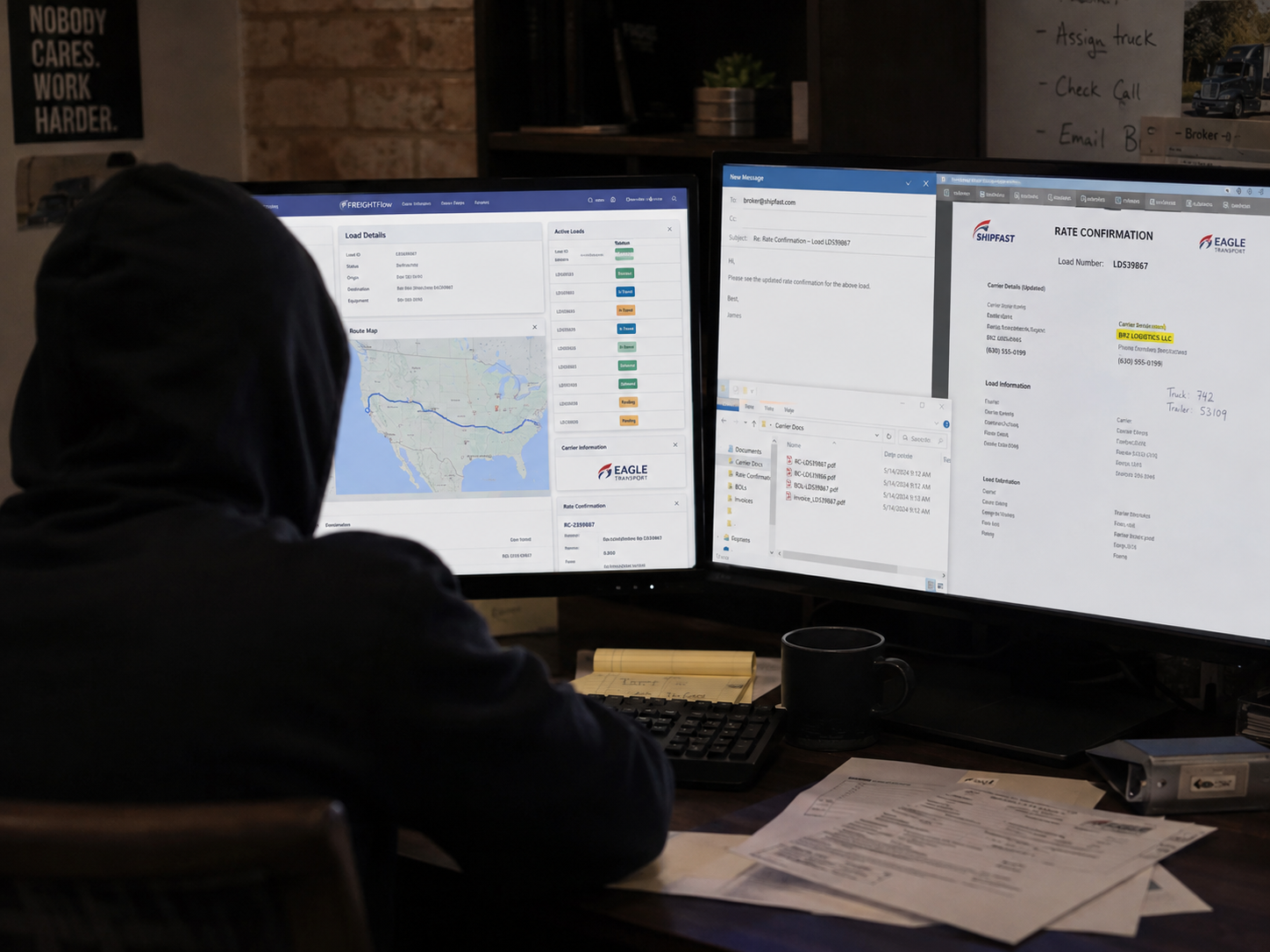
Instead of physically breaking into parked trucks, criminal groups use this method to obtain cargo directly from a shipper’s premises. They pose as established carriers using forged documents, similar email addresses and copied company details.
Major digital freight exchanges have become one of the channels used to secure transport orders. Once the criminals obtain an assignment, they arrive at the loading facility, present apparently valid documentation, collect the cargo and subsequently cut all communication with the customer.
FENADISMER says the criminal networks involved are becoming increasingly professional and continue to improve their phishing, document forgery and corporate identity theft techniques.
Average Loss Exceeds €85,000
According to FENADISMER, the average value of cargo stolen through these impersonation schemes exceeds €85,000.
The federation identifies Spain as the European country most affected specifically by this type of carrier identity fraud, followed by the Netherlands, Germany, France, Portugal and Italy.
Household appliances are the main target, accounting for 42.9% of the cases analyzed by FENADISMER. Food products represent 28.6%, consumer electronics 14.3%, and perfumes and cosmetics another 14.3%.
Their relatively high value and potential for rapid resale make these goods particularly attractive to organized cargo criminals.
Europe Recorded 2,181 Incidents in June
Separate figures from TAPA EMEA show a broader rise in supply-chain crime across Europe, covering not only fraudulent cargo collection but also thefts from vehicles, trailers and facilities.
TAPA recorded 2,181 incidents in June 2026, an increase of 41.6% compared with May.
Germany reported the largest number with 440 incidents, up from 343 a month earlier, representing an increase of 28.3%.
Italy rose from 176 to 320 incidents, Spain from 111 to 280, France from 139 to 262 and the United Kingdom from 169 to 224.
Spain recorded the fastest increase among the top five markets, adding 169 reported incidents, or more than 152%.
Together, the five countries accounted for 1,526 incidents, around 70% of all cases added to the TAPA database in June.
How Criminals Copy Carrier Identities
One of the warning signs highlighted by FENADISMER is an almost imperceptible change in an email address.
Criminals may add an extra letter to a corporate domain, reverse characters or replace the official business address with a generic Gmail account. These differences can easily go unnoticed during routine communication.
Another warning sign is an attempt to move negotiations outside the freight exchange. Fraudsters may ask to discuss rates, vehicle allocation and other details through WhatsApp or mobile phone calls instead of the platform’s internal messaging system.
Suspicion should also be raised when a supposed carrier immediately accepts a rate without negotiation or suddenly has trucks available during periods when capacity is scarce.
PDF Documents Are Not Sufficient Verification
FENADISMER also warns companies against relying solely on documents supplied in PDF format.
Modern editing tools make it relatively easy to change company details, vehicle registration numbers and other information while maintaining a convincing appearance.
A further risk arises when the carrier reports a last-minute change in a truck’s license plate or other vehicle details.
If the shipper accepts the change without conducting a new verification, criminals may be able to collect the cargo with a vehicle that was never included in the original transport arrangement.
One Verification Call Can Stop the Fraud
FENADISMER recommends independently contacting the transport company through an official telephone number before releasing a shipment.
The verification call should not be made to a number supplied in an unexpected email or last-minute message because that contact may belong directly to the fraudsters.
The federation also recommends keeping service confirmations and contractual communication within the freight exchange, checking commercial references and ensuring that the sender’s email domain exactly matches the address registered on the marketplace and the carrier’s official website.
These checks become particularly important for high-value cargo and whenever vehicle or driver information changes shortly before loading.
Recovering Losses After the Theft Is Difficult
FENADISMER says recovering money through legal action after this type of fraud has already taken place can be extremely difficult.
Criminal groups can quickly change companies, phone numbers and countries of operation, while entities used in fraudulent transactions may have no assets from which losses can be recovered.
International freight exchange terms can create additional complications. In some cases, jurisdiction clauses may require disputes to be heard before courts in another country, such as France or Germany, increasing legal costs and complexity for Spanish transport companies.
For this reason, FENADISMER considers active verification before releasing the cargo one of the most effective protections against carrier impersonation.
Cargo Crime Is Becoming Digital
The emerging fraud demonstrates how cargo-security risks are changing. Criminals no longer necessarily need to cut open a trailer or attack a driver at a parking area to steal a valuable shipment.
A convincing imitation of a legitimate carrier’s digital identity may be enough to persuade a warehouse to hand over the cargo voluntarily.
For shippers and logistics operators, this means cybersecurity and identity-verification procedures are becoming as important to supply-chain protection as GPS tracking, secure parking and physical vehicle security.
Read also: Spain Dismantles Gang Robbing Moving Trucks