

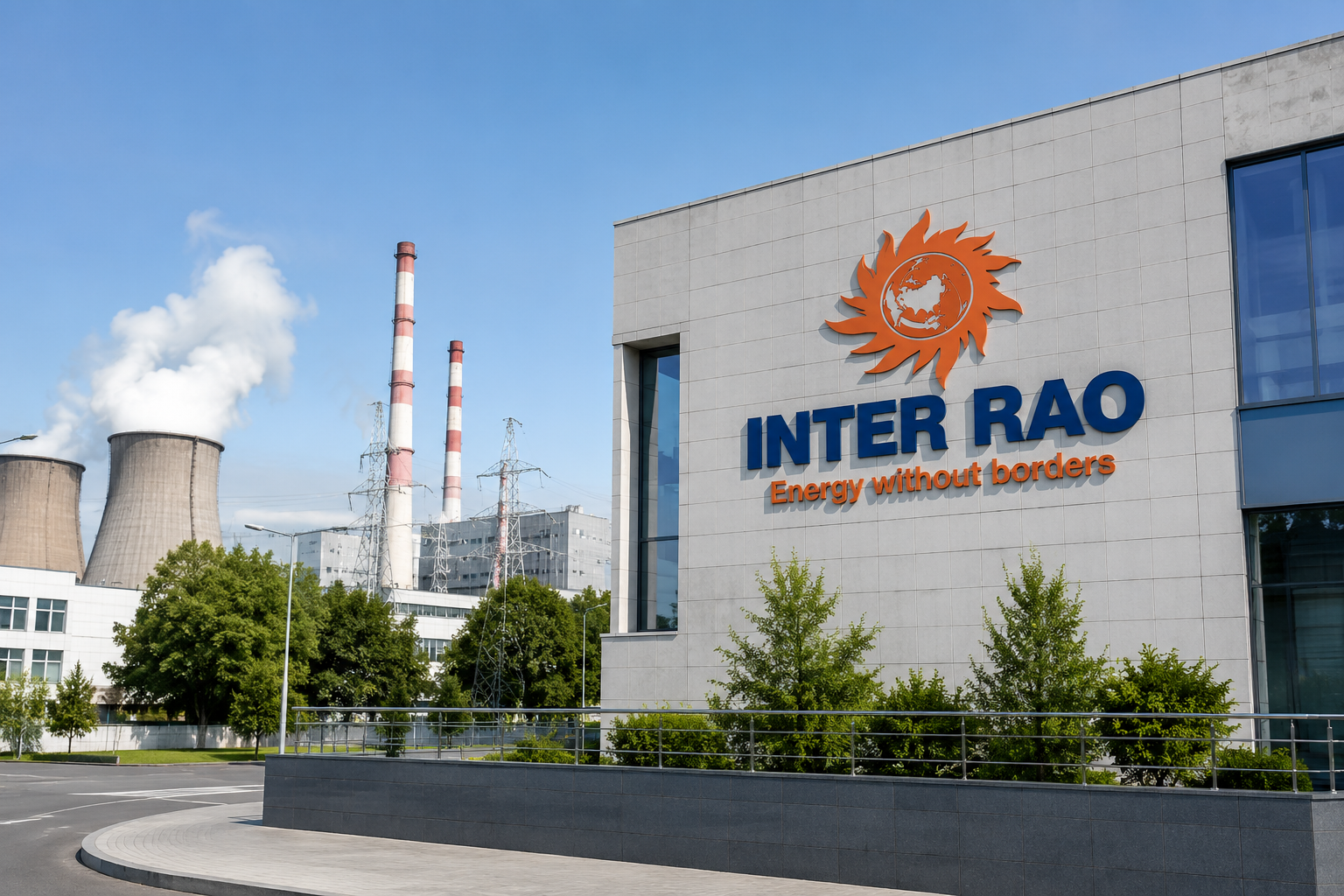
Inter RAO Has Been Added to the EU Sanctions List
The European Union has added PJSC Inter RAO UES to its 21st sanctions package against Russia.
Within EU jurisdiction, the consequences are significant: the company’s assets are frozen and EU persons and companies are prohibited from making funds or economic resources available to it.
For Kazakhstan, this matters more than a normal sanctions announcement involving a Russian company.
Inter RAO is Russia’s sole electricity export and import operator and directly supplies the Kazakh market.
More importantly, the company is built into the financial mechanism supporting the parallel operation of the two countries’ power systems.
The potential problem is therefore not simply whether Kazakhstan can buy another block of Russian electricity. It also concerns the settlement infrastructure behind continuous cross-border power flows.
Kazakhstan Imported 1.4 Billion kWh in Five Months
Inter RAO supplied Kazakhstan with 1.4 billion kWh between January and May 2026.
That was 28% more than during the same period a year earlier.
The company had previously expected Russian supplies to Kazakhstan to reach around 4.3 billion kWh for the full year.
That is a meaningful volume.
Kazakhstan consumed 124.6 billion kWh of electricity in 2025. If Russian deliveries reach 4.3 billion kWh this year, the gross import volume would be equivalent to around 3.4% of last year’s national consumption.
But that should not be interpreted as Kazakhstan’s net electricity deficit.
The Russian and Kazakh systems operate in parallel, meaning electricity can flow in both directions at different times. Some transactions exist to balance hourly deviations rather than simply cover an annual shortage.
Kazakhstan Can Have a Surplus and Still Import Russian Power
The first five months of 2026 illustrate the point.
Kazakhstan generated approximately 53.6 billion kWh while consuming around 53.3 billion kWh, giving it a small aggregate surplus of about 300 million kWh.
During the same period, Inter RAO exported 1.4 billion kWh into Kazakhstan.
There is no contradiction.
A national annual or monthly electricity total says little about whether the grid is balanced during a particular hour.
Even a country with an annual surplus can need imports during an evening demand peak, an unplanned power-station outage or a period of lower renewable generation.
At other times, electricity can flow back across the border.
Dependence on the Russian system therefore cannot be measured solely by subtracting annual generation from annual consumption.
Inter RAO Is Part of the Balancing Mechanism
This distinction is particularly important because of the structure of the Russia–Kazakhstan agreement governing parallel grid operation.
The arrangement involves several contractual relationships.
KEGOC cooperates with Rosseti and Russia’s System Operator on the technical operation of the interconnected grid and electricity transmission.
But the purchase and sale of electricity used to compensate hourly deviations between scheduled and actual cross-border flows is handled between KEGOC and Inter RAO.
The sanctions therefore affect a company positioned directly inside the settlement mechanism for grid balancing.
That makes the issue more complicated than sanctions against an ordinary Russian generating company.
Replacing Inter RAO with another commercial counterparty would not necessarily be immediate because the company is explicitly embedded in the interstate framework.
Russia Also Provides System Stability
Parallel operation provides Kazakhstan with something beyond imported kilowatt-hours: access to a much larger synchronous power system.
When consumption and generation move out of balance, power flows have to adjust rapidly.
During Kazakhstan’s ratification of the bilateral agreement, officials specifically highlighted the Russian system’s role in helping maintain acceptable frequency and voltage levels while compensating hourly imbalances.
For a large interconnected system, this is a normal advantage.
The greater the pool of generators, networks and reserves operating together, the easier it is to absorb an unexpected generator outage or a sudden increase in demand.
Kazakhstan’s exposure therefore extends beyond the commercial price of imported electricity.
Cross-border flows are also part of the country’s reliability architecture.
The EU Cannot Simply Switch Kazakhstan Off
It is important to separate the sanctions issue from the physical operation of the grid.
The European Union does not control the transmission lines between Russia and Kazakhstan and cannot physically terminate synchronous operation through a sanctions decision.
Kazakhstan is also not part of the EU sanctions regime.
A Kazakh company is therefore not automatically prohibited under Kazakh law from purchasing electricity from Inter RAO simply because the Russian company has been listed by Brussels.
The complication begins when a payment enters EU financial jurisdiction.
The Main Vulnerability Is Financial, Not Physical
If a payment to Inter RAO involves an EU bank or another institution required to comply with EU asset-freeze rules, the transaction becomes problematic.
This is particularly relevant to euro settlements.
Banks in third countries may also tighten their own compliance procedures.
A Kazakh bank is not automatically legally required to transpose every EU sanction into domestic law. But it may depend on European correspondent banking, operate its own sanctions policy or simply decide that a transaction involving a listed Russian company creates excessive risk.
The result could be a situation in which the electricity trade itself remains technically possible but payments require different banks, currencies or settlement arrangements.
That is a much more realistic risk than an immediate physical shutdown of the interconnector.
Kazakh Banks Are Not Automatically Cut Off
The implications should not be overstated.
Inter RAO’s EU listing does not automatically mean that every Kazakh bank processing a related transaction loses its European correspondent accounts.
The outcome depends on the specific transaction, currency, intermediaries, bank policies and whether EU jurisdiction is involved.
It is therefore too simplistic to say the new sanctions will automatically stop electricity deliveries.
The more accurate conclusion is that transaction risk has increased.
Additional compliance checks, delayed payments and bank refusals can all make a previously routine cross-border electricity relationship more complicated.
That matters in power markets because hourly balancing cannot be stored for several weeks while counterparties renegotiate banking arrangements.
Kazakhstan’s Own Position Is Improving
There is an important factor reducing the longer-term risk.
Kazakhstan has sharply accelerated the commissioning of domestic generation.
Around 2.6 GW of traditional and renewable capacity is scheduled to enter service in 2026.
Large flexible gas-fired projects will make the biggest contribution, including the 1 GW combined-cycle plant in the Turkestan region, 240 MW in Kyzylorda and the modernisation of Almaty’s CHP-2 and CHP-3.
The government expects Kazakhstan to fully cover domestic electricity demand by the end of the first quarter of 2027 and achieve a sustained surplus in both energy and balancing capacity by 2029.
The Inter RAO sanctions therefore arrive just as the country is already trying to reduce its need for external supply.
Energy Volume Is Only Half the Problem
Adding new power stations does not automatically replace all the advantages of being connected to a much larger system.
A reliable grid needs more than sufficient annual electricity production.
It needs flexible generators, rapid reserves, frequency regulation, strong transmission lines and the ability to compensate immediately for the loss of a major power unit.
Kazakh authorities have previously acknowledged a shortage of regulating capacity.
New combined-cycle gas turbines should improve that position because they are much more flexible than ageing baseload coal units.
But until those projects are fully commissioned and tested, the country remains in a transition period.
Russian cross-border flows still provide an additional reliability buffer.
Ageing Equipment Remains a Vulnerability
One of Kazakhstan’s long-standing challenges is the condition of its generating equipment.
Average wear at power plants was estimated at around 56% in 2025.
The country is carrying out a major repair programme involving generating units, boilers, turbines and thousands of kilometres of transmission networks.
Modernising a power system of this scale takes years.
As long as ageing plants remain in service, unplanned outages increase the value of external reserve and balancing support.
Reducing dependence on Russia is therefore more complex than replacing several billion imported kilowatt-hours with equivalent annual domestic generation.
Energy Security Matters to Logistics and Industry
The consequences also extend beyond the electricity sector.
Any increase in the cost or complexity of cross-border balancing can ultimately affect industrial consumers.
Electricity prices and reliability matter directly to mining, metals, railways, warehouses, data centres and other energy-intensive infrastructure.
Kazakhstan is simultaneously trying to establish itself as one of Eurasia’s leading logistics and industrial hubs. K2Cargo.News has previously examined why Kazakhstan is becoming a key node in Eurasia’s changing logistics network.
New railways, terminals, manufacturing facilities and digital infrastructure all require additional power.
Energy-system resilience is therefore becoming part of the country’s wider logistics competitiveness.
The Most Likely Outcome Is a Change in Settlement Arrangements
For now, a restructuring of payment mechanisms appears more plausible than an end to physical electricity flows.
Both Kazakhstan and Russia have strong incentives to maintain parallel grid operation.
Kazakhstan is one of Russia’s largest electricity export markets, while the Russian system continues to provide Kazakhstan with valuable balancing support.
The commercial relationship is therefore likely to be preserved where legally possible.
But using financial channels connected to the EU will become much more difficult.
If existing banks refuse transactions, the counterparties will need legally compliant alternatives.
That raises costs, administrative complexity and settlement risk.
Replacing Inter RAO Would Not Be Simple
In theory, the commercial structure could eventually be redesigned around a different entity.
In practice, this would be far from immediate.
Inter RAO is not simply a private supplier selected through an ordinary procurement process.
It is Russia’s designated cross-border electricity trader and is expressly named in the bilateral framework governing hourly imbalance settlements with KEGOC.
The wider arrangement also involves Rosseti and Russia’s System Operator.
A full restructuring would therefore require coordination among several organisations and potentially amendments to existing contractual arrangements.
The first response is consequently more likely to involve payment adaptation than replacement of the energy counterparty.
Sanctions Accelerate a Transition Already Underway
Kazakhstan was already moving toward reducing its electricity deficit before the EU’s 21st package.
New gas generation, modernised coal capacity, renewables and major grid projects are intended to reduce the need for external electricity.
Nuclear generation will add another source over the longer term.
The Inter RAO listing simply changes the economics of that strategy.
Dependence on a foreign electricity supplier now creates not only technical and pricing exposure but also financial-infrastructure risk.
A perfectly functioning transmission line is of limited value if settlement under the underlying contract becomes difficult.
The Real Question Is Not Whether Brussels Can Switch Off the Grid
The EU has not acquired the ability to turn off Kazakhstan’s electricity system through one sanctions decision.
The physical Russia–Kazakhstan connection remains in place, the interstate agreement continues to operate and Kazakhstan is not itself bound by EU sanctions.
But the Inter RAO listing creates a new weakness in the settlement layer.
During the coming months, the key indicator will not simply be whether electricity continues flowing across the border.
It will be whether KEGOC and its Russian counterparts can maintain a reliable contractual and financial framework for the parallel operation of the two systems.
If Kazakhstan’s planned 2026 generating projects enter service on time, the country should approach 2027 with considerably less dependence on imported energy.
Yet replacing the stability benefits of a large synchronous grid is more difficult than simply building another power plant.
The 21st sanctions package is therefore not an immediate energy crisis for Kazakhstan. It is a warning that energy independence depends not only on domestic generation, but also on resilient networks, reserves and payment mechanisms.
Read also: Why Kazakhstan and Georgia Are Becoming Key Hubs of Eurasia