

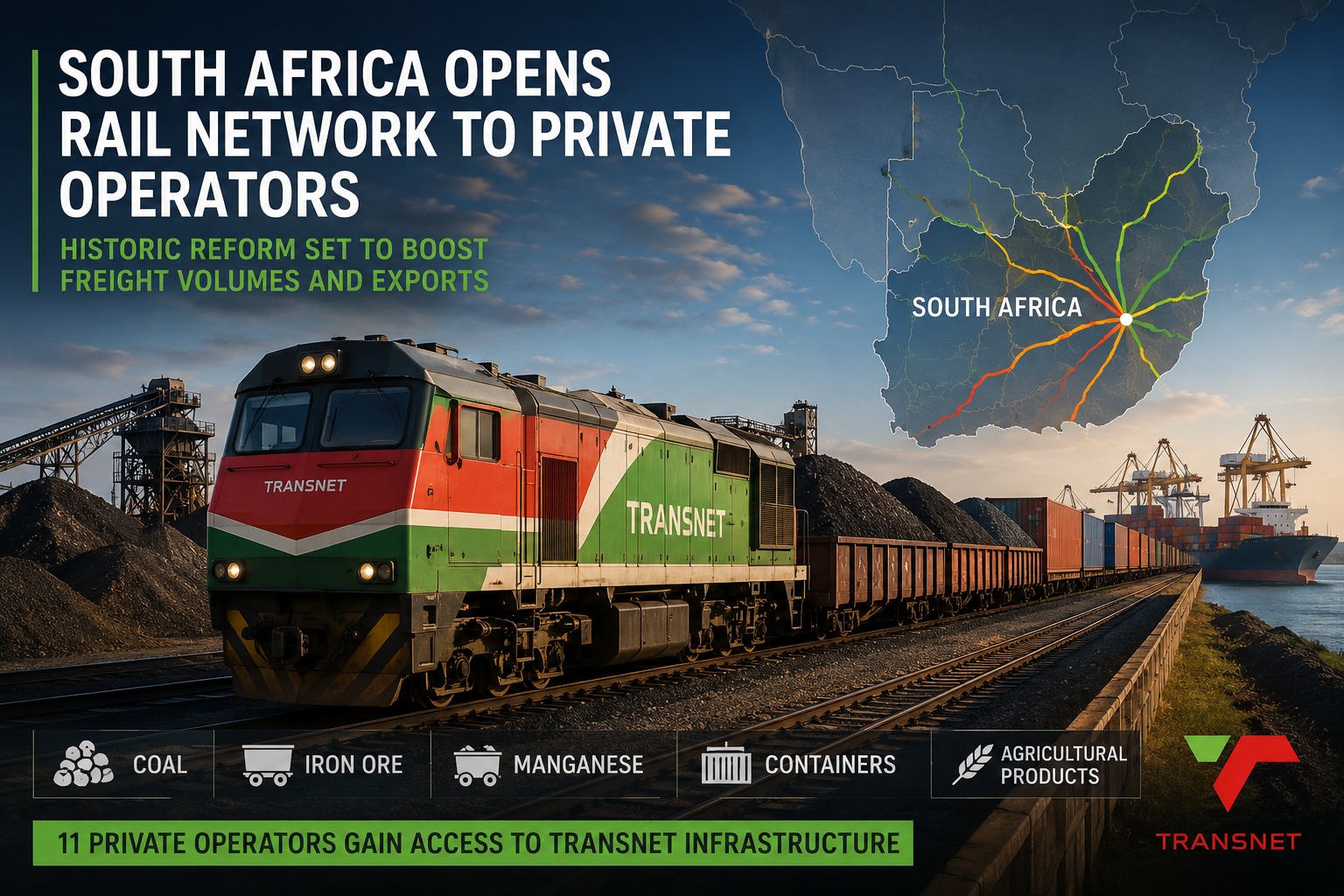
South Africa has launched one of the most ambitious transportation reforms in its history. State-owned freight and logistics company Transnet has granted access to the national rail network to 11 private freight operators.
For the country, this is far more than a regulatory change. The move has the potential to reshape South Africa’s logistics sector, influence export competitiveness, attract investment, and alter freight flows across Southern Africa.
Industry experts are already describing the initiative as one of the most significant developments in the African rail freight market in the past two decades.
Why the Reform Was Needed
For many years, South Africa’s railway system was regarded as one of the most advanced on the African continent. However, the sector has faced mounting challenges in recent years.
Aging infrastructure, insufficient investment, locomotive shortages, maintenance backlogs, vandalism, and widespread cable theft have significantly reduced capacity across several key freight corridors.
The consequences have been felt throughout the economy. Mining companies have struggled to move export cargo efficiently, containerized freight has increasingly shifted to road transport, and the country’s highways have become congested with thousands of additional trucks.
For Africa’s largest industrial economy, the impact has been substantial. Industry analysts estimate that rail bottlenecks have cost the country billions of dollars in lost export revenue annually.
What Will Change
For the first time in many years, private companies will be able to use the state-owned rail network to operate their own freight services.
In practice, South Africa is transitioning toward an Open Access rail model, a framework already used in several advanced transportation markets around the world.
Under this approach, the rail infrastructure remains publicly owned, while multiple operators compete to provide transportation services. This creates competition based on efficiency, service quality, reliability, and pricing.
The model is expected to:
- Increase the number of freight trains operating on the network;
- Improve infrastructure utilization;
- Attract private-sector investment;
- Create a more competitive freight market;
- Reduce transportation costs for shippers.
Industries Expected to Benefit the Most
The reform is expected to deliver the greatest benefits to South Africa’s export-oriented industries.
Key commodities likely to see improved transportation capacity include:
- Coal;
- Iron ore;
- Manganese ore;
- Chrome;
- Copper and other minerals;
- Agricultural products;
- Containerized freight.
Manganese is attracting particular attention. South Africa possesses the world’s largest manganese reserves and remains one of the leading global suppliers of this critical mineral, which is widely used in steelmaking and battery manufacturing.
As global demand for electric vehicle batteries continues to grow, more efficient manganese logistics could become a significant competitive advantage for the country.
Major Ports Are Also Expected to Benefit
The rail reform is closely linked to the performance of South Africa’s major seaports.
A large share of the country’s exports currently moves through:
- Port of Durban;
- Port of Richards Bay;
- Port of Cape Town;
- Port of Ngqura;
- Port of Saldanha Bay.
Many of these facilities have struggled with cargo delivery constraints from inland production regions.
An increase in freight rail capacity is expected to accelerate the movement of commodities and containers to port terminals, reduce congestion, and improve export efficiency.
For international shippers, this could translate into more predictable transit times and lower logistics risks.
Who Has Gained Access to the Network?
During the first phase of the program, access agreements were awarded to 11 private freight operators.
These companies will be able to launch their own rail services on designated corridors while paying access fees to utilize Transnet’s infrastructure.
The development represents a major shift for the market. Previously, most freight services depended on a single operator. Increased competition is expected to improve service quality and expand transportation capacity.
Economic Impact Could Extend Beyond Transportation
Analysts believe the reform could generate benefits across the broader South African economy.
Higher Export Volumes
Improved transportation efficiency will allow mining companies and exporters to increase shipments to global markets.
New Investment Opportunities
Private operators are already exploring investments in locomotives, rolling stock, maintenance facilities, and digital freight management systems.
Lower Logistics Costs
For bulk commodities, rail remains one of the most cost-effective transportation modes over long distances.
Reduced Highway Congestion
Shifting cargo back from road transport to rail could reduce pressure on highways and lower public spending on road maintenance.
The Impact Will Extend Beyond South Africa
The significance of the reform reaches far beyond the country’s borders.
South Africa remains the primary logistics hub of Southern Africa and plays a critical role in serving freight flows for neighboring countries, including:
- Botswana;
- Namibia;
- Zimbabwe;
- Zambia;
- Democratic Republic of the Congo.
For many businesses in these countries, South African ports provide the most important gateway to international markets.
As a result, improvements in South Africa’s rail network are likely to strengthen regional trade and supply chain efficiency across Southern Africa.
What Comes Next?
While the reform marks a historic milestone, significant challenges remain. South Africa must continue modernizing rail infrastructure, renewing rolling stock, and improving security along key freight corridors.
Nevertheless, opening the national rail network to private operators is already being viewed as a landmark moment for Africa’s transportation sector.
If the initiative achieves its objectives, South Africa could recover lost freight volumes, increase mineral exports, and reinforce its position as Africa’s leading logistics hub.
For global supply chains, the implications are substantial. Over the coming years, Africa may become a more influential participant in international trade flows, with South Africa serving as a critical gateway connecting the continent’s resource-rich regions to global markets.