

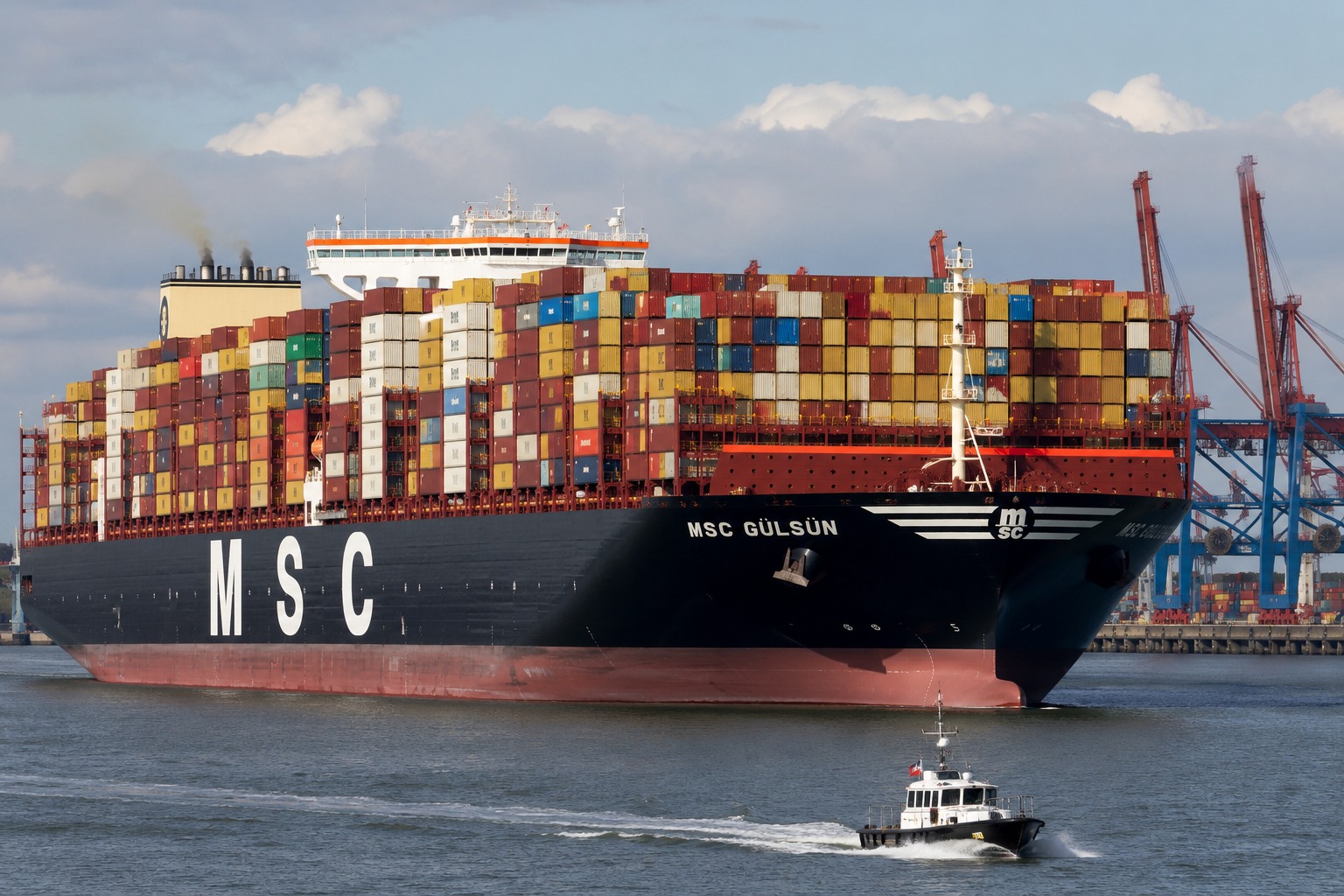
The global container shipping industry has entered a new era. According to maritime consultancy Alphaliner, Mediterranean Shipping Company (MSC) has reached a historic milestone by controlling 21.5% of the world’s container fleet for the first time in its history. In practical terms, more than one out of every five container ships operating worldwide is now under MSC’s control.
This achievement highlights the success of the company’s ambitious expansion strategy, which has dramatically reshaped the competitive landscape of global container shipping over the past several years.
MSC Consolidates Its Position as the World’s Leading Carrier
For decades, Danish shipping giant Maersk was regarded as the undisputed leader of the container shipping industry, maintaining the largest fleet capacity in the world.
However, following the pandemic and the record profits generated by container carriers during the subsequent logistics boom, MSC embarked on an aggressive expansion programme.
The company invested billions of dollars in:
- new container vessel construction;
- acquisitions of second-hand ships;
- expansion of terminal assets;
- development of logistics infrastructure;
- strengthening its presence on major international trade routes.
As a result, MSC not only overtook Maersk but has continued to widen the gap between itself and its closest competitor.
According to Alphaliner estimates, MSC’s fleet now exceeds 6.7 million TEU, representing an all-time record for the global container shipping industry.
Why Maersk Is Losing Its Leadership Position
Unlike MSC, Maersk’s management has deliberately pursued a different strategic direction.
The Danish company has chosen not to compete for the largest fleet size and has instead focused on long-term business sustainability.
Maersk’s current priorities include:
- decarbonisation of shipping operations;
- construction of vessels powered by methanol and other alternative fuels;
- expansion of contract logistics services;
- digitalisation of supply chains;
- integration of transport and warehousing solutions.
The company has repeatedly stated that fleet size leadership is no longer its primary strategic objective.
Instead, Maersk aims to become a fully integrated logistics provider capable of offering customers not only ocean freight services but also warehousing, trucking, rail transportation, and digital supply chain solutions.
Massive Vessel Acquisitions Reshaped the Market
One of the key factors behind MSC’s success has been its unprecedented activity in the second-hand vessel market.
Between 2020 and 2025, the company acquired hundreds of ships across multiple vessel classes, taking advantage of the exceptional profitability generated during the post-pandemic shipping boom.
Industry experts note that no container carrier in modern shipping history has undertaken such a large-scale fleet acquisition programme within such a short period.
At the same time, MSC placed orders for dozens of new container ships at shipyards in China and South Korea.
Many of these vessels continue to enter service and expand the company’s capacity today.
Growing Influence Over Global Cargo Flows
MSC’s expansion carries implications far beyond the company itself.
As the owner of the world’s largest container fleet, the carrier benefits from:
- a broader global service network;
- greater flexibility in vessel deployment;
- faster responses to changes in market demand;
- stronger negotiating power with ports and terminal operators;
- significant economies of scale.
For shippers, this provides access to one of the most extensive container shipping networks in the world.
At the same time, the increasing concentration of market power has raised concerns among some regulators and industry stakeholders, as major carriers continue to exert greater influence over global supply chains.
Africa Emerges as a Key Growth Region
MSC has been particularly active in expanding its presence across Africa.
The company continues to invest in:
- container terminals;
- port infrastructure;
- logistics centres;
- inland transportation corridors.
Its strongest presence can be found in:
- Egypt;
- Morocco;
- South Africa;
- Nigeria;
- Côte d’Ivoire;
- Kenya.
The African market remains one of the fastest-growing regions for the global container shipping industry, supported by population growth, urbanisation, and expanding international trade.
As a result, MSC’s continued expansion across the continent is expected to have a significant impact on regional cargo flows in the coming years.
A New Phase of Competition Among Shipping Giants
The historic milestone of controlling 21.5% of the world’s container fleet demonstrates how rapidly the balance of power is changing within the industry.
Today, the market is increasingly defined by two distinct business models:
MSC
- focus on fleet scale;
- expansion of global shipping networks;
- continuous growth in container capacity;
- development of terminal operations.
Maersk
- focus on integrated logistics;
- environmental modernisation of the fleet;
- digital service offerings;
- end-to-end supply chain solutions.
Both strategies offer distinct advantages, and the coming years will reveal which approach proves more effective in an increasingly complex and competitive global marketplace.
Why It Matters
MSC’s achievement of controlling 21.5% of the global container fleet is more than just an industry statistic. It reflects a broader transformation taking place throughout the maritime shipping sector.
For cargo owners, it signals growing market concentration, stronger influence from major carriers, and an evolving competitive environment. For ports and terminal operators, it highlights the need to adapt to the expanding influence of global logistics giants.
If current trends continue, MSC may further increase its market share and strengthen its position as the world’s largest container shipping company, while Maersk continues its pursuit of becoming one of the most technologically advanced and environmentally sustainable logistics ecosystems in the industry.