

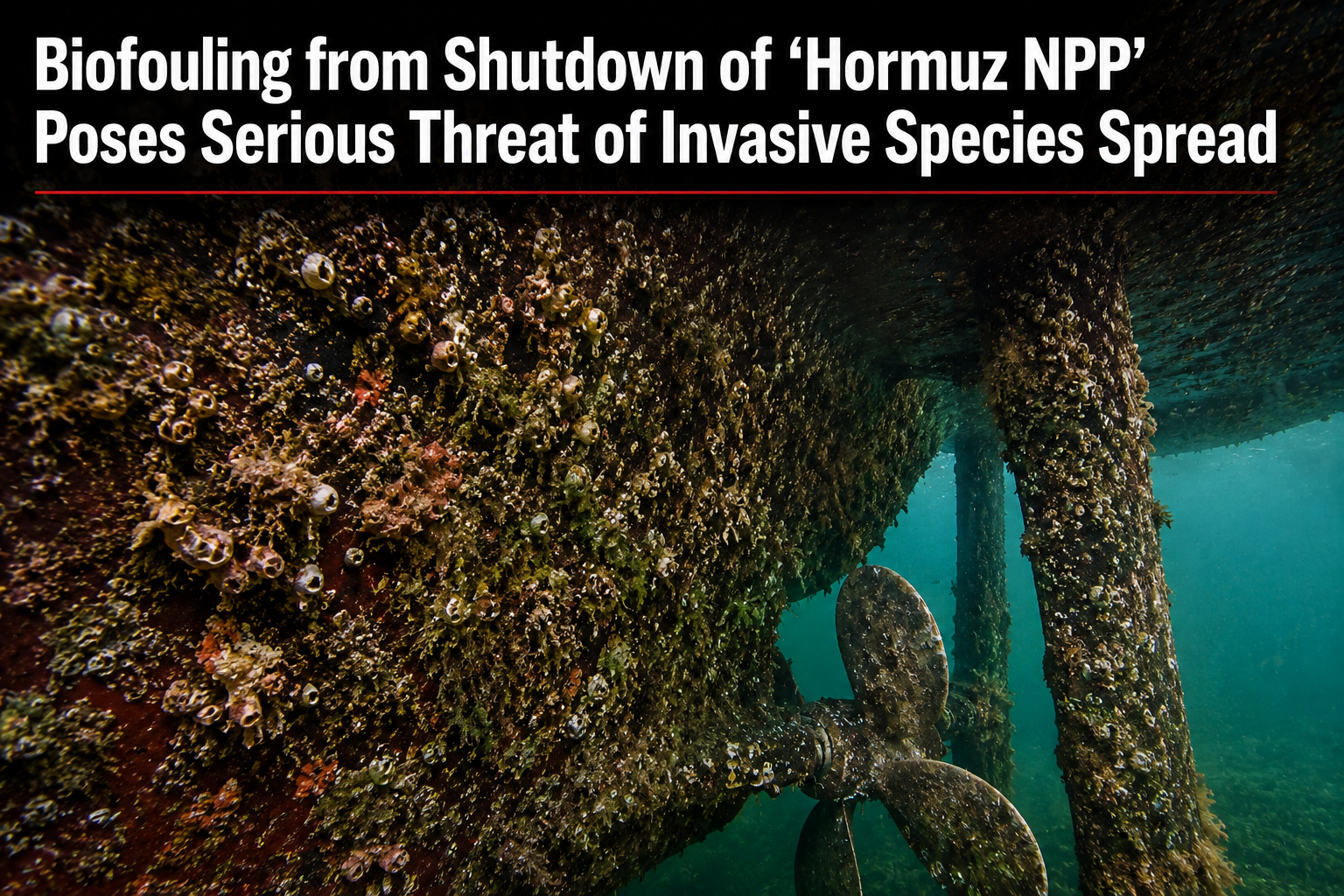
While global attention remains focused on military risks, energy markets, and the future of one of the world’s most important maritime corridors, another crisis is quietly unfolding — one whose consequences could be felt for decades.
As thousands of commercial vessels remain anchored in the Persian Gulf following the disruption of shipping through the Strait of Hormuz, an invisible but potentially serious threat is developing beneath the waterline. Entire communities of marine organisms are growing on ships’ hulls and could soon be transported to ports around the world.
According to an international team of scientists writing in the journal Biological Invasions, the shipping industry may be facing one of the largest marine invasive-species dispersal events in modern history, driven by the prolonged and involuntary shutdown of a significant portion of the global fleet.
A Geopolitical Crisis Becomes an Environmental Threat
Researchers estimate that approximately 1,500 commercial vessels have been forced to remain idle in the warm waters of the Persian Gulf for far longer than normal operating and maintenance schedules would allow.
For marine biologists, these conditions are nearly ideal for the rapid development of biofouling — the accumulation of algae, barnacles, mollusks, crustaceans, sponges, and other organisms on the submerged surfaces of a vessel.
“If you were designing a worst-case scenario for the spread of invasive species, it would be difficult to create conditions more favorable than these,” environmental scientist and study co-author Professor Mario Tamburri told The Guardian.
Hormuz Could Become the Starting Point for a Global Migration
Scientists are particularly concerned not only about the growth already covering the ships, but about what will happen once navigation through the Strait of Hormuz resumes.
Each vessel departing the Persian Gulf could effectively become a floating platform carrying dozens of marine species across international waters.
These organisms may be transported to ports in Europe, Asia, Africa, North America, and South America, including ecosystems where many of them have never previously existed.
Their arrival could disrupt local food chains, damage coastal infrastructure, displace native species, and impose significant costs on fisheries, ports, and environmental authorities.
Why the Persian Gulf Presents an Exceptional Risk
The Persian Gulf’s unusually warm waters create favorable conditions for organisms capable of surviving high temperatures, intense competition, and significant variations in salinity.
Researchers believe that species able to thrive in such a demanding environment may be particularly resilient when introduced into new habitats.
Many ships also arrived in the Gulf with existing biofouling communities collected during previous voyages. During months of inactivity, these organisms have continued to grow, reproduce, and mix with local species.
As a result, the submerged surface of each vessel may now support a complex biological community capable of being transported thousands of miles to an entirely different marine environment.
The Environmental Problem Is Also an Economic One
Biofouling does more than spread potentially invasive species. It also increases drag as a ship moves through the water, reducing speed and raising fuel consumption.
Heavily fouled vessels may burn significantly more fuel, increasing operating costs and greenhouse gas emissions at a time when the shipping industry is under growing pressure to improve efficiency and reduce its environmental footprint.
International Maritime Organization guidance calls for prompt action when ships remain idle for extended periods, particularly after approximately 18 to 30 days without regular movement.
However, cleaning such a large number of vessels before departure would be extremely difficult.
Cleaning Capacity Is Unlikely to Meet Demand
Underwater hull-cleaning capacity in Persian Gulf ports is limited and was not designed to service hundreds of vessels simultaneously.
The challenge is made even more difficult by uncertainty surrounding the timing and conditions under which the Strait of Hormuz may fully reopen.
Most of the blocked vessels are expected to take the first available opportunity to leave the region rather than wait for comprehensive hull inspections or cleaning.
That would shift the burden to subsequent ports of call, many of which may lack the equipment, personnel, containment systems, or environmental protocols required to safely remove the accumulated growth.
Ports Around the World Could Face a New Biosecurity Challenge
The study’s authors argue that the reopening of the Strait of Hormuz should be treated not only as the restoration of global trade, but also as the beginning of an international marine biosecurity operation.
They recommend that vessels undergo visual assessments of hull fouling before departure and that shipping companies monitor changes in fuel efficiency during transit.
This information could be shared with destination ports, allowing authorities to prepare sufficient hull-cleaning resources before affected vessels arrive.
Scientists also recommend enhanced monitoring for newly introduced marine species in high-risk ports and coastal waters. Early detection could allow local authorities to contain an outbreak before an invasive organism becomes permanently established.
A Global Response May Determine the Outcome
Researchers have called for the creation of a coordinated international network of safe and effective in-water vessel-cleaning services.
Such a network would need to ensure that organisms removed from ships are captured and treated rather than released directly into local waters, where cleaning itself could accelerate the spread of invasive species.
Whether the prolonged shutdown near the Strait of Hormuz becomes a global biological dispersal event will depend less on the organisms already attached to the ships than on the speed, coordination, and effectiveness of the international response.
History has repeatedly shown that preventing the introduction of invasive species is far less expensive and more effective than attempting to control them after they have become established.
The current crisis is another reminder that the consequences of geopolitical conflict are not limited to security, energy prices, or disrupted supply chains. In some cases, they can alter marine ecosystems thousands of miles away and reshape the biological landscape of the world’s oceans.