

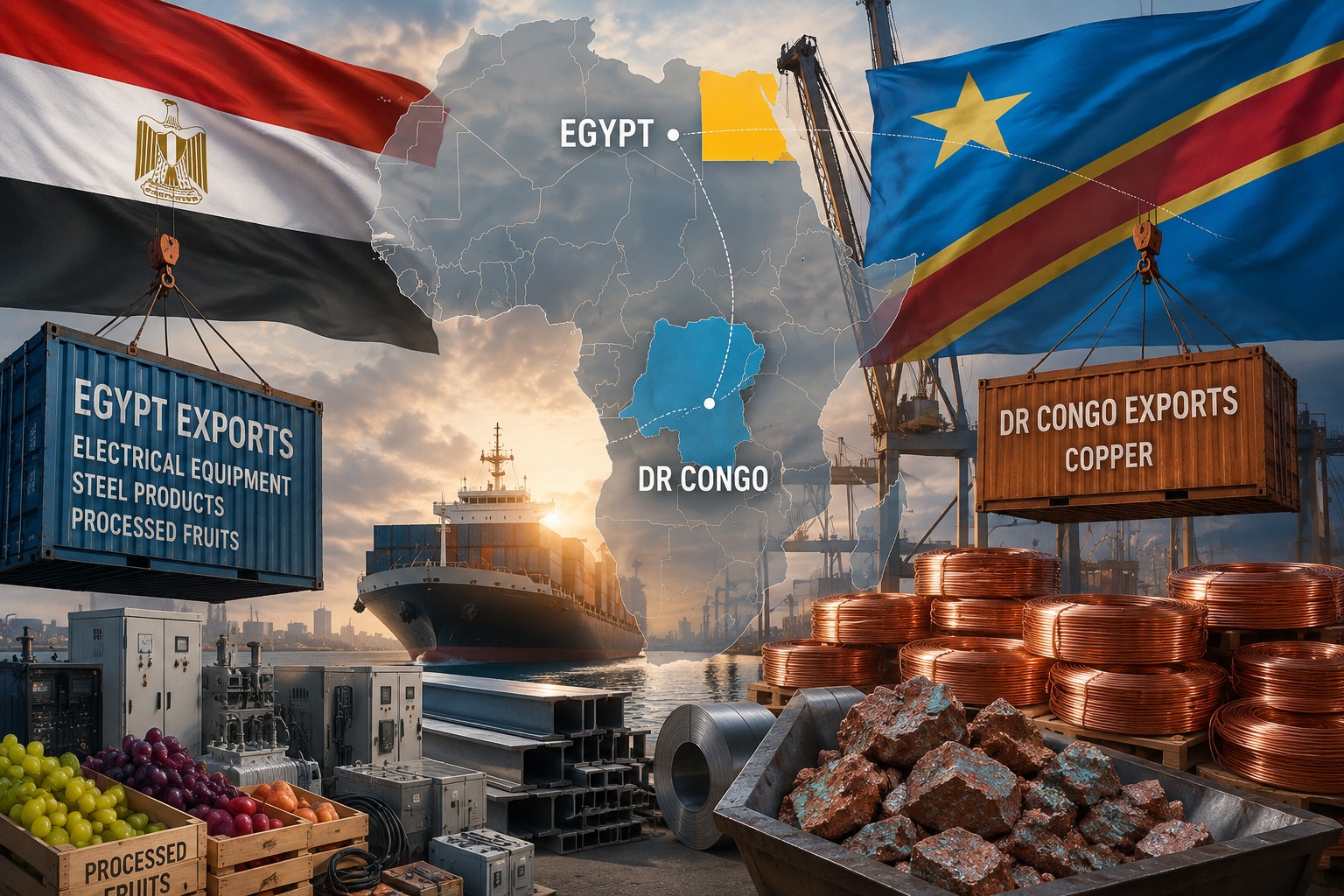
Despite a decline in bilateral trade volumes during 2025, Egypt and the Democratic Republic of Congo continue to expand economic cooperation across industry, mining, infrastructure, and investment sectors.
New figures released by Egypt’s Central Agency for Public Mobilization and Statistics (CAPMAS) indicate that relations between the two countries are gradually evolving beyond traditional merchandise trade toward a broader strategic partnership.
Trade Turnover Falls by Nearly One-Third
According to CAPMAS, total trade between Egypt and the Democratic Republic of Congo reached $461.6 million in 2025, compared with $679.1 million in 2024.
This represents a decline of approximately 32% in bilateral trade.
The decrease has been attributed to several factors, including:
- fluctuations in global commodity prices;
- instability along certain logistics routes in Central Africa;
- weaker industrial demand for selected metal products;
- ongoing shifts in global supply chains.
Despite the decline in overall trade volumes, both countries remain strongly committed to expanding economic cooperation.
Egypt Expands Exports of Industrial Goods
The structure of Egyptian exports to the Democratic Republic of Congo highlights Cairo’s growing focus on higher value-added products.
The main export categories included:
- electrical and power-generation equipment;
- steel products and rolled metal;
- processed fruits and vegetables;
- construction materials;
- industrial machinery and equipment.
Demand has been particularly strong for equipment used in energy and infrastructure projects, as the Democratic Republic of Congo continues to modernise its transportation and industrial networks.
For Egyptian manufacturers, Central Africa is increasingly becoming one of the continent’s most promising export destinations.
Copper Remains the Dominant Import Commodity
On the import side, copper continues to account for the majority of shipments from the Democratic Republic of Congo to Egypt.
This is unsurprising given that the country ranks among the world’s leading producers of copper and cobalt—two metals that are essential to modern industry and emerging technologies.
Copper is widely used in:
- power generation and transmission equipment;
- construction projects;
- cable and wire manufacturing;
- the automotive industry;
- battery production and electric vehicle components.
Growing global demand for electrification and renewable energy technologies has made Congolese copper a strategically important resource for many countries, including Egypt.
Investment Becomes an Increasingly Important Driver
Industry analysts note that investment is playing an increasingly significant role in relations between Cairo and Kinshasa.
In recent years, Egyptian companies have expanded their presence across several African markets, including the Democratic Republic of Congo, through projects involving:
- construction;
- energy infrastructure;
- water supply systems;
- telecommunications;
- logistics and transportation.
Egyptian contractors continue to leverage their experience gained from major domestic infrastructure programmes, including new city developments, motorway construction, and logistics hub projects.
Remittances Provide an Additional Channel of Cooperation
The CAPMAS report also highlights financial transfers and remittance flows between the two countries.
Although these volumes remain relatively modest compared with Africa’s major migration corridors, the growing number of professionals and specialists working on projects in both countries is contributing to an increase in cross-border financial activity.
Economists often view expanding remittance flows as an indicator of deeper business relationships and greater labour mobility between partner economies.
African Economic Integration Emerges as a Key Growth Driver
The strengthening of Egypt–DR Congo relations is taking place against the backdrop of broader economic integration efforts across Africa.
Key drivers include:
- the African Continental Free Trade Area (AfCFTA);
- the development of North–South transport corridors;
- modernisation of ports and railway infrastructure;
- digitalisation of trade and customs procedures.
For Egypt, deeper engagement with Central Africa forms part of a wider strategy aimed at expanding its economic influence across the continent and strengthening its position as one of Africa’s leading trade and logistics hubs.
Why This Matters for Logistics
For the transportation and logistics industry, cooperation between Egypt and the Democratic Republic of Congo is of particular significance.
The Democratic Republic of Congo possesses some of the world’s largest reserves of copper, cobalt, and other strategic minerals required for the global energy transition. Egypt, meanwhile, continues to invest heavily in expanding and modernising its Red Sea and Mediterranean ports, logistics zones, and transportation infrastructure.
The combination of Central Africa’s mineral resources and Egypt’s growing logistics capabilities could create new export corridors for metals, industrial products, and consumer goods destined for Europe, the Middle East, and Asia.
Although trade volumes declined in 2025, long-term trends suggest considerable potential for future growth. Investments, infrastructure development, and increased trade in strategic resources are expected to become the primary drivers of deeper economic cooperation between two of North and Central Africa’s most important economies.
