

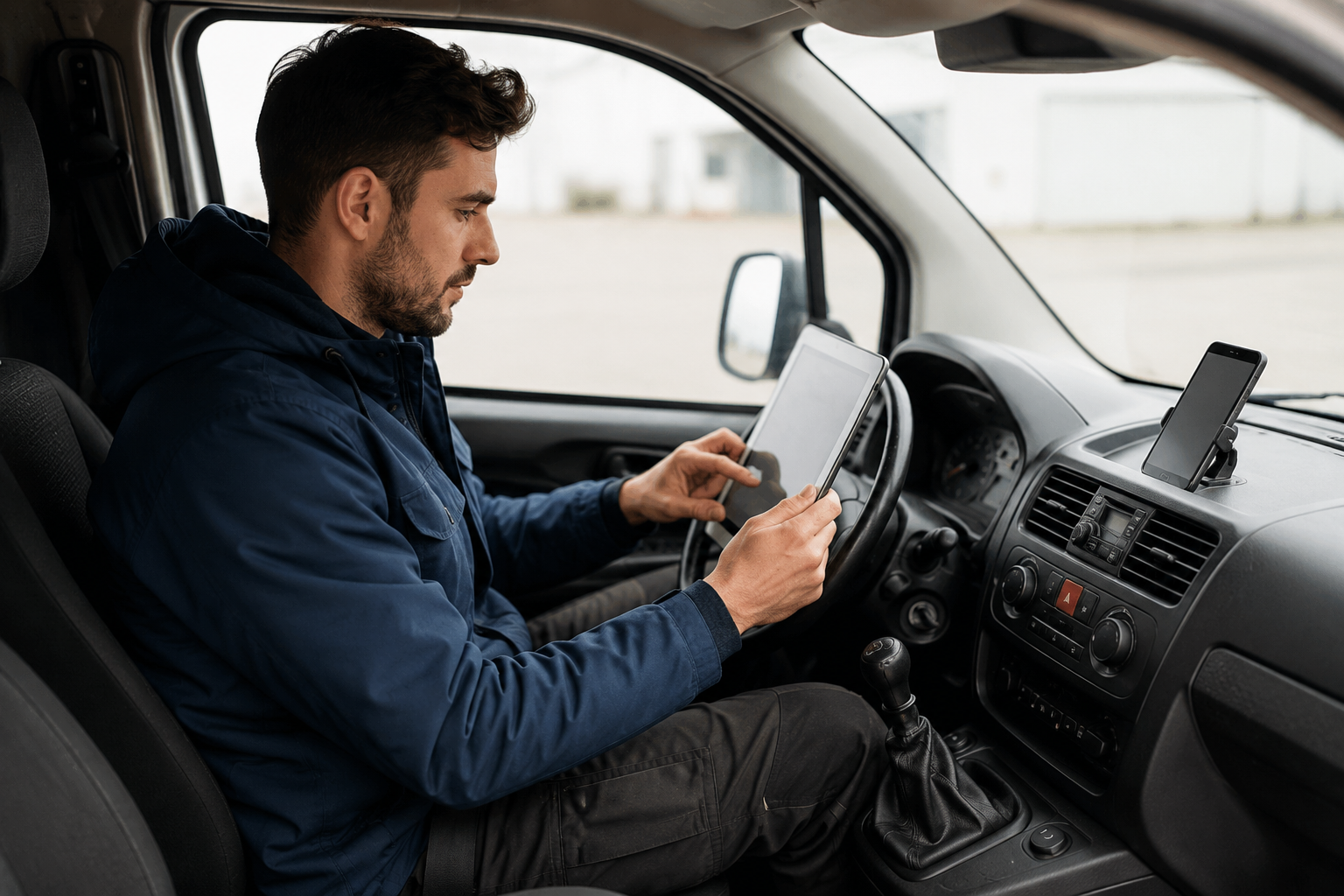
Italy is preparing a new digital tool that could make truck drivers direct participants in improving the country’s logistics infrastructure. Starting this autumn, drivers, transport companies and industry organizations will be able to use a dedicated app to report problems they face during daily freight operations.
The app is being developed by Uniontrasporti as part of the infrastructure programme promoted and financed by Unioncamere. Its main purpose is to collect operational information from people who use roads, terminals, warehouses and logistics nodes every day.
The idea is simple: drivers often see problems earlier and more clearly than planners, infrastructure managers or statistical analysts. They know where truck parking is insufficient, where loading takes too long, which fuel stations create delays and which intermodal terminals do not work efficiently.
For Italy, this is not only a digital experiment. It is a practical attempt to improve road freight by turning scattered driver complaints into structured data. If the system works, it could help authorities and logistics stakeholders identify bottlenecks faster and prioritize infrastructure or service improvements.
As K2Cargo News previously reported in New Report Reveals Widespread Problems in Europe’s International Road Transport Sector, working conditions, parking shortages and operational inefficiencies remain serious challenges for international road transport across Europe.
What Drivers Will Be Able to Report
The new app will allow truck drivers to report problems across several critical points of the logistics chain.
The first category is truck parking. Lack of safe and available parking remains one of the most common problems for drivers in Europe. When drivers cannot find a suitable place to stop, they may lose time, violate rest-time planning or park in unsafe locations.
The second category is loading and unloading. Long waiting times at warehouses and distribution centers create delays that often do not appear clearly in official statistics. Drivers may spend hours waiting for a dock, paperwork, staff availability or permission to leave.
The third category is fuel stations. Problems at refueling points can affect route planning, rest periods and delivery schedules, especially when facilities are overcrowded, poorly organized or unsuitable for heavy vehicles.
The fourth category is intermodal terminals. These nodes are essential for combining road, rail and maritime transport, but delays or poor coordination can damage the efficiency of the whole supply chain.
By collecting reports from drivers, Uniontrasporti wants to create a more detailed picture of how the network really functions.
Why Driver Data Matters
Traditional infrastructure analysis usually relies on traffic counts, economic forecasts, official reports and data from transport operators.
These tools are useful, but they do not always capture the small operational problems that drivers face every day. A parking area may exist on paper but be full every evening. A warehouse may have enough docks but still create long waits because procedures are slow. A terminal may appear well connected but suffer from poor coordination.
Driver reports can fill this gap.
They provide real-time, ground-level information about the logistics system. If many drivers report the same problem in the same place, that location can be classified as a critical node. If delays appear repeatedly at certain loading points, stakeholders can investigate the cause.
The value of the app will depend on how well these reports are processed. A reporting tool is useful only if the collected data becomes practical recommendations for infrastructure, services and regulation.
Italy Needs Better Freight Efficiency
The project comes at a time when road transport in Italy faces several structural challenges.
Driver shortages, aging workforce, rising operating costs and infrastructure bottlenecks are already affecting the sector. According to IRU, 7% of truck driver positions in Italy are currently unfilled, and this share could rise to 17% by 2028. Only a small share of Italian truck drivers are under 25, while women remain heavily underrepresented in the profession.
This makes working conditions especially important. If drivers continue to face poor parking, long waits and unpredictable logistics processes, it becomes harder to attract new people to the job.
Digital tools alone will not solve the driver shortage. But they can help identify the everyday problems that make the profession less attractive.
From Complaint to Infrastructure Planning
The main promise of the app is that it can turn individual complaints into data-based planning.
A driver’s report about a missing parking place may seem small. But thousands of similar reports can show where parking demand is systematically higher than supply. Reports about loading delays can reveal which warehouses or industrial areas create the biggest productivity losses. Reports about fuel stations and intermodal nodes can help classify weak points in the network.
This information can be useful for public authorities, chambers of commerce, logistics companies, terminal operators and infrastructure planners.
For transport companies, the app may also become a way to show customers and partners where delays really occur. This is important because drivers and carriers are often blamed for late deliveries even when the cause is waiting time at a warehouse or congestion at a terminal.
Germany Shows a Parallel Direction
Italy’s initiative fits into a broader European movement toward digital tools for road freight.
Germany has launched the Stellplatzinformationsdienst, or SID, a nationwide digital information service for truck parking. The system provides near-real-time data on the occupancy of roughly 1,850 truck rest areas along German motorways and makes the data available for integration into apps and planning systems.
The German model focuses mainly on parking availability. Italy’s planned app is different because it collects reports from drivers about multiple parts of the logistics chain. But both projects share the same logic: road freight needs better data, and digital systems can help drivers, dispatchers and authorities make better decisions.
This trend is likely to continue. As European freight becomes more complex, real-time information on parking, delays, infrastructure and service quality will become a basic part of transport management.
What This Means for Logistics Companies
For logistics companies, the app could create both opportunities and responsibilities.
The opportunity is better visibility. If companies can understand where delays happen most often, they can adjust routes, improve delivery planning and negotiate better procedures with customers and warehouses.
The responsibility is participation. The app will be useful only if drivers and operators actually use it. Companies may need to encourage drivers to report issues accurately and consistently, without turning the process into another administrative burden.
There is also a question of trust. Drivers must feel that their reports will be used to improve conditions, not to monitor or punish them. If the app is perceived as a control tool, adoption may be limited. If it is seen as a way to give drivers a voice, it can become valuable.
A Step Toward Driver-Centered Logistics
The planned Italian app is important because it changes the perspective of infrastructure planning.
Instead of looking only from the top down, it asks the people on the road to report what is really happening. This approach recognizes that drivers are not only users of infrastructure. They are also observers of the logistics system.
The app will not solve every problem immediately. Italy will still need more parking capacity, better loading standards, efficient terminals and stronger coordination between public and private actors. But reliable field data can help decide where action is most urgent.
If the platform is implemented well, it could become a useful model for other European countries. Road freight needs not only new roads and terminals, but also better information about how existing infrastructure performs in real life.
The message from Italy is clear: drivers know where the logistics chain breaks down. Now the challenge is to turn that knowledge into decisions, investment and better working conditions.
Read also: New Report Reveals Widespread Problems in Europe’s International Road Transport Sector
