

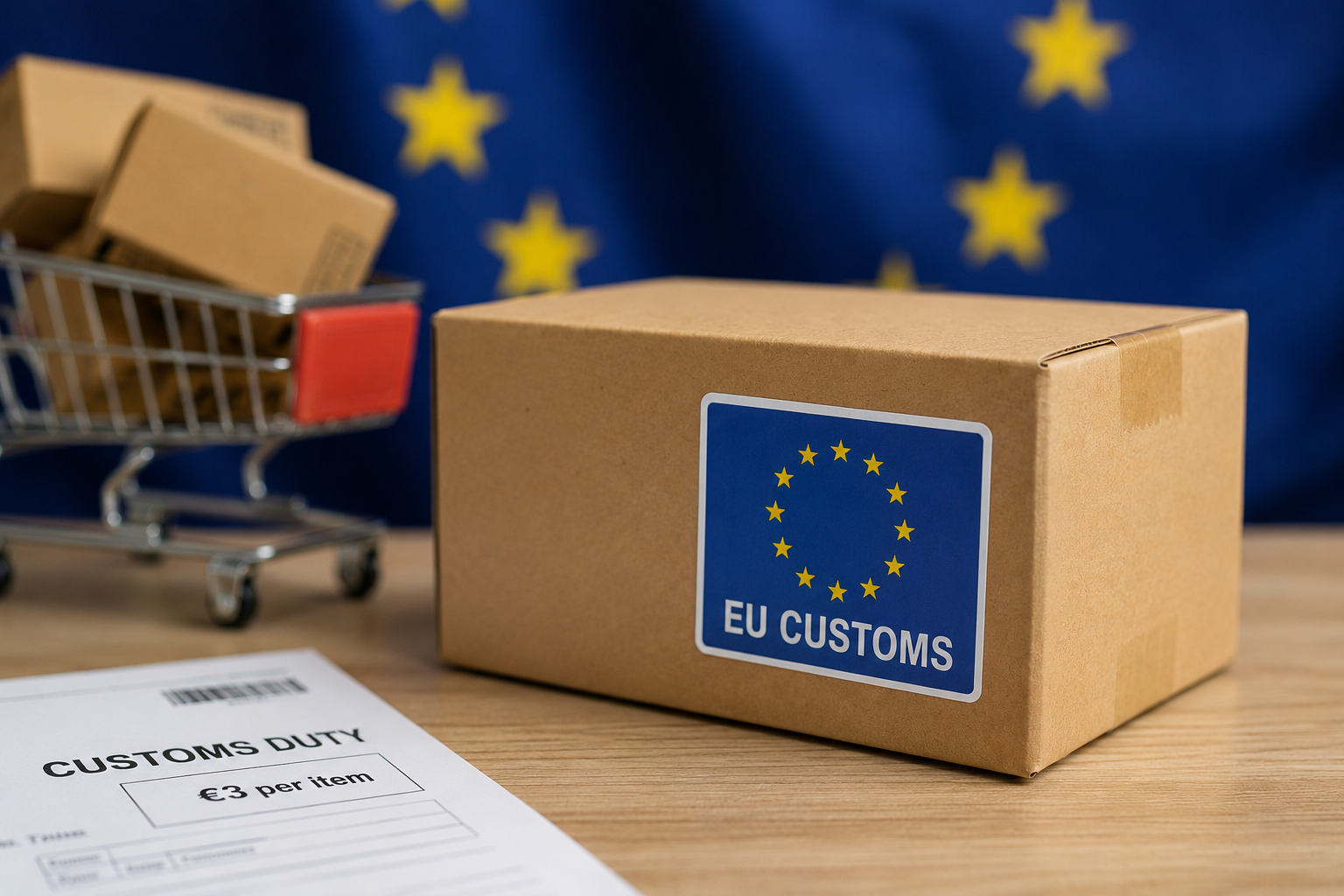
The European Union has introduced one of the most important customs changes for cross-border e-commerce in years. From 1 July 2026, low-value goods imported from outside the EU are no longer covered by the previous €150 duty-free exemption. Instead, Council Regulation (EU) 2026/382 introduces a temporary fixed customs duty of €3 per customs item for e-commerce imports.
The measure will apply until 1 July 2028, when the EU Customs Data Hub is expected to allow customs authorities to apply the standard Common Customs Tariff to each imported product based on its Harmonized System code.
For consumers, the change may look small at first. A €3 duty does not appear significant compared with the price of many online purchases. But for low-value baskets containing several different categories of goods, the impact can quickly become substantial. A parcel containing four different customs classifications may generate a €12 duty instead of a single €3 charge.
For logistics companies, online platforms and customs brokers, the reform is much more than a tax adjustment. It changes the economics of direct-to-consumer imports and may accelerate a shift from intercontinental air parcels toward sea freight, rail transport and European warehouse-based distribution.
Why the EU Is Changing the Rules
The previous €150 duty-free threshold was designed for a different era of trade. It made sense when cross-border small parcels were a limited part of total commerce. But the rapid growth of platforms such as Shein, Temu, AliExpress and other low-cost marketplaces has transformed the scale of the market.
Low-value parcels imported into the EU increased from 4.6 billion in 2024 to almost 5.9 billion in 2025. That means Europe was receiving roughly 16 million low-value shipments every day. More than 90% of these parcels originated from China.
European policymakers argue that the old model created unfair competition for EU-based retailers, which must comply with stricter tax, labor, product safety and environmental requirements. Customs authorities have also raised concerns about undervaluation, incorrect product descriptions and unsafe goods entering the single market.
The new duty is therefore intended not only to raise revenue, but also to restore a more balanced competitive environment.
The Duty Applies by Customs Item, Not by Parcel
The most important operational detail is that the €3 duty is not calculated simply per physical parcel.
It applies to each customs item or declaration line inside the shipment. In practice, this means that several identical goods with the same customs classification can be treated as one customs line, while different product categories trigger separate charges.
For example, five identical cotton T-shirts may generate one €3 customs duty. But a parcel containing a cotton T-shirt, a polyester shirt, a watch and a cosmetic product would require four separate customs lines, creating a total duty of €12.
This distinction is critical for marketplaces and sellers. They can no longer rely on simplified parcel-level assumptions. Product data, tariff classification and customs descriptions must become much more accurate.
For logistics providers, this will increase the importance of digital customs systems. Couriers, postal operators and fulfillment platforms will need real-time connections between product catalogues, checkout systems, customs declarations and duty calculation tools.
As K2Cargo News previously reported in “AI Is Transforming Europe’s Logistics Industry”, digital technologies are becoming a central part of modern transport operations. The new EU customs regime shows why that trend is accelerating: without accurate data, logistics companies will face higher compliance risks and more border delays.
Air Cargo May Lose Part of Its E-Commerce Volumes
The reform is expected to affect air freight first.
For years, the direct-to-consumer model relied heavily on fast intercontinental air transport. Small parcels could move from Asian warehouses directly to European consumers while benefiting from the duty-free threshold. This made low-value online orders commercially viable even when shipped one by one.
The new €3 duty changes that equation.
For very cheap goods, especially fast fashion, accessories, cosmetics and small consumer products, the fixed duty may represent a significant share of the final price. This could reduce the attractiveness of sending individual parcels by air directly to consumers.
As a result, more platforms may shift toward bulk imports through traditional B2B channels. Goods can be shipped in larger consolidated lots by sea or rail, cleared through customs in Europe, stored in regional warehouses and then delivered to consumers as intra-EU shipments.
This does not mean that e-commerce air cargo will disappear. High-value, urgent and premium products will still move by air. But the lowest-value segment may increasingly migrate toward slower and cheaper supply chains.
European Warehouses Could Benefit
One of the biggest winners may be the warehouse sector inside the EU.
If platforms move from direct parcel shipping to bulk import models, they will need more distribution centers, cross-docking facilities and fulfillment hubs in Europe. Countries such as Poland, Hungary and Cyprus are already being discussed as potential beneficiaries because of their location, cost structure and role in regional distribution.
Once goods are imported and customs-cleared in the EU, subsequent sales to final consumers are treated as intra-European movements. This makes the logistics model more similar to traditional retail distribution and less dependent on millions of small customs declarations.
For third-party logistics providers, this creates new opportunities. Demand may increase for bonded warehouses, fulfillment centers, customs brokerage, returns management, inventory control and last-mile distribution.
The trend also fits a broader shift in global logistics. Large companies are trying to control more parts of the supply chain rather than relying on fragmented transport models. K2Cargo News recently analyzed this trend in CMA CGM Buys FedEx Supply Chain: Impact on US Logistics, where the focus was on how major logistics groups are building integrated ecosystems covering transport, warehousing and distribution.
Italy Delays Its National €2 Parcel Charge
Italy offers an important example of how sensitive this reform is for national logistics markets.
A separate national €2 charge on low-value non-EU parcels, which would have increased the total cost to €5 per shipment, has been suspended until 1 October 2026. The delay followed warnings from the logistics sector about possible diversion of air cargo flows away from Italian airports.
According to industry reports, Confetra modeled a scenario in which Italy could lose a significant share of e-commerce air cargo to alternative European hubs such as Liège, Frankfurt and Schiphol. Such a shift would risk weakening the position of Malpensa and Fiumicino in the fast-growing e-commerce logistics segment.
This shows that customs policy does not affect only online shoppers. It can also influence airport competitiveness, cargo routing, warehouse investment and the location decisions of global platforms.
Returns and DDP Models Will Become More Important
The reform will also change the way returns and consumer payments are handled.
Before 2026, many non-EU e-commerce shipments used DAP terms, where duties and taxes could be paid by the buyer at delivery. Because many low-value parcels were duty-free, this did not create major friction.
With the new customs duty, this model becomes riskier. A consumer who orders several low-cost items may face duties, additional VAT calculations and courier handling charges at the door. If the added cost is higher than expected, refusal rates may increase.
Returns are especially problematic for low-value fashion and consumer goods. International return logistics can cost more than the product itself, making reverse flows economically unattractive.
This will push more platforms toward DDP models, where duties and taxes are calculated and paid at checkout. For consumers, this creates price transparency. For sellers, it requires much stronger integration between product data, customs classification, VAT treatment and courier systems.
What This Means for the Logistics Market
The removal of the €150 duty-free threshold marks a turning point for European e-commerce logistics.
For consumers, prices for ultra-cheap non-EU goods may rise. For platforms, the direct parcel model becomes less attractive. For air cargo operators, some low-value e-commerce volumes may shift to sea, rail and warehouse-based distribution. For European logistics providers, the reform could create new demand for fulfillment, customs and inventory management services.
The most important change is structural. The EU is moving away from a model where millions of small parcels entered the single market with limited customs costs. Instead, Europe is forcing platforms and sellers to organize their supply chains more formally, with better data, clearer classification and more responsibility for compliance.
The transition will not be smooth. Customs systems, couriers, online marketplaces and consumers will all need time to adapt. But the direction is clear: low-value e-commerce imports into Europe will no longer operate under the same cost structure that supported the previous boom.
For logistics companies, the winners will be those able to combine customs expertise, digital tools, warehousing capacity and flexible transport solutions. The new duty may begin as a €3 charge, but its real impact will be measured in how it reshapes the flow of goods into the European market.