

Period: February–June 2026
On February 28, 2026, the United States and Israel launched large-scale strikes against military and political targets in Iran, which led to the death of Supreme Leader Ali Khamenei and escalated into a full-scale war. In response, Iran announced the closure of the Strait of Hormuz, a critical maritime chokepoint through which around 20% of global seaborne oil and liquefied natural gas shipments pass.
The United States responded with a naval blockade, followed by mutual attacks on commercial vessels. In May and June 2026, the parties reached a temporary ceasefire agreement that included the reopening of the strait. However, logistics networks and energy markets remain unstable.
Key Facts: Number of Ships Attacked
Iran’s Actions
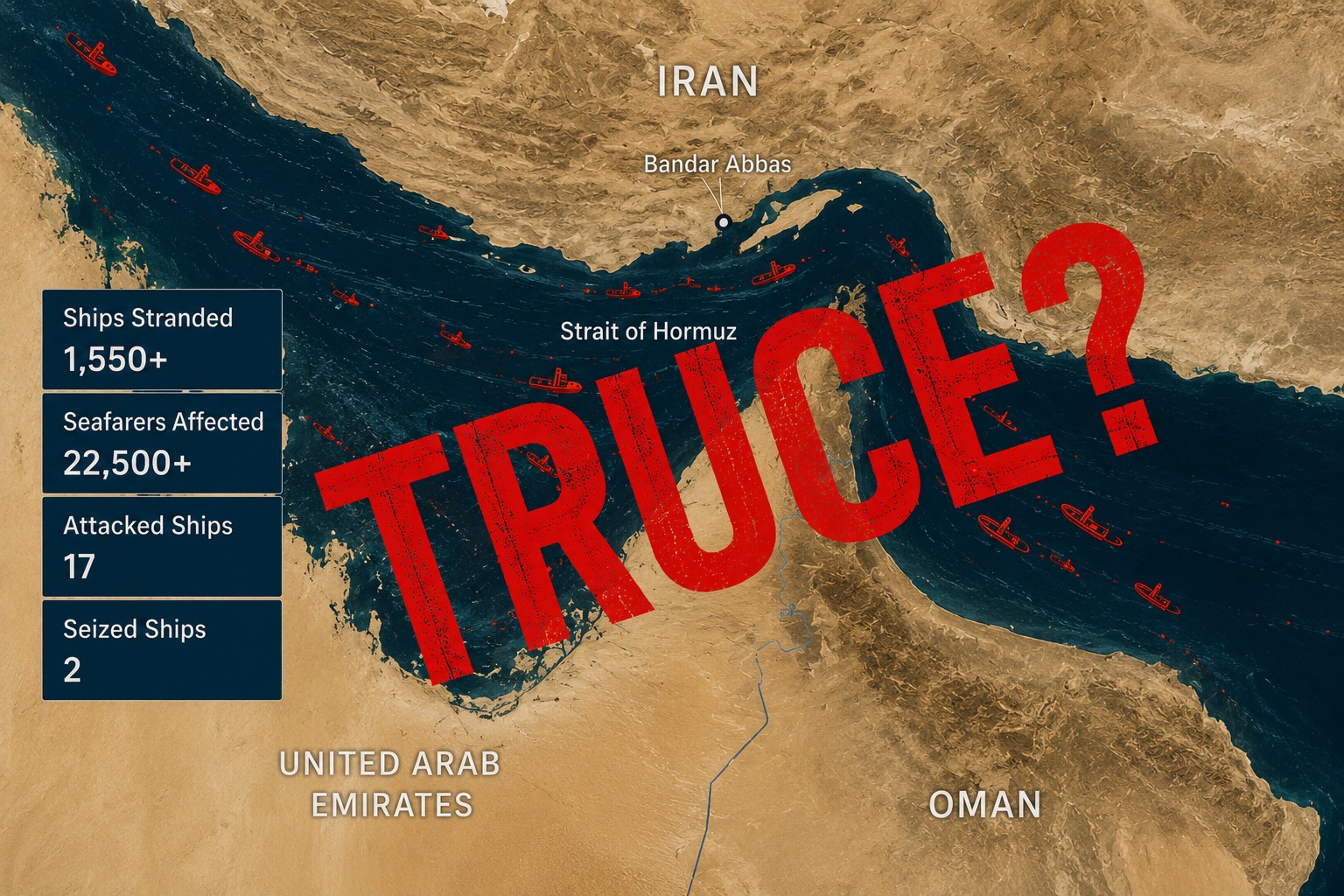
Since the beginning of the conflict, Iran has attacked dozens of merchant vessels using missiles, drones, artillery fire, and vessel seizures. According to consolidated estimates, at least 17 commercial ships were damaged during the crisis, seven of which were abandoned by their crews. Iran also captured two merchant vessels. These attacks resulted in the deaths of at least 14 seafarers.
The International Maritime Organization reported that around 2,000 commercial vessels and 20,000 seafarers were stranded in the Persian Gulf due to the closure of the strait. Around 400 vessels were waiting in the Gulf of Oman for permission to transit. According to Carra Globe, by May 8, more than 1,550 ships with 22,500 seafarers remained blocked near the entrance to the strait, while traffic had fallen to roughly 5% of prewar levels.
U.S. Actions
On April 13, the United States imposed a naval blockade and began intercepting vessels heading to Iran. According to U.S. Central Command, by mid-May, 85 vessels had been stopped, three had been seized, and 26 had managed to bypass the blockade.
The blockade was costly for Tehran: President Donald Trump stated that it was costing Iran $500 million per day, while the Pentagon estimated Iran’s lost oil revenue at $4.8 billion by May 1. In response, Iran seized two cargo vessels, further escalating the crisis.
Financial Losses
Iran
Iran’s losses from the blockade amounted to at least $4.8 billion in lost oil revenue by May 1, with daily losses estimated at $500 million.
The economic crisis was worsened by the suspension of oil and gas exports. Brent crude exceeded $120 per barrel, forcing major energy companies, including QatarEnergy, to declare force majeure.
As foreign currency revenues declined, Iran faced rising food and energy prices, as well as import restrictions.
Persian Gulf States and the Global Economy
The blockade sharply reduced oil exports from Kuwait, Iraq, Saudi Arabia, and the UAE. Production in these countries fell by 6.7 million barrels per day by March 10 and by more than 10 million barrels per day by March 12. This loss of capacity triggered a surge in oil and LNG prices.
The UN and UNDP estimated that the economic damage to Arab countries could reach $120–194 billion due to higher energy prices, transport costs, and inflation.
In Europe, the Dutch TTF gas benchmark doubled, exceeding €60/MWh, while energy companies warned of recession risks caused by rising prices. The decline in maritime trade also triggered container shortages and higher freight rates.
Asian economies suffered the greatest impact: analysts estimate that 80–84% of the direct effects of the blockade were absorbed by East Asia. Japan and South Korea relied on strategic reserves, China had about 35 days of gas reserves, while Taiwan and India had only 11 and 20–25 days respectively.
The blockade also drove up food and fertilizer prices. Supply disruptions caused food prices in Gulf countries to jump by 40–120%, creating risks for water access and food security.
Other Countries
The United States incurred significant costs related to the military campaign and humanitarian support for allies.
Countries less dependent on Persian Gulf oil, including Norway, Brazil, and Venezuela, benefited from higher prices and increased market share.
Insurance companies introduced war-risk surcharges, increasing the cost of insuring ships and cargo.
Consequences of the Blockade
Global energy crisis. The closure of the strait and reduced production caused one of the largest oil supply disruptions in history. Brent and WTI rose by 8–20%, while gas and fertilizer prices increased sharply.
Disruption of global supply chains. More than 1,550 ships and 22,500 seafarers were stranded near the strait. Container lines including Maersk, MSC, CMA CGM, and Hapag-Lloyd suspended transits. The partial paralysis of logistics caused shortages of raw materials and components for the automotive, pharmaceutical, electronics, and other industries.
Higher transport costs. Insurance premiums and freight rates rose by around 30%, while alternative routes added 10–14 days to transit times and significantly increased fuel costs.
Social consequences. Higher energy prices drove up the cost of food and services, strengthening inflationary pressure on households, especially in developing countries.
Military and environmental risks. The war involved numerous attacks on infrastructure. According to the IEA, more than 40 energy facilities were severely or very severely damaged.
Future Scenarios and the Ceasefire
Ceasefire and Reopening of the Strait
On June 15, 2026, the United States and Iran announced a temporary agreement intended to reopen the Strait of Hormuz. According to Reuters, the preliminary agreement includes a ceasefire, further talks on Iran’s nuclear program, and a gradual easing of sanctions. It also extends the previous ceasefire by another 60 days.
Under the deal, Iran agreed to allow free passage through the strait for 60 days, after which it plans to charge navigation fees. The draft agreement also reportedly places navigation services under joint Iranian-Omani control.
The agreement allows shipping traffic to partially resume, but the process is complicated by the need for demining, extensive damage to ports and infrastructure, and continued fighting in Lebanon.
Possible Scenarios
Strengthening of the ceasefire. If the United States, Israel, and Iran agree on the next stages, including oversight of Iran’s nuclear program and the withdrawal of armed groups from Lebanon, the blockade could be fully lifted. This would restore oil and gas flows, reduce prices, and return ships to standard routes.
Partial recovery. If the ceasefire drags on and the parties continue using the strait as leverage, Iran may retain control over navigation and collect fees. In this scenario, logistics networks would adapt to a prolonged restriction, while shipping companies would lock in alternative routes.
Collapse of negotiations. If hostilities resume, Iran could close the strait again. Attacks on vessels would likely continue, while the United States could reinstate the blockade and resume strikes on infrastructure.
Changes in Logistics After the Conflict
Alternative routes. The closure of Hormuz and the blockade of the Red Sea forced shipping companies to reroute. The main alternative became the route around the Cape of Good Hope, adding 10–14 days and 3,500–4,000 nautical miles to Asia-Europe and Asia-Middle East services.
Overland and multimodal routes. Saudi Arabia increased the use of the East-West Pipeline and the Red Sea port of Yanbu for oil exports, bypassing Hormuz. For other goods, routes from the UAE, Saudi Arabia, or Oman westward via Suez are being developed, though capacity remains limited.
Air freight. Air cargo was used for urgent shipments despite high costs. DHL launched dedicated cargo flights between Asia and the United States/Europe.
Relocation of logistics centers. Companies accelerated the development of warehouses and micro-fulfillment centers in Middle Eastern countries with access to alternative routes.
Supply chain diversification. Companies are reassessing just-in-time models, increasing inventories, and moving production closer to consumers. Pharmaceutical analysts note that resilience now requires backup capacity and localized production of active pharmaceutical ingredients.
Regional integration. Regional agreements may emerge between Gulf states and key importers such as China, India, and Europe to create guaranteed corridors and jointly manage the strait.
Participants and Beneficiaries of the Ceasefire
| Participant | Benefits After the Ceasefire | Risks and Losses |
|---|---|---|
| Iran | Partial sanctions relief, restoration of oil and petrochemical exports, renewed foreign currency inflows, preservation of the political regime | Damaged infrastructure, multibillion-dollar war losses, risk of renewed sanctions and military action |
| United States | End of an expensive military campaign, reduced pressure on oil markets, political gains from achieving a ceasefire | No full regime change in Iran, continued threat from Iran’s nuclear program |
| Israel | Reduced threat of direct Iranian missile attacks, temporary stabilization of the security situation | Limited freedom of action against Iran and its allies, persistence of regional threats |
| Saudi Arabia | Restoration of oil exports through the Strait of Hormuz, reduced infrastructure risks | Need for further investment in alternative supply routes |
| UAE | Return of cargo flows through Jebel Ali, Khalifa, and Fujairah ports, recovery of transit business | Risk of another crisis and continued elevated insurance rates |
| Qatar | Restoration of LNG and petrochemical exports, easing of force majeure restrictions | Need to restore damaged energy infrastructure |
| China | Resumption of stable oil and LNG supplies, lower energy import costs | Stronger push to diversify energy suppliers |
| India | Stabilization of oil supplies from the Persian Gulf, lower freight costs | Continued dependence on Middle Eastern energy supplies |
| Japan and South Korea | Reduced risk of energy shortages, restoration of logistics chains | Expansion of strategic reserve programs |
| European Union | Lower oil and gas prices, reduced inflationary pressure | Need to accelerate the development of alternative energy sources |
| Shipping companies | Higher revenue from elevated freight rates during the crisis, new routes and services | Losses from delays, damaged vessels, and schedule disruptions |
| Insurance companies | Sharp increase in war-risk insurance premiums | Claims related to damaged ships and cargo |
| DHL, UPS, FedEx, and air cargo operators | Higher demand for urgent air freight, launch of new routes | Decline in excess revenue after maritime transport normalizes |
| Norway, Brazil, Venezuela, and other oil-producing countries outside the region | Additional profits from high oil prices during the crisis | Possible oil price correction after Hormuz reopens |
| Houthis and other proxy groups | Temporary increase in influence over maritime routes | Stronger international military pressure and sanctions |
What Comes Next for the World After the Conflict?
Long-term diversification of routes and energy sources. The crisis showed that dependence on a single maritime chokepoint makes the global economy vulnerable. Investment is expected to increase in alternative pipelines, transcontinental railways, LNG terminals in Africa and the Mediterranean, and renewable energy.
Restructuring of global logistics. Companies will build micro-fulfillment centers, increase inventories of raw materials and components, and implement risk analysis systems. Governments will subsidize strategic reserves and support domestic producers.
A new security architecture. The ceasefire could lead to the creation of a Persian Gulf navigation authority involving Iran, Oman, the United States, and international organizations. Freedom of navigation will become a permanent monitoring issue, while the presence of international naval forces may become long-term.
Political consequences. The survival of the Iranian regime strengthened its domestic control but also intensified internal unrest. Israel remains without a clear solution to Iran’s nuclear issue and faces the strengthening of Shiite groups in Lebanon. The United States preserved its military presence in the region but faces criticism over unfinished objectives. The prospects for full normalization remain uncertain.
Socioeconomic impact. Many countries, especially developing economies, experienced higher fuel and food prices, triggering inflation and protests. In the post-conflict period, governments will need to soften the impact through subsidies, fiscal relief, and social support measures.
Conclusion
The blockade of the Strait of Hormuz during the U.S.-Israeli war against Iran became the largest disruption to global energy and trade flows since the second oil shock. It damaged more than a dozen commercial vessels, led to the detention of hundreds of ships, caused billions of dollars in losses for regional economies, created a months-long logistics and energy crisis, and exposed the vulnerability of the global economy to local conflicts.
The ceasefire offers hope for the restoration of transport flows, but future stability will depend on compliance with agreements, demining of the waterway, and the creation of a new collective security framework. In the long term, the crisis will accelerate energy diversification, the restructuring of global supply chains, and the strengthening of international cooperation mechanisms.