

Explosion Occurred While the Tanker Was at Anchor
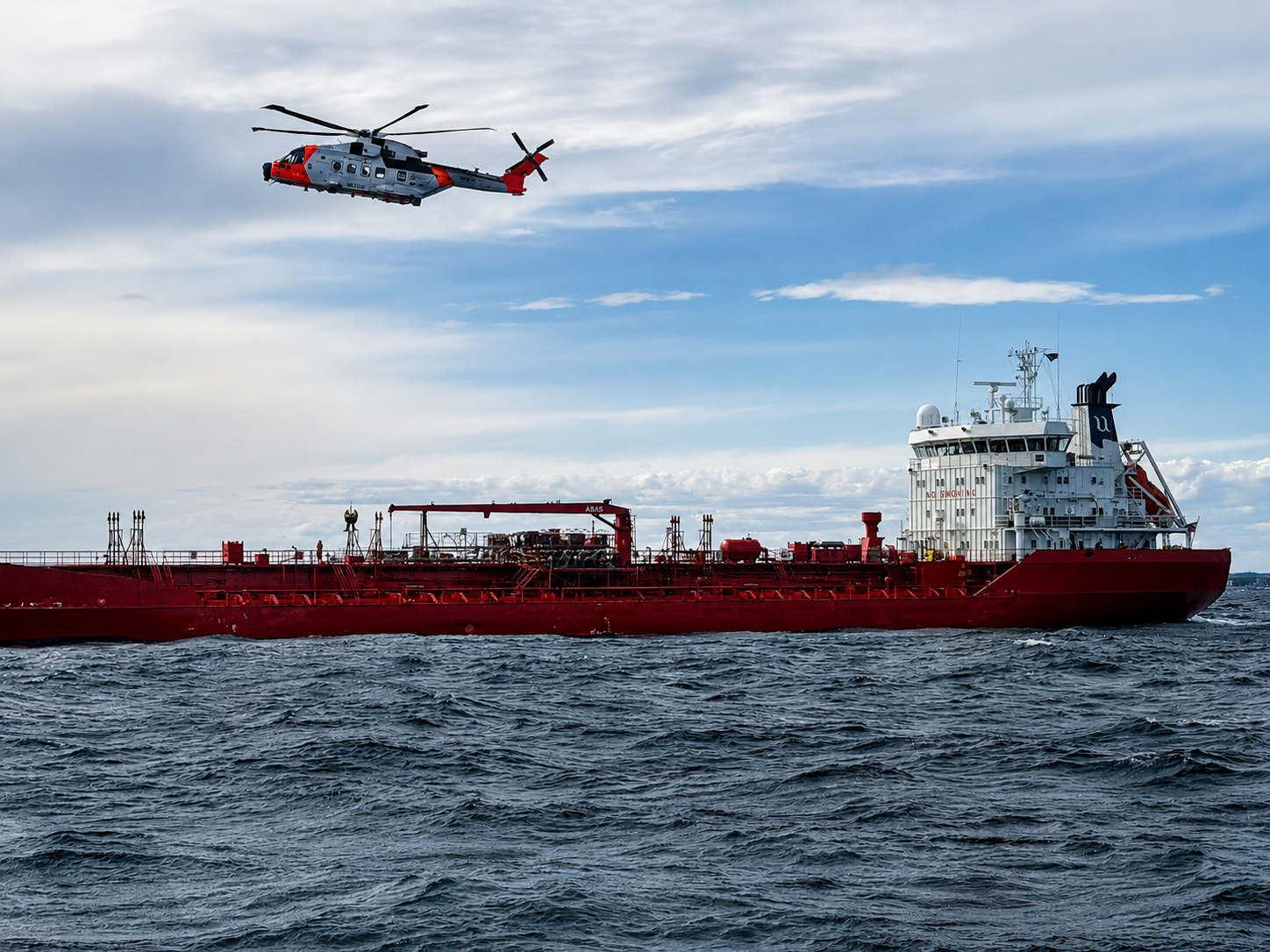
A major emergency response was launched off southeastern Norway on July 28 after an explosion and fire aboard the chemical tanker Bergstraum.
The vessel was anchored in the Hvaler area near Skjærhalden, south of the entrance to the Oslofjord. Operator Utkilen said the tanker was at anchor outside Fredrikstad rather than sailing when the incident occurred.
The first emergency reports came at around 15:30 local time.
Heavy smoke followed a loud explosion.
The initial response was particularly large because of the nature of the cargo: Bergstraum was carrying sulfuric acid.
Damage to the cargo containment system could have transformed a local onboard fire into a much more serious marine emergency.
That scenario did not materialise.
Sulfuric Acid Cargo Tanks Remained Intact
Available information indicates that the explosion occurred in an empty tank and did not directly affect the compartments containing sulfuric acid.
No release of hazardous substances into the sea was reported.
That distinction is critical when assessing the severity of the accident.
Sulfuric acid is a hazardous and highly corrosive chemical cargo. The environmental consequences of a release would depend on factors including the quantity, concentration and local water conditions, but any significant uncontrolled spill would require an immediate emergency response.
In the Bergstraum incident, the cargo containment system remained intact according to the information available.
The event therefore remained primarily an onboard fire and technical emergency rather than developing into a chemical spill.
Crew Began Firefighting Before Rescue Units Arrived
The crew’s initial response helped prevent the situation from escalating.
Seafarers used foam to fight the fire while external emergency forces were still travelling to the vessel.
Rescue craft, police boats, fire units and a helicopter were deployed.
Norwegian emergency agencies led the response, with Swedish maritime rescue and coastguard resources also providing assistance.
Specialist RITS firefighting personnel were brought aboard.
After the open flames had been suppressed, teams continued cooling the vessel’s structure to prevent reignition.
This is particularly important following explosions in enclosed shipboard spaces, where heated metal and residual vapours can remain dangerous even after visible flames disappear.
All 15 Crew Members Were Uninjured
Bergstraum was carrying a crew of 15 seafarers from Baltic countries and the Philippines.
All were accounted for.
No injuries were reported and evacuation was ultimately not required.
Emergency services had nevertheless prepared rescue resources in case conditions deteriorated.
The absence of casualties is particularly significant given the force of the initial explosion and the amount of smoke reported around the vessel.
Once the fire was under control, emergency teams shifted their focus toward structural cooling, monitoring the cargo system and determining whether the tanker could be moved safely.
Bergstraum Is a 30-Year-Old Chemical Tanker
Bergstraum was built in Norway in 1996.
The double-hulled chemical tanker has a deadweight of approximately 9,500 tonnes. It is roughly 124 metres long and around 19 metres wide.
The vessel is registered in the Norwegian International Ship Register and classed by DNV.
Bergen-based Utkilen manages the ship commercially and technically, while ownership is held by group subsidiary Utkilen Shipping.
Utkilen specialises in chemical transportation and operates a fleet of dedicated tankers.
Chemical tankers form a specialised shipping segment because different cargoes can require specific tank materials, temperature control, cleaning procedures and segregation.
K2Cargo.News recently reported on changes in the sector when Eastern Pacific Shipping exited the chemical tanker segment, selling a fleet of 14 specialised vessels.
An Empty Tank Does Not Mean There Is No Explosion Risk
One of the most important aspects of the incident is that the explosion occurred in an empty tank.
To a non-specialist, this may appear counterintuitive.
If a tank contains no cargo, it might seem that it should contain no significant hazard.
In practice, enclosed spaces aboard tankers can remain hazardous even after cargo has been discharged.
Residual vapours, contamination or other gas mixtures may remain inside. The precise mechanism behind the Bergstraum explosion is still subject to investigation, so attributing it to any particular substance would be premature.
This is why work in and around cargo tanks requires gas testing, ventilation, formal permits for hot work and strict shipboard safety procedures.
An explosion in an adjacent space can potentially damage pipelines, bulkheads, ventilation or electrical systems even when the principal cargo remains contained.
That escalation was avoided in this case.
Cause of the Accident Is Still Being Investigated
Utkilen announced an internal investigation following the incident.
The company is expected to examine the sequence of events, equipment condition and circumstances surrounding the explosion and fire.
Norwegian authorities are also examining what happened.
Until that process is complete, drawing a firm conclusion about a specific technical defect or procedural failure would be premature.
This is particularly important in chemical shipping, where a similar outward event — such as an explosion in an empty tank — can result from very different underlying mechanisms.
Investigators will need to determine not only the immediate ignition source but also how a potentially hazardous atmosphere developed in the affected space.
Bergstraum Needed Assistance in 2022
This is not Bergstraum’s first significant technical incident in recent years.
In November 2022, the tanker lost propulsion in Harøyfjorden on Norway’s western coast following a technical failure that resulted in an engine blackout.
The vessel was approximately 0.6 nautical miles from shore.
Calm weather helped prevent a grounding risk from escalating, and the Norwegian Coast Guard established a tow to Elnesvågen.
That incident ended without major consequences.
The latest explosion will nevertheless bring renewed attention to the technical history of a vessel built three decades ago.
Age alone, however, does not establish that a ship is unsafe.
Commercial vessels can remain in service for decades when they meet classification requirements and receive appropriate maintenance and upgrades. Any connection between the 2022 and 2026 events would therefore require evidence from the investigation.
Chemical Cargoes Require Multiple Layers of Protection
The accident illustrates why chemical transportation requires more complex safety measures than many conventional bulk cargoes.
The central principle is that one failure should not immediately result in loss of control over the cargo.
Chemical tankers therefore use measures such as double hulls, specialised cargo tanks, gas detection, ventilation, emergency firefighting, cargo segregation and strict maintenance procedures.
Crew training is equally important.
In the Bergstraum case, the crew’s ability to begin firefighting during the first critical minutes helped contain the situation before external teams reached the vessel.
Reaction time matters particularly in chemical shipping, where damage to a cargo pipeline or tank can change the nature of an emergency very quickly.
A Major Environmental Accident Was Avoided
The most important outcome was that the sulfuric acid remained contained.
A significant chemical release would have made the operation considerably more complex.
Emergency teams would have needed to manage the fire, protect the crew, contain pollution and defend the surrounding coastline at the same time.
The Hvaler area has sensitive coastal environments, while the incident occurred close to the approaches to the Oslofjord.
Confirmation that no hazardous leak had occurred was therefore one of the main factors preventing the event from developing into a large-scale environmental emergency.
Environmental monitoring nevertheless remains important after incidents involving hazardous cargo even when no visible release is detected.
The Cargo Is Only One Part of the Risk
Bergstraum also demonstrates a broader feature of hazardous-goods shipping: serious risks can exist even when the cargo tank itself remains sealed.
A fire can disable propulsion.
An explosion can damage structural components.
Smoke can prevent the crew from operating normally.
Loss of control close to shore can create a grounding risk.
Chemical transport safety therefore depends on the integrity of the entire vessel rather than solely on the tank containing the hazardous substance.
That is why the Bergstraum investigation matters beyond this single voyage.
Its findings may indicate whether existing technical and operational safeguards were sufficient or whether additional measures are required.
The Outcome Was Far Better Than the Worst-Case Scenario
During the first minutes after the explosion, the incident appeared potentially severe.
A chemical tanker was carrying sulfuric acid, heavy smoke was visible and emergency services prepared for the possibility that the crew might have to be evacuated.
Within hours, the picture was substantially less serious.
All 15 seafarers were safe, cargo containment remained intact, no hazardous spill was reported and the open fire was extinguished.
The central question is now what caused the explosion.
For maritime logistics, the incident is another reminder that even a local accident aboard a hazardous-cargo tanker must initially be treated as a potentially major emergency.
In this case, shipboard containment, the crew’s response and rapid deployment of rescue resources prevented the incident from developing into something considerably more serious.