


For much of the post-Soviet period, Eurasia’s transport map remained relatively unchanged. The main freight flows between Europe and Asia relied on infrastructure inherited from the Soviet era, while Russia played the dominant role in the transit of goods, energy resources, and raw materials. However, recent geopolitical developments have accelerated a fundamental transformation of Eurasian logistics, forcing governments and businesses to rethink traditional trade routes.
At the center of this shift is the Middle Corridor — a transport network linking China, Central Asia, the Caspian Sea, the South Caucasus, and Europe. Only a few years ago, the route was viewed as a secondary alternative to established transit channels. Today, it is increasingly emerging as one of the most important components of the new Eurasian economy.
Kazakhstan and Georgia occupy a particularly important position within this system. Once regarded as peripheral actors in global politics, both countries are rapidly becoming strategic connectors between some of the world’s largest economic centers.
A New Logic of Global Trade
For decades, globalization was driven primarily by efficiency. Businesses focused on the fastest and cheapest transportation routes, while political risks often remained a secondary consideration. Recent geopolitical crises, however, have exposed the vulnerabilities of this model.
The war in Ukraine, growing tensions between Russia and the West, uncertainty surrounding Taiwan, and disruptions in the Red Sea and the Middle East have pushed governments and businesses to prioritize supply chain resilience.
Today, reliability has become just as important as cost. As a result, alternative transport corridors capable of reducing dependence on specific countries or regions are gaining strategic value.
The Middle Corridor fits perfectly into this broader diversification strategy.
Kazakhstan as Central Asia’s Logistics Powerhouse
Kazakhstan has long occupied a unique position in the regional economy. The country possesses the largest reserves of oil, uranium, and non-ferrous metals in Central Asia, while also benefiting from a strategic location between China and Europe.
In recent years, Astana has invested heavily in railway modernization, the expansion of the Caspian ports of Aktau and Kuryk, and the development of multimodal logistics centers.
These investments are not aimed solely at increasing transit volumes. Kazakhstan seeks to establish itself as an independent logistics hub capable of playing a more influential role in global trade.
The rapid growth of freight traffic along the Trans-Caspian International Transport Route demonstrates that this strategy is already delivering results.
Georgia as Europe’s Gateway
The success of the Middle Corridor, however, depends heavily on the South Caucasus.
After crossing the Caspian Sea, cargo moves through Azerbaijan before entering Georgia on its way to Black Sea ports and European markets. This makes Georgia’s infrastructure increasingly important.
The ports of Poti and Batumi, railways, highways, and digital logistics platforms are becoming part of an integrated network connecting Central Asia with the European Union.
While Georgia’s geopolitical importance was once viewed primarily through a security lens, its role as a transit hub is now equally significant.
At a time when access to reliable transport routes has become a strategic asset, Georgia’s transit geography provides considerable leverage.
World Bank: The Window of Opportunity Is Open Now
According to a recent World Bank report, the present moment represents the best opportunity to unlock the full potential of the Middle Corridor. New data and economic modeling presented in the study confirm the corridor’s long-term viability and growing strategic relevance.
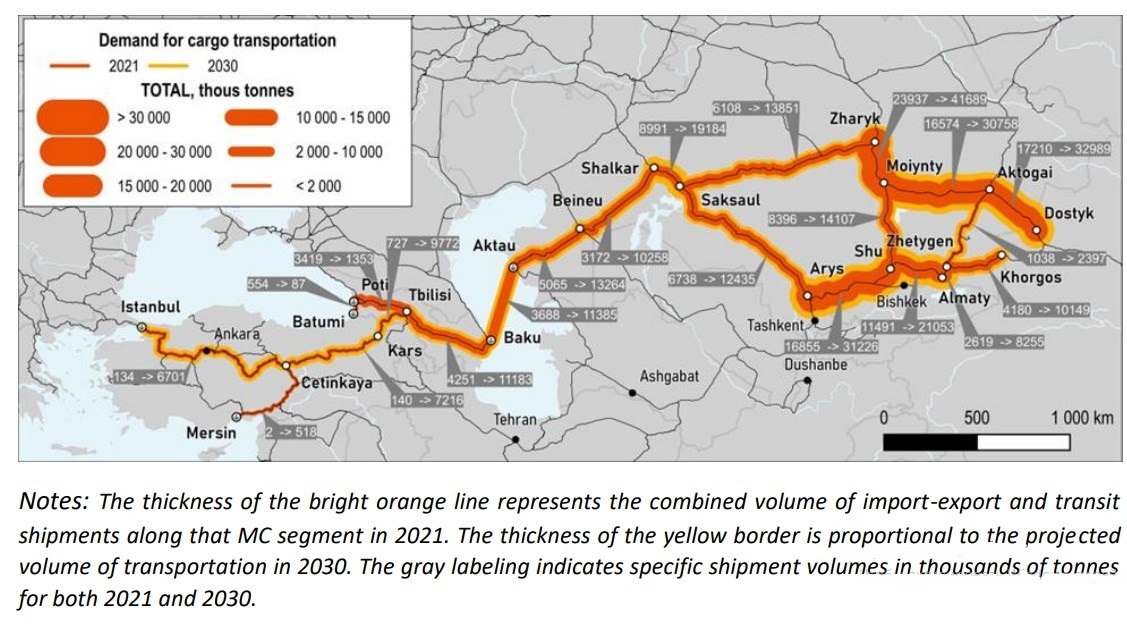
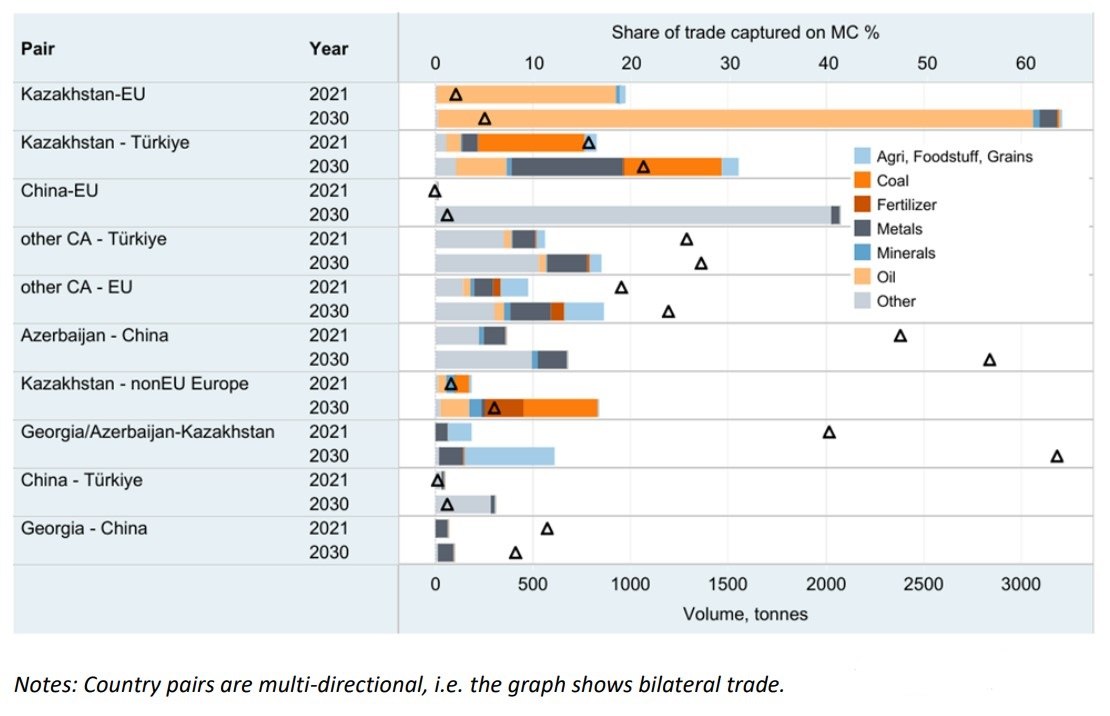
The report projects that freight traffic along the Middle Corridor via the Caspian Sea could nearly triple by 2030, reaching approximately 11 million tonnes annually. The strongest growth is expected in trade flows between Europe and Kazakhstan, as well as between Europe and China.
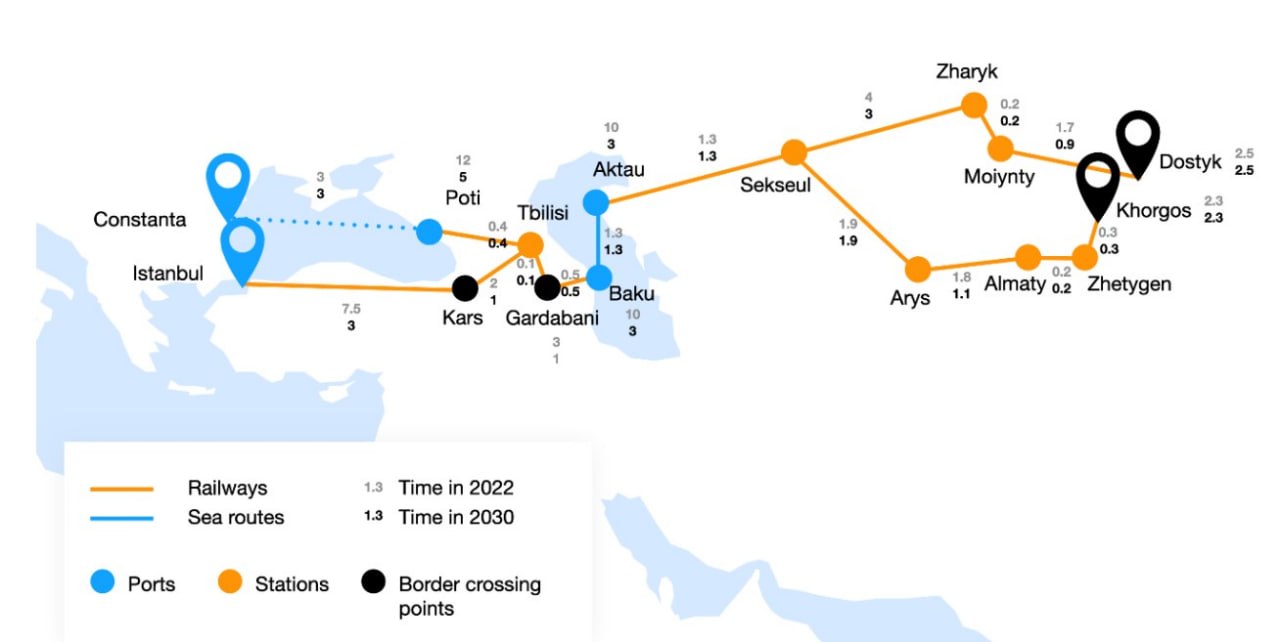
Equally important is the issue of transit time. Currently, the Middle Corridor often takes nearly three times longer than the Northern Route through Russia and offers little advantage over maritime shipping. However, the World Bank concludes that a combination of targeted infrastructure investments and operational reforms could cut transit times by roughly half before the end of the decade.
The study emphasizes that future success will depend not only on new infrastructure but also on stronger coordination among Kazakhstan, Azerbaijan, and Georgia. Harmonized tariffs, digitalized customs procedures, simplified border controls, and integrated corridor management are viewed as essential steps toward improving efficiency.
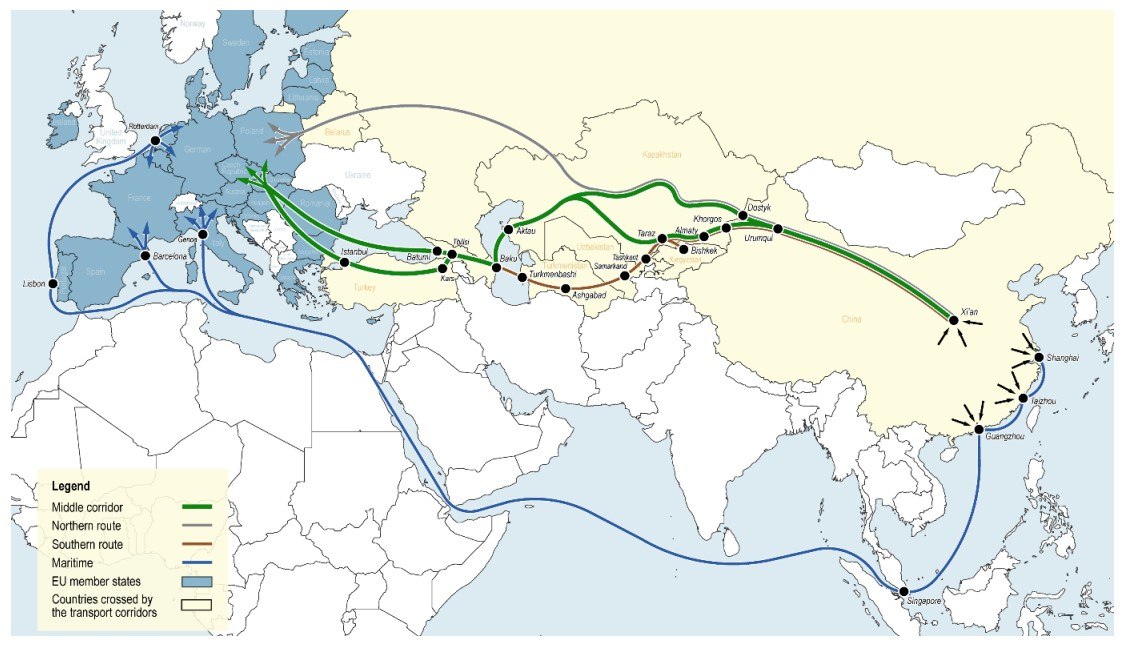
The MC among trade corridors connecting Europe and Asia
Cargo flows along the MC in 2021 and 2030
Growth until 2030 largest for trade between Europe – Kazakhstan and Europe – China
Time breakdown for MC route in 2022 and in 2030 in case of realization of the announced infrastructure development plans (in days)
In essence, the World Bank argues that the Middle Corridor should no longer be viewed merely as a transport route. Instead, it should be developed as a broader economic corridor capable of stimulating growth across both Central Asia and the South Caucasus.
Energy Security and Critical Minerals
The importance of Kazakhstan and Georgia extends far beyond transportation.
The European Union is actively seeking new sources of energy and critical raw materials required for its green transition. Kazakhstan possesses substantial reserves of uranium, copper, lithium, and rare earth elements that are becoming increasingly important for batteries, renewable energy technologies, and advanced manufacturing.
Georgia, meanwhile, provides the infrastructure and market access necessary to connect these resources with Europe and global markets.
As a result, the relationship between the two countries is not solely about logistics. It reflects the emergence of a new system of economic interdependence linking Central Asia, the South Caucasus, and Europe.
The Geopolitics of Corridors
One of the defining characteristics of today’s international system is the growing importance of infrastructure as a source of geopolitical influence.
In the past, power was measured largely through military capabilities and economic size. Today, transport corridors, ports, pipelines, digital networks, and logistics hubs increasingly shape geopolitical relevance.
Countries capable of connecting regions gain influence even without possessing major military power.
“Kazakhstan and Georgia demonstrate how countries that have traditionally not been regarded as global power centers can become indispensable elements of the world economy. In the twenty-first century, control over corridors, ports, and logistics hubs is increasingly becoming just as important as control over territory,”
— Abdulmelik Alkan, Adjunct Professor at Webster University and an expert on Eurasian geopolitics.
Kazakhstan and Georgia perfectly illustrate this transformation. Neither country is a major military power, yet both are becoming increasingly important to the functioning of Eurasian trade.
They are part of a new economic geography in which strategic significance is determined not only by size, but by the ability to facilitate the movement of goods, energy, capital, technology, and investment.
What Comes Next
Competition over Eurasia’s transport corridors is likely to intensify in the coming years. China continues to expand its Belt and Road Initiative, Europe seeks to diversify trade and resource supply chains, and Türkiye is strengthening its position as a critical transit hub between Asia and Europe.
Against this backdrop, the strategic importance of Kazakhstan and Georgia is expected to continue growing.
Their partnership is evolving beyond traditional diplomacy and becoming part of a broader restructuring of global logistics. If World Bank projections prove accurate and freight volumes along the Middle Corridor reach 11 million tonnes by 2030, Kazakhstan and Georgia could emerge not merely as transit countries, but as key architects of Eurasia’s new economic geography.
Read also: Russia & Kazakhstan Launch First Driverless Truck Route