

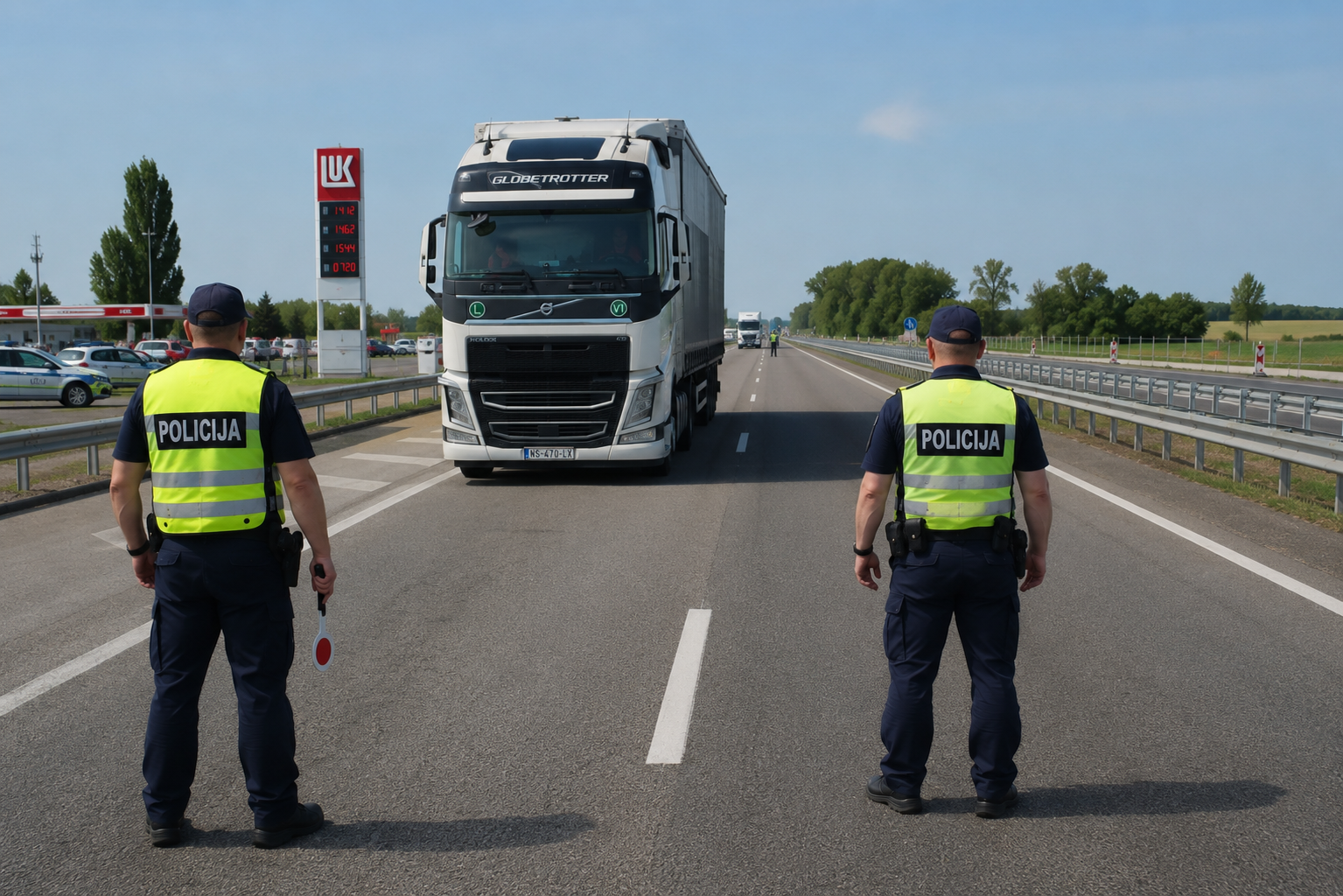
Overloaded trucks have become a systemic problem
The Lithuanian government is stepping up its campaign against overloaded trucks, which accelerate pavement deterioration and create additional road-safety risks. Road construction specialists and hauliers have discussed the problem for decades, but the existing enforcement system has covered only a very small proportion of heavy-vehicle traffic.
The Ministry of Transport and Communications has announced the “STOP Road Damage” programme, with Klaipėda selected as one of its main priorities.
The port city was chosen because it handles Lithuania’s largest concentration of freight traffic. Large numbers of trucks travel through Klaipėda every year to serve the port, terminals, warehouses and industrial facilities. As a result, violations involving gross vehicle weight and axle loads have a particularly strong impact on roads in and around the city.
Checks covered less than one percent of traffic
Available figures indicate that the previous weighing regime reached only a fraction of the vehicles passing through Klaipėda.
Around 1.4 million trucks travelled through the city last year, while the Lithuanian Transport Safety Administration inspected approximately 5,000 vehicles at the checkpoint. This means that only about 0.35% of the total freight flow was checked.
Just 13 administrative reports were issued for weight violations. The considerable difference between the number of trucks using the route and the small number of recorded offences raised questions about whether the system was capable of detecting the actual scale of overloading.
Lithuanian Transport Minister Juras Taminskas acknowledged that weak enforcement creates gaps through which violations can go unnoticed.
“When control is too weak, gaps emerge that allow violations to remain undetected.”
The Klaipėda checkpoint uses an outdated system
Truck inspections near Klaipėda are currently conducted mainly through a traditional selection process. Inspectors visually identify vehicles that appear suspicious and direct them to stationary scales.
The effectiveness of this model depends on the number of officers present, their experience and the ability to stop selected trucks safely. It cannot provide systematic control of the entire freight flow.
An automated pre-selection weighing system was launched on the route in 2010. The equipment could identify potentially overloaded vehicles while they were moving and direct only those with suspicious readings to a detailed inspection.
The system stopped operating in 2017. Its shutdown significantly reduced enforcement capacity and forced inspectors to return to visual selection.
There have been unofficial claims within the sector that pressure from some businesses may have contributed to the suspension of automatic weighing. Companies allegedly warned that cargo could be redirected from Klaipėda to Latvian ports, where similar controls were absent or less restrictive. These allegations have never been publicly confirmed by the authorities.
One in four trucks may be overloaded
Data collected by weigh-in-motion systems installed by Via Lietuva at three locations in 2024 demonstrated the possible scale of non-compliance.
The analysis indicated that approximately 25% of trucks exceeded either the permitted gross vehicle weight or an axle-load limit. In some cases, the actual weight was reportedly almost twice the legal maximum.
These results differ sharply from the figures produced by stationary inspections. They suggest that many overloaded vehicles previously passed through the road network without being checked or penalised.
Weak enforcement also creates unequal conditions for compliant hauliers. An overloaded vehicle can carry more cargo in a single journey, reduce the number of trips required and lower the operator’s cost per tonne.
Companies that follow the rules must use additional vehicles or make more journeys while respecting both gross-weight and axle-load restrictions. Stronger control is therefore also a matter of fair competition in the road-freight market.
Axle loads may be more damaging than total weight
Experts stress that the most severe road damage is not always caused by gross vehicle weight alone. Incorrect distribution of cargo between individual axles can be even more destructive.
Under the applicable limits, a heavy vehicle’s total weight generally cannot exceed 40 tonnes. The maximum load on a driven axle is 11.5 tonnes, while other axles are normally limited to 10 tonnes.
A vehicle can remain within the gross-weight limit while still exceeding the permitted load on one axle. Concentrated pressure over a relatively small contact area accelerates rutting, cracking and deformation of the pavement.
The consequences are particularly severe during summer. Asphalt becomes softer in high temperatures, allowing overloaded axles to push more deeply into the road surface. The resulting ruts can reduce vehicle stability, interfere with drainage and increase the risk of aquaplaning during rain.
Modestas Lukošiūnas, head of infrastructure maintenance at Via Lietuva, said the consequences go well beyond normal wear.
“Ruts and uneven areas appear on asphalt surfaces, along with potholes, cracks and crumbling road edges. This not only damages infrastructure but also creates risks for road safety.”
A single overloaded truck may cause damage comparable to that produced by hundreds or even thousands of passenger cars. A relatively small number of offending vehicles can therefore create substantial additional costs for road maintenance and reconstruction.
Drivers are avoiding weighing points
Even under the current limited enforcement system, some drivers deliberately avoid stationary weighing facilities. They use local roads where heavy-vehicle traffic is restricted or prohibited.
This shifts freight traffic from main roads to streets and secondary routes that were not designed to carry large numbers of heavy trucks. The result is faster pavement deterioration, more noise and greater safety risks for residents and other road users.
The problem is also visible inside Klaipėda. On one street near the fishing port, truck drivers regularly ignore a sign prohibiting heavy-vehicle traffic. Police have already issued 43 administrative reports for such violations since the beginning of the year.
The restoration of automatic weighing should make enforcement more difficult to avoid. However, monitoring will also need to cover alternative routes. Otherwise, some operators may continue diverting trucks through local roads to bypass the main control point.
Automatic weighing will return near Klaipėda
The Ministry of Transport and Communications has begun preparations to modernise the enforcement system. Tenders are being announced for new weighing equipment, while an automatic pre-selection system is expected to be reinstalled at the Klaipėda checkpoint.
The equipment will analyse trucks while they are moving and provide almost continuous monitoring of traffic travelling toward or away from the port area.
When the system detects a potential gross-weight or axle-load violation, the information can be forwarded to inspectors. The truck may then be directed to certified stationary scales for an accurate measurement and formal enforcement procedure.
While the new equipment is being procured and installed, the Lithuanian Transport Safety Administration plans to increase staffing and introduce round-the-clock operation at the checkpoint.
This will expand the number of inspections, but manual enforcement alone cannot provide full coverage. With hundreds of thousands of trucks using the route, checks based on physical stops will inevitably remain selective.
Lithuania plans 18 weigh-in-motion systems by 2028
Lithuania intends to install 18 weigh-in-motion systems on the country’s main roads by 2028.
Their operating principle will be similar to automated speed cameras. The equipment will measure a moving truck’s total weight and the load applied to each axle without requiring the vehicle to stop.
In the future, information about detected violations is expected to be transferred automatically to the national Register of Administrative Offences. This would allow Lithuania to move from selective roadside checks toward continuous monitoring of heavy-vehicle traffic.
Automation should also reduce subjective vehicle selection and make enforcement more predictable. Operators would no longer be able to rely on the absence of inspectors or the limited capacity of a stationary checkpoint.
Donatas Čygas, dean of the Faculty of Environmental Engineering and a professor of road engineering at Vilnius Gediminas Technical University, highlighted the broader importance of the system.
“Controlling the gross weight and axle loads of freight vehicles is essential because it helps ensure road safety, protects road infrastructure and supports fair competition between carriers.”
Hauliers will need tighter loading controls
Stronger enforcement will require transport operators to pay closer attention to cargo distribution.
It will no longer be sufficient to confirm that the total combination weight remains below 40 tonnes. Companies will also need to consider the load on every axle, the position of cargo inside a semi-trailer, product density, unloading sequence and the redistribution of weight after partial deliveries.
This will be particularly important for operators carrying bulk materials, steel, construction products, containers, timber and heavy industrial equipment. In these sectors, incorrect cargo positioning can produce an axle-load violation even when the total weight remains legal.
Hauliers may need to strengthen checks at loading sites, use their own weighing equipment, verify cargo documents more carefully and train drivers to identify overloading risks before entering public roads.
More intensive inspections may also increase processing times for some trucks near Klaipėda. If checkpoint infrastructure is insufficient, directing suspicious vehicles to secondary weighing could create queues. The success of the reform will therefore depend not only on technology but also on traffic management around inspection facilities.
Technology must be supported by effective penalties
Modern weigh-in-motion systems can monitor considerably more trucks than stationary checkpoints relying on visual selection. However, installing equipment alone will not automatically reduce violations.
The system will require reliable integration with public registers, rapid processing of offences, clear appeal procedures and effective collection of penalties.
Authorities must also prevent operators from learning enforcement schedules in advance or avoiding detection by using neighbouring roads.
The “STOP Road Damage” programme will test whether Lithuania can replace largely symbolic weight control with permanent monitoring covering most heavy-vehicle movements.
For compliant hauliers, the reform could create fairer operating conditions. For companies whose business model depends on overloading vehicles, automatic weighing will increase the risk of penalties, vehicle delays and the need to reorganise transport operations.
Read also: Lithuania to Introduce Kilometer-Based Road Tolls for Trucks in 2027