

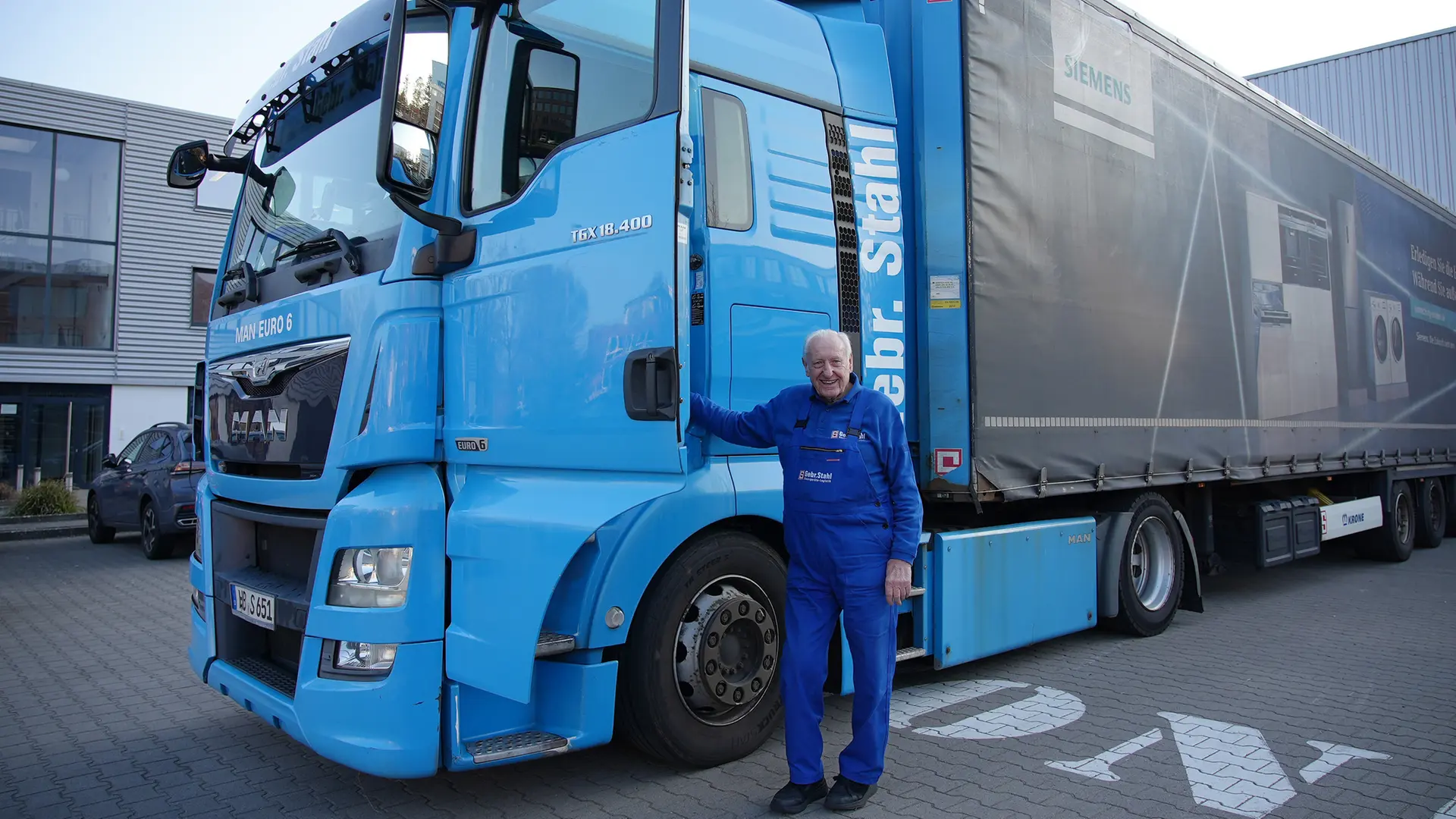
Herbert Stahl continues making deliveries across northern Germany as European road carriers confront an ageing workforce and a persistent shortage of professional drivers
German truck driver Herbert Stahl is 86 years old but has no plans to end his professional career. Four days a week, he gets behind the wheel of a heavy truck to deliver washing machines and other household appliances to customers across northern Germany.
Stahl works for the family-owned transport and logistics company Gebrüder Stahl. His father established the business in Bremen-Blumenthal in 1945. The company now operates a fleet of 38 vehicles and provides up to 32,000 square metres of warehousing capacity.
Herbert Stahl previously helped manage the family business and its vehicle fleet. Management has since passed to the next generation, but the continuing driver shortage means that he still regularly carries out deliveries himself. Most of his assignments are fixed daytime routes, allowing him to return home in the evening.
“I don’t know anyone older, and I’m on the road a lot,” Herbert Stahl told German broadcaster NDR
His working day begins at around 6:00. In addition to driving the truck, Stahl takes part in delivering and unloading household appliances. Friday is his regular day off.
German law does not establish a maximum age for driving a truck. A person’s ability to remain professionally active depends on their medical fitness and possession of a valid licence rather than their age alone.
According to Bremen’s official public-service portal, C and CE licences are issued or renewed for five years at a time. Applicants must provide a general medical certificate and evidence that their eyesight meets the required standard.
Stahl recently completed the necessary medical and ophthalmological examinations and had his truck licence renewed for another five years. Provided that he remains medically fit, he will therefore be able to continue driving professionally beyond his 90th birthday.
“My doctor simply can’t find anything wrong with me,” the driver joked after his latest examination
The medical requirements apply to truck-licence holders regardless of age. Renewal is not automatic: an application must be submitted to the local licensing authority, preferably four to six weeks before the current entitlement expires.
Stahl’s story has attracted attention as Europe’s road transport workforce continues to age. Industry publications frequently estimate that drivers under 25 account for only around 4–5% of the European workforce. However, the latest available International Road Transport Union report shows substantial differences between countries and research samples.
IRU data puts the share of German truck drivers under 25 at just 2.6%. The proportion falls to 2.2% in Italy and stands at approximately 3% in both Poland and Spain. At the other end of the age range, drivers over 55 represent 31.6% of the workforce in the countries studied.
IRU expects 3.4 million truck drivers across the surveyed markets to retire by 2029. In Europe, approximately 17% of the current driver population is forecast to retire within five years—roughly one in every six drivers.
Retaining medically fit and qualified older employees can help carriers compensate for workforce shortages. Experienced drivers already understand routes, customers, vehicles and cargo-handling procedures. Their continued participation allows operators to accept more orders and reduces the risk of trucks remaining idle.
Stahl’s case cannot, however, serve as a universal solution to the labour shortage. Truck driving involves long periods of sitting, early shifts, physical work, dense traffic and sustained concentration. Whether an older driver can continue working must be assessed individually and supported by objective medical evidence.
Europe’s logistics sector ultimately needs both to retain experienced professionals and make the occupation more accessible to younger workers. IRU identifies training costs, age-related entry barriers, inadequate secure parking and poor treatment at delivery sites among the factors discouraging new entrants.
Read also: Germany faces a shortage of approximately 100,000 professional truck drivers