

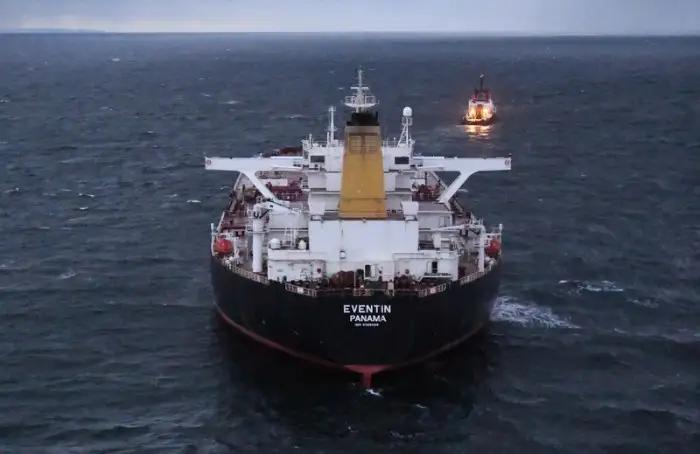
Two Urgent Proceedings Have Ended
German customs will not confiscate or dispose of the Eventin tanker and approximately 99,000 tonnes of Russian oil on board while the underlying legal proceedings remain unresolved.
According to the Hamburg Fiscal Court, the Federal Customs Administration agreed to wait for judgments in the main actions. The parties subsequently declared the two urgent interim proceedings settled.
“The vessel and its cargo will not be confiscated or disposed of until the court proceedings have concluded,” the court said.
The development does not permanently cancel the customs authorities’ decisions. The legal dispute over the vessel and cargo continues, while Eventin remains anchored off the German island of Rügen in the Baltic Sea.
Eventin Has Remained off Rügen Since January 2025
The 274-metre tanker, registered under IMO 9308065, lost propulsion while sailing through international waters in the Baltic Sea on January 9, 2025.
According to the German Federal Fiscal Court’s case record, a power failure left the vessel unable to manoeuvre. It drifted into German territorial waters and was subsequently towed to an anchorage near Sassnitz.
German customs prohibited the tanker from leaving on January 13 while investigating a possible breach of EU sanctions covering Russian petroleum products.
Eventin was not on the EU sanctions list when the casualty occurred. It was added to Annex XLII of Regulation (EU) No 833/2014 with effect from February 25, 2025, as a vessel that the EU associates with Russian oil transport and sanctions circumvention.
Panama removed the tanker from its ship registry on March 7, 2025.
Customs Intended to Sell the Vessel and Cargo
Following laboratory testing, the German authorities identified the cargo as a Russian-origin petroleum product falling under an EU-restricted customs classification.
Customs ordered the cargo to be secured in February 2025. On March 14, it ordered the oil confiscated for the benefit of the German state and prepared for its disposal. Separate measures covered the seizure and planned sale of the vessel.
The owners of the tanker and cargo challenged those decisions. They argue that Eventin entered German waters solely because of a technical emergency rather than through a planned import of sanctioned petroleum products.
In May 2025, the Mecklenburg-Western Pomerania Fiscal Court suspended enforcement of the confiscation decision. The Federal Fiscal Court subsequently rejected the customs authority’s appeal, finding serious doubts about the legality of immediate confiscation.
Court Must Balance Sanctions and Maritime Distress Rights
One of the central legal questions concerns how the entry of sanctioned goods into EU customs territory should be interpreted.
The Federal Fiscal Court noted that bringing goods into the European Union would normally involve an act guided by human intent. Eventin, however, entered German waters while drifting without propulsion or navigational control.
The court also referred to the right of innocent passage and the internationally recognised right of a vessel in distress to seek a place of refuge.
Customs authorities argue that the Russian cargo entered EU customs territory and became subject to the relevant prohibition regardless of the circumstances that brought the vessel into German waters.
The main proceedings will have to determine whether EU sanctions apply in full to cargo brought into the bloc because of a maritime emergency and whether the right to seek refuge also includes the ability to resume the voyage afterwards.
Main Actions Continue in Hamburg
The legal action concerning Eventin’s cargo has been pending before the Hamburg Fiscal Court since March 25, 2026. A separate action filed by the vessel owner has been under consideration since April 8, 2026.
The tanker is owned by Laliya Shipping Corp., a company registered in Majuro, Marshall Islands.
Laliya Shipping has also challenged Eventin’s EU designation. In Case T-271/25, the company is seeking annulment of the vessel’s inclusion in Annex XLII of the EU sanctions regulation.
While the proceedings continue, both the tanker and its cargo remain effectively removed from commercial use. German authorities are also continuing to incur expenses associated with keeping the vessel safely anchored.
The final rulings could have broader implications for other vessels carrying sanctioned cargoes that enter European waters because of mechanical failure or maritime distress. The courts will have to define where EU sanctions enforcement ends and international protections for ships in distress begin.
