

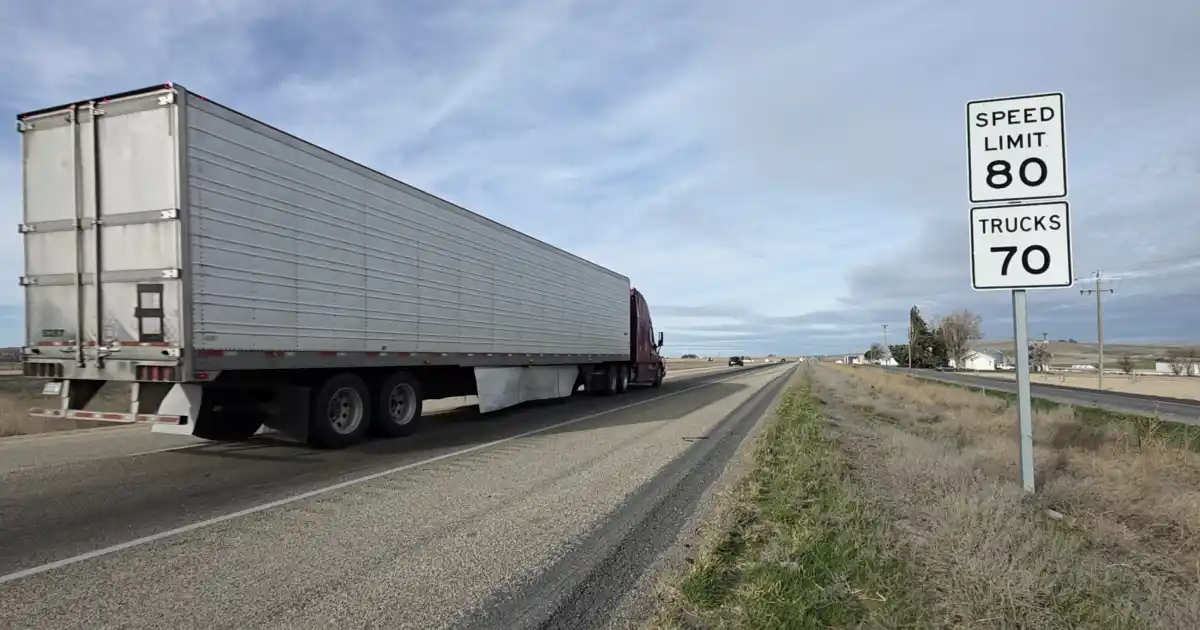
Since July 1, 2026, heavy trucks have been permitted to travel at up to 80 mph on designated Idaho highways, matching the limit applied to passenger vehicles
One Speed Limit for Cars and Heavy Trucks
The US state of Idaho has abolished its separate speed limit for heavy commercial vehicles. Under House Bill 664, vehicles with five or more axles operating at a gross weight above 26,000 pounds, or approximately 11.8 tonnes, may travel at the same posted speed as other vehicles from July 1, 2026.
On highway sections carrying an 80 mph limit, heavy trucks can therefore legally travel at approximately 128 km/h. They were previously restricted to 70 mph, equivalent to about 113 km/h.
Governor Brad Little signed the legislation on March 23, 2026. The change does not introduce a statewide 80 mph limit on every road. It applies only where that speed is posted, while lower limits remain in force in urban areas and on other highway sections. Interstate routes around Boise, for example, generally retain a maximum speed of 65 mph, or about 105 km/h.
Idaho Expects Fewer Overtaking Manoeuvres
The main argument behind the change is that removing the speed difference between cars and trucks could reduce overtaking and lane changes. State authorities also expect passenger vehicles to spend less time alongside trucks and inside their blind spots.
“What we hope to do is eliminate crashes involving passenger cars and large commercial vehicles,” Idaho State Police commercial vehicle specialist Steve McClain said
Large trucks have extensive blind spots, and passenger vehicles can enter them while overtaking. Supporters of the measure argue that allowing both categories to travel at the same speed should reduce these interactions.
The bill’s supporting rationale also cited research suggesting that a speed difference of 10 mph, or 16 km/h, can increase interactions between vehicles by 227%. The figure nevertheless represents an argument advanced in support of the legislation and does not guarantee that the new rule will reduce Idaho’s crash rate.
Travelling at 80 mph Is Not Mandatory
The new limit represents the maximum permitted speed rather than a recommended operating speed. Carriers and drivers must still consider the combination’s weight, tyre and brake condition, visibility, weather and traffic density.
“If we’re not comfortable driving a commercial vehicle, a large commercial vehicle at 80 miles an hour, then drive to your abilities,” McClain said
Idaho State Police will continue enforcing speed limits using radar and handheld lidar equipment. Idaho applies an absolute speed-limit rule, meaning the value shown on a sign is the maximum for all vehicles regardless of surrounding traffic speeds.
Not every truck is expected to use the full 80 mph allowance. Some US carriers install fleet speed limiters to control fuel consumption, reduce vehicle wear and comply with insurance or internal safety requirements.
Higher Speeds Raise Braking-Distance Concerns
Matching truck and passenger-car speeds may reduce overtaking, but operating a heavy combination at 128 km/h increases both the distance required to stop and the potential severity of a collision. Brake condition, following distance and driver reaction time will therefore become particularly important.
The effect on road safety can only be assessed after sufficient crash data have been collected. Idaho State Police plans to monitor incidents involving commercial vehicles and compare the results with the period when split speed limits were in force.
For road carriers, the change could moderately reduce journey times on rural sections of Interstates 15, 84 and 86. The actual operational benefit will depend on fleet speed policies, fuel costs and the restrictions imposed by individual transport companies.
As K2Cargo.News previously reported, European authorities are simultaneously strengthening the monitoring of truck behaviour: Bulgaria is using toll-system cameras to detect prohibited overtaking by heavy vehicles.
Read also: LTL Market Trends: FedEx Spin-off and Amazon Freight Expansion