

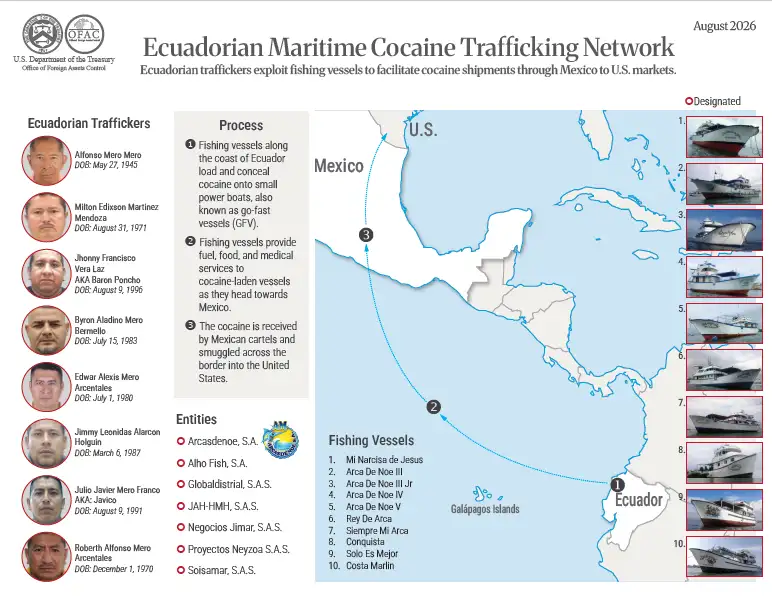
The U.S. Office of Foreign Assets Control imposed sanctions on eight individuals and seven Ecuador-based companies on August 20. Ten Ecuador-flagged fishing vessels were also identified as blocked property.
According to the U.S. Department of the Treasury, the targets formed part of a maritime cocaine-trafficking network affiliated with the Ecuadorian gangs Los Choneros and Los Lobos and connected to Mexican cartels.
“Working alongside our law enforcement partners, we will continue to disrupt the cartels’ drug trafficking operations and protect our borders,” Treasury Secretary Scott Bessent said.
How the Maritime Network Operated
U.S. authorities said the network used fishing businesses near the Ecuadorian port city of Manta as cover for drug-trafficking activities.
Cocaine was loaded onto small go-fast boats heading north through the eastern Pacific. Fishing vessels supplied these boats with fuel, food and medical assistance while also helping crews monitor the movements of law-enforcement ships.
OFAC alleges that one sanctioned operator, Julio Mero Franco, coordinated shipments of between 30 and 40 metric tons of cocaine per month from Ecuador to Central America and Mexico. The Treasury Department said the fishing vessel Todos Vuelven was also used to transport multi-ton quantities of cocaine directly.
Ten Vessels Identified as Blocked Property
The official OFAC sanctions update lists Todos Vuelven, Arca De Noe III, Arca De Noe III Jr, Arca De Noe IV, Arca De Noe V, Conquista, Siempre Mi Arca, Rey De Arca, Costa Marlin and Solo Es Mejor.
The decision does not automatically amount to the physical seizure of every vessel. However, property within the United States or controlled by U.S. persons must be blocked, while transactions involving the designated parties are generally prohibited without an OFAC license or applicable exemption.
The restrictions may affect banks, insurers, port agents, bunker suppliers and other maritime service providers. Shipping companies will therefore need to examine vessel ownership, beneficial-control structures and sanctions exposure before providing services.
Fishing Boats Served as a Support Network
The case demonstrates how commercial fishing vessels can support drug trafficking without necessarily carrying every shipment themselves. Acting as offshore supply platforms, they can extend the operating range of go-fast boats and help their crews evade maritime surveillance.
Under Operation Pacific Viper, the U.S. Coast Guard intercepted more than 225,000 pounds, or approximately 102 metric tons, of cocaine in the eastern Pacific between August 2025 and June 2026. Washington expects the new sanctions to weaken the financial and logistical infrastructure supporting these maritime routes.
Read also: EU Sanctions Inter RAO: Risks for Kazakhstan’s Power Grid