

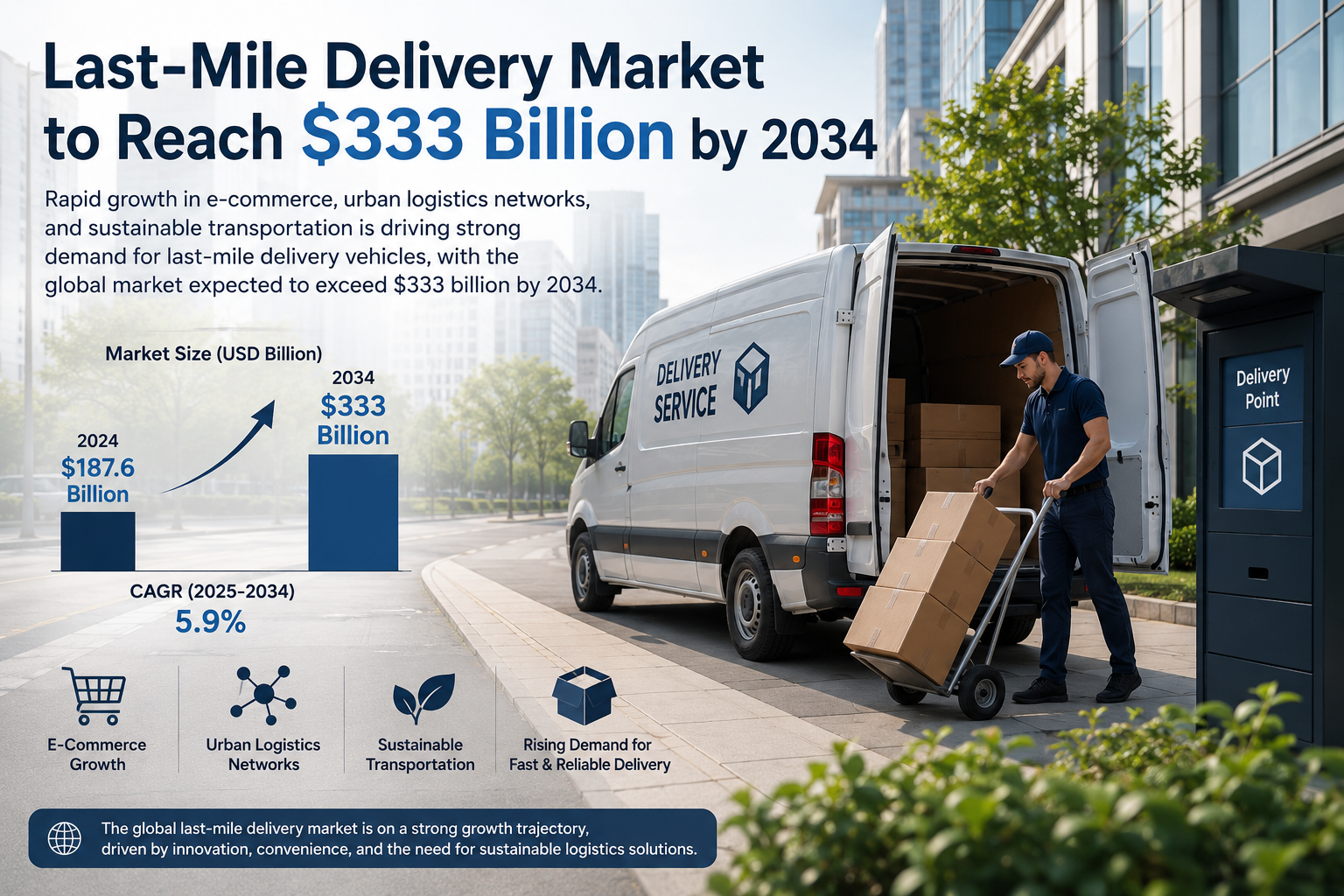
The market for last-mile delivery vehicles remains one of the fastest-growing segments of the global logistics industry. According to the latest report from Global Market Insights, the worldwide market was valued at approximately $173 billion in 2025 and is projected to reach $333.4 billion by 2034, expanding at a compound annual growth rate (CAGR) of 7.6%.
Last-mile delivery is widely regarded as the most complex and expensive stage of the supply chain. It represents the final step in transporting goods directly to end customers, whether at homes, offices, parcel lockers, pickup points, or retail locations. Industry analysts estimate that last-mile operations can account for up to 50% of total logistics costs in the e-commerce sector.
E-Commerce Continues to Drive Market Growth
The rapid expansion of online retail remains the primary catalyst behind the growing demand for last-mile delivery vehicles. Global marketplaces and e-commerce platforms continue to increase order volumes year after year, creating a need for larger delivery fleets and more efficient urban distribution systems.
The strongest growth is currently being recorded across Asia, North America, and Europe. In major metropolitan areas, same-day and even within-hours delivery services are increasingly becoming standard customer expectations. As a result, logistics providers are investing heavily in specialized delivery vehicles, route optimization software, and advanced fleet management technologies.
The expansion of grocery delivery, pharmaceutical distribution, and fast-moving consumer goods is also contributing significantly to market growth, as delivery speed has become a key competitive advantage for retailers and logistics operators alike.
Electric Vehicles Are Reshaping Urban Logistics
One of the most significant trends expected to define the next decade is the electrification of last-mile transportation.
Logistics companies are steadily replacing conventional delivery fleets with electric vans, battery-powered trucks, cargo bikes, and electric three-wheel vehicles. Rising fuel costs, stricter environmental regulations, and the introduction of low-emission zones are accelerating this transition.
Major global players including Amazon, DHL Group, UPS, and FedEx have already committed billions of dollars to expanding their electric delivery networks.
Market analysts expect the share of electric vehicles in last-mile logistics to grow considerably faster than in long-haul freight transportation, largely due to shorter routes and the suitability of urban delivery operations for battery-powered vehicles.
Automation Is Becoming a Competitive Necessity
At the same time, artificial intelligence and automation technologies are transforming delivery operations.
Modern logistics platforms can analyze traffic conditions in real time, predict delivery times, optimize routes, reduce vehicle mileage, and improve fleet utilization. These capabilities allow operators to lower costs while increasing service reliability.
A growing number of companies are also testing autonomous delivery robots, self-driving vans, and drone delivery systems for small shipments. Although large-scale deployment remains limited by regulatory frameworks, many industry experts view these technologies as key components of future logistics networks after 2030.
Environmental Regulations Are Transforming Logistics
Europe remains one of the most dynamic regions for last-mile delivery services.
The highest demand is concentrated in Germany, France, the United Kingdom, the Netherlands, Spain, and Italy, where strong e-commerce growth and expanding cross-border trade within the European Union continue to increase urban freight volumes.
At the same time, European governments are tightening environmental regulations. Low-emission zones, restrictions on diesel-powered vehicles, and incentive programs for electric commercial fleets have become common across many major cities.
By 2030, numerous European metropolitan areas plan to significantly reduce or even eliminate conventional diesel delivery vans from city centers, creating substantial opportunities for electric vehicle manufacturers and logistics providers.
Driver Shortages Accelerate Digital Transformation
Another major challenge facing European logistics is the persistent shortage of professional drivers.
Industry organizations estimate that the deficit already amounts to several hundred thousand drivers across Europe. To address this issue, logistics companies are increasingly investing in automated transportation management systems, digital route planning tools, and AI-powered logistics platforms.
These technologies help improve operational efficiency, reduce labor dependence, and optimize delivery performance in increasingly complex urban environments.
Urban Logistics Hubs Gain Strategic Importance
The development of micro-fulfillment centers and urban logistics hubs is becoming another defining feature of the European market.
Companies are placing smaller warehouses and distribution facilities directly within large cities or in nearby suburban areas to shorten delivery times and reduce pressure on transportation infrastructure.
This trend is particularly visible in Germany, the Netherlands, Belgium, and the Scandinavian countries, where fast delivery expectations continue to rise among both consumers and businesses.
What It Means for International Logistics
The expansion of the last-mile delivery vehicle market is influencing the entire global supply chain.
Growing order volumes require larger warehouse networks, more sophisticated multimodal transportation solutions, and ongoing modernization of logistics infrastructure. For international logistics providers, this means investing not only in long-distance freight transport but also in localized distribution systems that increasingly determine customer satisfaction and service quality.
As e-commerce continues to expand worldwide, the importance of last-mile logistics will only increase. Over the coming decade, this segment is expected to become one of the most attractive areas for investment, shaping the future of transportation technologies, urban mobility, and global supply chains.
Read also: SID: Germany Launches a Truck Parking Availability System
