

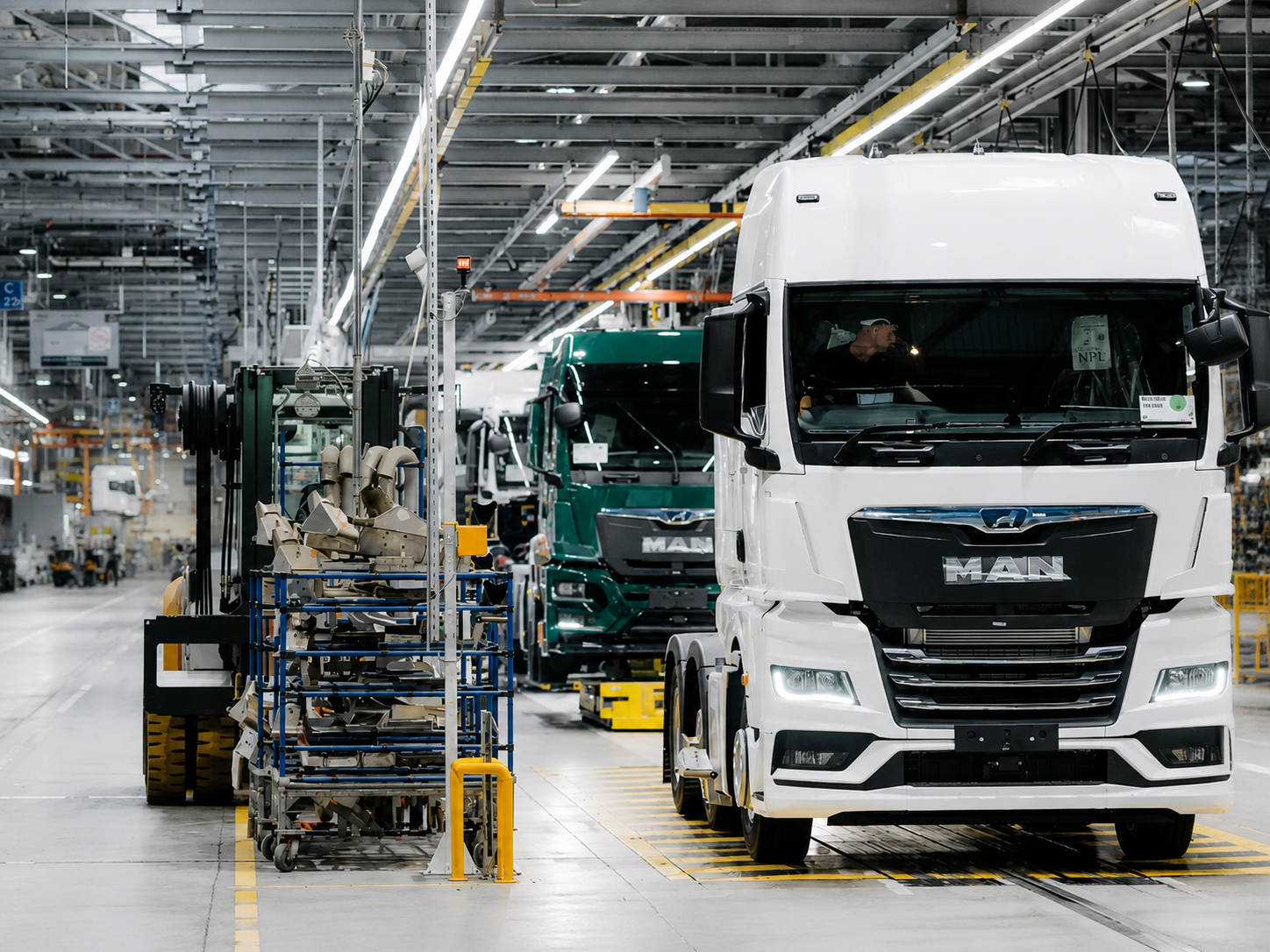
A conflict over annual bonuses at the MAN truck plant in Niepołomice has turned into a wider debate about pay fairness, productivity and the role of Central European factories in the European automotive industry.
According to Polish media reports citing trade union representatives, permanent employees at the Polish plant are expected to receive an annual bonus of PLN 1,500 gross. At the same time, employees at German MAN plants are reportedly set to receive €1,632, equivalent to almost PLN 7,000. German apprentices and students are expected to receive €365 — a level that Polish workers compare with the bonus offered to experienced staff in Niepołomice.
The difference has triggered strong resistance from unions. Workers are demanding a bonus of PLN 5,000, more than three times the amount proposed by the company but still below the German level. Trade union representatives are preparing a formal protocol of disagreement, a step that can open the way to a collective dispute. If no compromise is reached, a strike is among the options being considered.
For MAN, the conflict comes at a sensitive time. The Niepołomice plant near Kraków has recently undergone a major expansion and modernization program worth around €200 million. The Polish facility is an important part of MAN’s European truck production network, and any interruption could affect the production and delivery schedule of new vehicles.
As K2Cargo News previously reported in New Report Reveals Widespread Problems in Europe’s International Road Transport Sector, labor conditions are becoming one of the key pressure points across the European transport and logistics ecosystem.
Why the Bonus Became a Flashpoint
The dispute is not only about one annual payment.
For workers in Niepołomice, the bonus has become a symbol of unequal treatment inside the same industrial group. Employees argue that wage differences between Poland and Germany still exist, but the gap is no longer as wide as it was in the past. In their view, a bonus difference of more than four times is difficult to justify, especially when the Polish plant plays a major production role.
The emotional reaction is understandable. A bonus is usually interpreted not only as extra income, but also as recognition of the workforce’s contribution. If employees believe they produce at a high level but receive much lower recognition than colleagues abroad, the issue quickly becomes about dignity and fairness.
This is why the conflict has moved beyond a technical payroll discussion. It now touches on how multinational manufacturers distribute profits, reward productivity and manage expectations across different labor markets.
Productivity Argument Strengthens the Unions
Union representatives and workers point to the productivity of the Polish plant as one of their main arguments.
Reports from the Polish side say that the Niepołomice plant can produce around 105 trucks per shift, compared with about 40 vehicles at a German plant. These figures are presented by employees as evidence that the Polish workforce is highly efficient and should not be treated as a lower-value part of the group.
From the company’s perspective, bonus systems can depend on many factors: collective agreements, local labor rules, plant-level profitability, cost structure, historical pay models and internal HR policy. But for employees, the comparison is simpler: the company is one, the brand is one, the production standards are shared — so the reward should not differ so dramatically.
That contrast is what makes the dispute difficult to defuse. Even if management explains the difference through national agreements or local compensation systems, workers may still see it as unequal treatment.
A Strike Could Hit Truck Deliveries
The most serious risk for MAN is production disruption.
If unions move from disagreement to a formal collective dispute and then to strike action, production of new trucks in Niepołomice could be suspended. In the automotive and commercial vehicle sector, even a short stoppage can create consequences for suppliers, dealers and customers.
Truck production relies on synchronized supply chains. Components arrive according to schedule, assembly lines are planned in detail, and finished vehicles are expected by dealers and fleet customers. A strike can interrupt this chain and create delays that are not limited to one factory gate.
For dealers, delayed deliveries mean postponed handovers to customers. For transport companies, waiting longer for new vehicles can affect fleet renewal plans, maintenance schedules and capacity management. For suppliers, a stoppage can force temporary adjustments in production and logistics.
This is why labor disputes in manufacturing plants matter to the wider transport market. Trucks are not just industrial products; they are future capacity for freight companies.
Poland’s Role in European Truck Manufacturing
The MAN plant in Niepołomice is one of the key examples of how Poland has become a major manufacturing base for European automotive and commercial vehicle producers.
Lower costs were historically one of the reasons why international manufacturers expanded production in Central and Eastern Europe. But the situation has changed. Polish industrial workers are more experienced, productivity is higher, and labor expectations have grown. At the same time, inflation and cost-of-living pressures have made compensation issues more sensitive.
The old model — in which Central European plants were treated mainly as lower-cost production sites — is increasingly difficult to maintain. Workers now compare not only wages within Poland, but also conditions across the same corporate group in Germany, Austria or other Western European markets.
This is especially true when plants are modernized and receive large investments. Expansion creates expectations: if a factory becomes more important for the group, workers expect their compensation and recognition to reflect that role.
The €200 Million Expansion Adds Pressure
MAN’s recent investment in Niepołomice is central to the background of the conflict.
The company completed a major expansion of its Polish truck production site in 2023. The investment was worth about €200 million, and the plant area was enlarged by roughly one third to around 41 hectares. Production was organized in three shifts as the plant ramped up its output.
For management, this investment shows long-term confidence in the Polish site. For workers, it reinforces the argument that the plant is strategically important and should be rewarded accordingly.
There is a tension here. Companies often expect major investments to increase efficiency and competitiveness. Workers, however, expect that higher productivity and the greater importance of the site will also translate into better pay and benefits.
When those expectations are not aligned, even a bonus decision can become a trigger for wider conflict.
What Management Must Consider
MAN’s management now faces a choice between cost control and labor stability.
Keeping the proposed bonus level may protect short-term labor cost discipline, but it risks escalating the conflict. Raising the bonus closer to the unions’ demand would increase costs, but could reduce the threat of a strike and show recognition of the Polish workforce.
The company also has to consider reputational risk. A public dispute over lower bonuses in Poland compared with Germany can damage the image of the employer, especially in a labor market where skilled industrial workers are valuable.
For manufacturers, employer reputation matters. If workers believe the company treats one country’s workforce as second-class, recruitment and retention can become harder. This is particularly relevant in regions where industrial companies compete for qualified production workers, mechanics, technicians and logistics staff.
A Wider European Labor Question
The dispute at MAN is part of a broader European issue.
Multinational manufacturers operate across countries with different wages, tax systems, collective agreements and living costs. Some differences are inevitable. But as Central European economies converge with Western Europe, employees are increasingly challenging large internal gaps.
The question is no longer whether Polish wages are equal to German wages. They are not. The question is whether the difference in bonuses and benefits is proportionate to productivity, responsibility and the strategic role of the plant.
That is why the Niepołomice dispute may attract attention beyond MAN. Other companies with factories in Central Europe face similar expectations from workers who compare themselves with colleagues in Western plants.
The Next Step Is Negotiation
The immediate outcome will depend on negotiations between management and unions.
The unions are demanding PLN 5,000. The company has reportedly proposed PLN 1,500. Between these two figures there is room for compromise, but the political and emotional pressure around the case is growing.
If a formal collective dispute begins, the process may include mediation and other legal steps before a strike. However, the threat itself is already significant because it signals that workers are prepared to use stronger tools if talks fail.
For MAN, the safest path may be a negotiated settlement that avoids production stoppages. For workers, the key objective is to show that the Polish plant’s contribution deserves more than symbolic recognition.
The conflict in Niepołomice shows that Europe’s industrial map is changing. Polish plants are no longer just lower-cost production sites. They are major, modern and productive parts of European manufacturing networks. Workers now expect compensation policies to reflect that reality.
Read also: New Report Reveals Widespread Problems in Europe’s International Road Transport Sector