

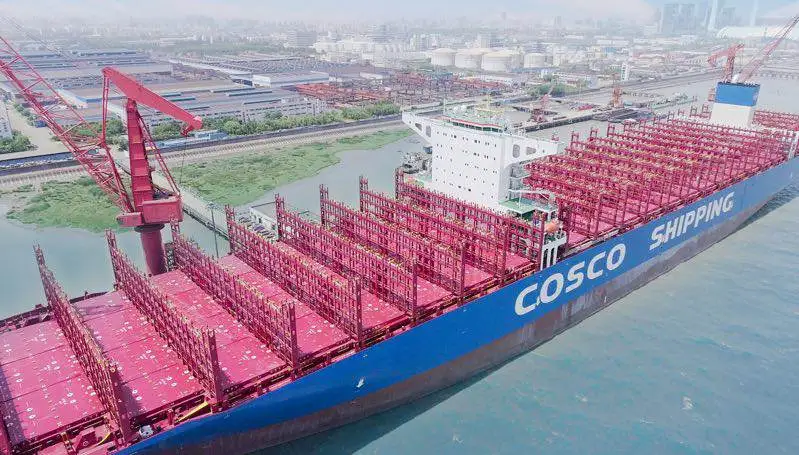
Twelve vessels of around 22,000 TEU will strengthen Asia–Northwest Europe services, while six feeder ships will support regional cargo flows
COSCO Shipping Holdings has announced orders for 18 new container vessels with a combined value of approximately $2.99 billion. The company’s board approved the contracts on August 28, 2026, as part of a broader fleet expansion and environmental modernisation programme.
The orders were placed through subsidiary COSCO Shipping Assets Management. Shanghai Waigaoqiao Shipbuilding and China Shipbuilding Trading will build 12 ultra-large container vessels, while CSSC Huangpu Wenchong Shipbuilding and China Shipbuilding Trading will construct another six ships.
The transaction was disclosed in official COSCO Shipping Holdings documents published by the Hong Kong Stock Exchange.
The 18 vessels will provide combined capacity of approximately 279,600 TEU. Deliveries are scheduled to begin in 2028 and continue through 2030.
The larger contract covers 12 container ships in the 22,000-TEU class. Industry reports place their actual designed intake at approximately 21,700 TEU per vessel.
Each ship is priced at $224 million, bringing the value of this portion of the order to $2.688 billion. The 12 vessels will contribute approximately 260,400 TEU of capacity.
They will be equipped with dual-fuel propulsion systems capable of using liquefied natural gas. Deliveries are expected between 2028 and 2030.
COSCO plans to deploy the newbuilds primarily on major services between the Far East and Northwest Europe. Their scale is expected to reduce costs per container and reinforce the carrier’s position on one of the world’s most important trade corridors.
“The new vessels will strengthen the group’s competitive advantage on routes including the Far East–Northwest Europe trade,” COSCO Shipping Holdings said
The company expects the gradual replacement and redistribution of capacity to release existing vessels for emerging markets, regional services and trades between third countries.
The second contract covers six new-generation wide-beam container ships with capacity of 3,200 TEU each. Every vessel is priced at RMB339.8 million, equivalent to approximately $50 million.
The combined contract value is RMB2.039 billion, or around $300 million. The six vessels will add 19,200 TEU and are scheduled for delivery during 2028 and 2029.
Once in service, they will operate on international regional and feeder routes. Their role will be to connect smaller ports with COSCO’s principal transshipment hubs, where containers can be transferred to larger intercontinental vessels.
Combining ultra-large ships with feeder tonnage will support a more closely integrated mainline and regional network. For cargo owners, the strategy could expand service coverage and increase the number of connections to COSCO’s global routes.
As K2Cargo.News previously reported, carriers based in the UAE are also ordering feeder vessels from Chinese shipyards. The trend indicates that operators are investing simultaneously in large mainline ships and smaller tonnage for regional services.
COSCO said up to 70% of each vessel’s purchase price may be financed through external debt or bank loans. The remaining amount would be funded from the group’s internal resources.
Potential borrowing under the two contracts could therefore exceed $2 billion. The final financing structure will depend on bank terms, construction schedules and milestone payments to the shipyards.
The selected shipbuilders offered delivery slots and technical capabilities that met COSCO’s requirements. The company also said prices were comparable with the lowest offers received during preliminary project evaluations.
The order will not immediately increase market capacity because the first vessels are not due until 2028. Contract payments, however, will be reflected in capital expenditure as construction milestones are completed.
The latest contracts represent COSCO Shipping Holdings’ third major newbuilding package since the beginning of 2026.
In January, the group ordered 12 LNG dual-fuel ships of 18,000 TEU and six wide-beam vessels of 3,000 TEU. In April, controlled subsidiary Orient Overseas International ordered 12 dual-fuel container ships of 13,600 TEU for $2.22 billion.
Including the August agreements, COSCO’s 2026 programme covers 48 ships worth approximately RMB54.27 billion, equivalent to about $8 billion. The portfolio includes both large mainline vessels and ships intended for regional transport.
At the end of June, COSCO Shipping Holdings operated 604 container vessels with capacity of approximately 3.65 million TEU. Before the latest contracts, its owned orderbook contained 82 vessels representing around 1.18 million TEU.
The company had also reported orders for 42 methanol dual-fuel container ships totalling around 780,000 TEU and 24 LNG dual-fuel vessels representing approximately 380,000 TEU. The latest contracts will further increase the share of alternative-fuel-capable tonnage.
COSCO Shipping Holdings generated approximately RMB7.54 billion, or around $1.1 billion, in net profit attributable to shareholders during the second quarter of 2026. This figure is derived from the published first-half result of RMB13.419 billion after subtracting first-quarter profit of RMB5.88 billion.
Industry estimates indicate that quarterly profit increased by approximately one quarter from the same period a year earlier. Higher freight rates and growing transport volumes supported the recovery.
The average China Containerized Freight Index during the second quarter was 19.5% above the first-quarter level. COSCO attributed the stronger market to overseas inventory replenishment, accelerated shipments ahead of potential tariff changes and growing demand for the transport of artificial-intelligence and renewable-energy equipment.
The half-year comparison remained negative, however. Net profit attributable to shareholders fell 23.48% from RMB17.536 billion to RMB13.419 billion. The second-quarter figure therefore represents a recovery from a weaker start to the year rather than profit growth across the entire six-month period.
COSCO Shipping Holdings transported 14.279 million TEU during the first half of 2026, an increase of 7.52% year on year.
Asia–Europe and Mediterranean volumes rose 12.44% to 2.190 million TEU. Transpacific shipments increased 9.72% to 2.626 million TEU.
Intra-Asia services, including Australia, handled 4.735 million TEU, up 5.34%. Domestic Chinese volume increased 9.97% to 3.153 million TEU.
Group revenue reached RMB111.922 billion, equivalent to approximately $16.6 billion, representing growth of 2.59%. Container shipping generated most of the revenue, while terminal operations also reported higher throughput.
COSCO Shipping Ports’ total terminal throughput increased by 7.89% to 80.157 million TEU during the first half.
Controlled terminals handled 16.894 million TEU, up 2.5%. Non-controlled terminals processed 63.263 million TEU, an increase of 9.43%.
Overseas assets recorded particularly strong growth, with throughput rising 18.05% to 21.138 million TEU. The expanding terminal network will be important for the feeder vessels connecting regional ports with the group’s main hubs.
The new ships will also strengthen integration between COSCO’s liner and terminal businesses. Routing more cargo through affiliated infrastructure could give the group greater control over schedules, transshipment and onward container delivery.
The delivery of 12 ultra-large container vessels will add new capacity to the Asia–Northwest Europe trade after 2028. Its market impact will depend on trade growth, the retirement of older vessels and the continued use of longer diversion routes due to geopolitical risks.
For shippers, additional vessels may improve capacity availability and support competition between carriers. At the same time, large construction programmes create an oversupply risk if demand grows more slowly than the global fleet.
The world container fleet expanded by approximately 2.1% during the first half of 2026. COSCO expects capacity supply to grow around 4.2% for the full year, compared with estimated demand growth of 2.5–3%.
The company is relying on the lower unit costs of larger vessels, alternative-fuel capability and an integrated mainline-and-feeder network. This structure is intended to maintain competitiveness even if freight rates subsequently decline.
Read also: MSC controls more than one-fifth of the global container fleet
