

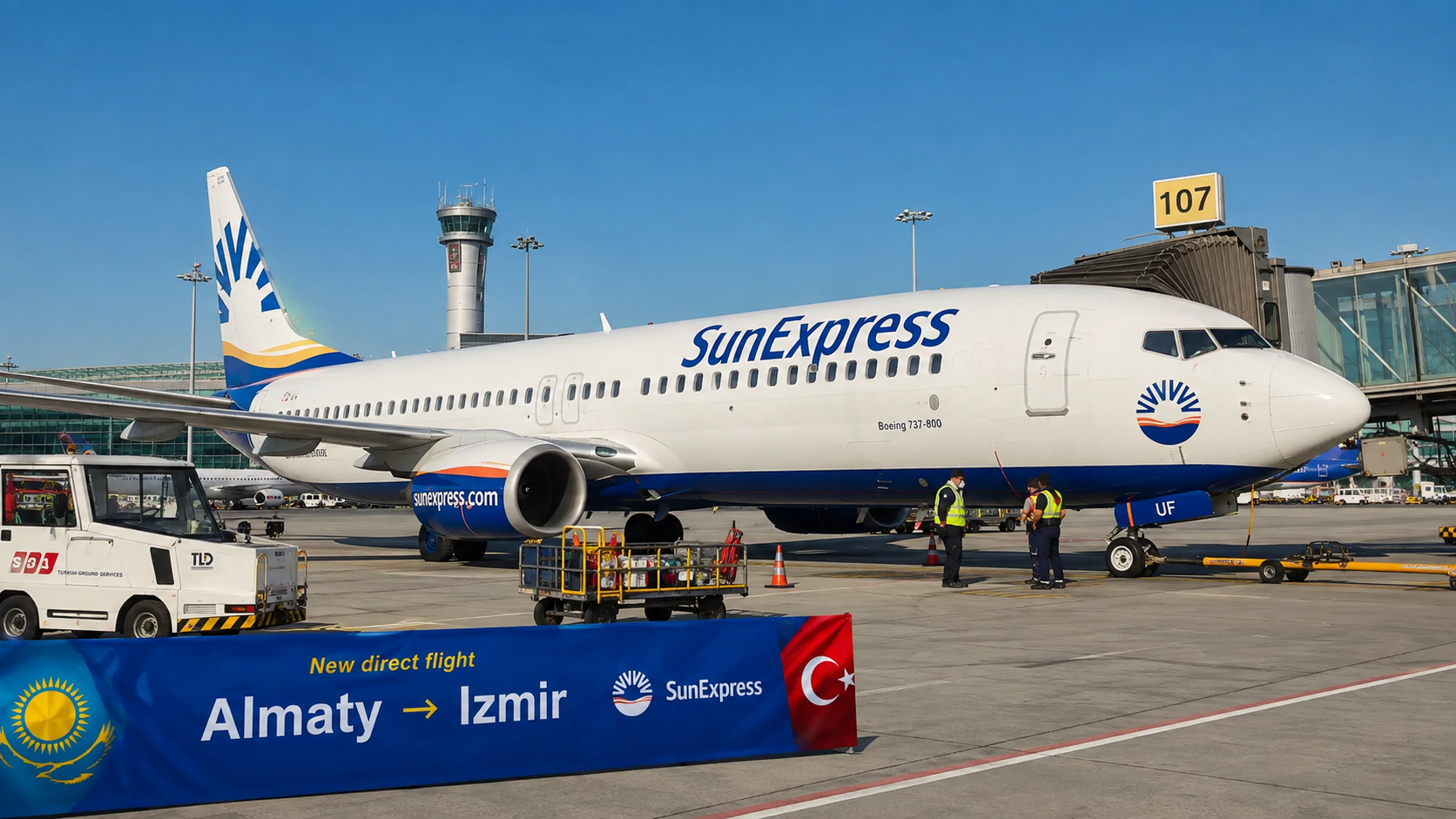
First Service Departed Izmir on July 31
Turkish airline SunExpress has launched direct scheduled flights between Izmir and Almaty.
The first Izmir–Almaty departure was scheduled for July 31, 2026, with return services from Kazakhstan beginning on August 1. The route will operate twice a week until the end of the summer aviation season in late October.
The service followed negotiations between the Consulate General of Kazakhstan in Izmir and SunExpress. Kazakhstan’s authorities describe the arrival of another foreign carrier as part of the country’s continuing effort to expand its international route network.
Flights are operated with Boeing 737 aircraft, the type widely used across SunExpress’ medium-haul network connecting Türkiye with European, Middle Eastern and other international markets.
Timetable Runs Until Late October
According to the published schedule, Izmir–Almaty flights depart on Tuesdays and Fridays at 9:00 p.m. and arrive in Kazakhstan at 5:00 a.m. the following day.
The outbound programme is scheduled to operate from July 31 until October 23, 2026.
Flights from Almaty to Izmir operate on Wednesdays and Saturdays, departing at 6:25 a.m. and arriving at 9:50 a.m. The return schedule runs from August 1 until October 24. All published times are local.
The timetable supports week-long holidays, short business trips and visits combining weekends with working days.
Passengers can now travel directly between Kazakhstan’s largest city and Türkiye’s Aegean coast without changing aircraft in Istanbul, Ankara or another hub.
Almaty Gains Another International Connection
Almaty remains Kazakhstan’s largest commercial, financial and tourism centre. Expanding direct connectivity from the city therefore matters to both passenger mobility and international business activity.
Kazakhstan has continued adding direct international routes throughout 2026. Government agencies link the strategy to tourism, investment, business mobility and stronger transport connectivity.
Other new services announced during the year included routes to Poland, Cyprus and Mongolia, illustrating the wider expansion of international networks from Almaty and Astana.
A direct flight reduces total journey time compared with an itinerary requiring a connection. Travellers avoid long transit periods, additional airport procedures and the risk of missing an onward service.
Predictability is particularly important for entrepreneurs, technical specialists, exhibition participants and company representatives working between Kazakhstan and Türkiye.
Izmir Provides Access to the Aegean Region
Izmir is one of Türkiye’s largest cities and an important economic centre in the western part of the country.
The route gives Kazakhstan direct access to the Aegean region, including tourism, industrial and agricultural areas surrounding the city.
Previously, many travellers reached the area through Istanbul or continued overland after arriving at another Turkish airport. A nonstop flight removes the need for an additional domestic sector and reduces pressure on connecting terminals.
Izmir is also a practical gateway to Çeşme, Alaçatı, Kuşadası, Ephesus and other popular destinations in western Türkiye. Initial demand is therefore likely to be strongly influenced by leisure travel.
SunExpress specialises in tourism-oriented aviation and operates an extensive network from Izmir, Antalya, Ankara, Dalaman and other bases. The airline says it serves approximately 250 routes across 37 countries and carries close to 16 million passengers annually.
The Route Supports Trade and Business Mobility
Türkiye remains a significant trading partner for Kazakhstan.
In 2025, the Turkish market accounted for approximately 4.9% of Kazakhstan’s exports, placing it among the country’s principal export destinations alongside Italy, China, Russia and the Netherlands.
A passenger flight cannot replace the rail, road and maritime services carrying most bilateral trade. It can, however, make contract negotiations, site visits, exhibitions and technical missions easier to organise.
The nonstop service may be especially valuable to small and medium-sized companies that previously had to route employees through Istanbul.
Potential beneficiaries include businesses operating in construction, food production, textiles, tourism, trade, machinery and professional services.
Better passenger connectivity can also support investment by allowing executives and specialists to reach projects more quickly.
Passenger Aircraft May Support Urgent Shipments
SunExpress has announced the service primarily as a passenger route. No dedicated freight programme, guaranteed cargo allocation or route-specific airfreight tariff has been published.
Passenger aircraft can nevertheless carry limited quantities of commercial cargo and mail in their lower holds. Actual capacity depends on passenger baggage, aircraft payload, airline policy and agreements with cargo agents.
Subject to commercial availability, the route could support small and urgent consignments such as documents, samples, spare parts, electronics, medical products, textiles, e-commerce orders and selected perishables.
Such capacity cannot compete with a dedicated freighter in scale. Its potential advantage is speed between southeastern Kazakhstan and western Türkiye without transshipment in Istanbul.
For freight forwarders, successful use of the route would depend on more than available aircraft space. Ground handling, customs clearance, temperature management and final delivery arrangements would also have to be in place.
Almaty Is Expanding Passenger and Cargo Aviation
The passenger network is growing alongside Almaty’s development as an airfreight gateway.
K2Cargo News previously reported that Emirates SkyCargo launched a dedicated Dubai–Almaty cargo route. The weekly Boeing 777F service provides more than 100 tonnes of specialised freight capacity and connects Kazakhstan with the carrier’s global network through Dubai.
The two routes serve different markets. Emirates SkyCargo handles full commercial shipments such as electronics, industrial equipment and temperature-sensitive goods. SunExpress is primarily focused on passengers but increases Almaty’s overall international connectivity.
Together, passenger and cargo services provide businesses with more options for moving employees, documents, product samples and commercial consignments through different international hubs.
Direct Flights Could Reshape Tourism Logistics
The service may influence tour operators, hotels, coach companies and airport-transfer providers.
Kazakh travel companies can build holiday packages around a direct arrival on the Aegean coast. Turkish operators gain easier access to Almaty, nearby mountain resorts, Charyn Canyon and other attractions in southeastern Kazakhstan.
The route may be particularly useful for organised groups. Nonstop travel simplifies the movement of passengers, baggage and tourism equipment while reducing the risk of luggage disruption during a connection.
Additional arrivals create demand for coaches, taxis, hotels and ground services at both destinations.
However, a twice-weekly schedule limits flexibility. A cancellation or major delay could require passengers to wait several days for the next direct flight or find an alternative journey through Istanbul.
Seasonality Is the Main Limitation
The initial SunExpress programme operates only until late October.
This indicates that the airline is first testing demand during the summer and early autumn. Any decision to extend the route, operate it year-round or increase frequency will depend on commercial performance.
A sustainable service requires more than strong peak-season tourism. The airline needs balanced demand in both directions from leisure passengers, students, business travellers and people visiting family.
An imbalance could weaken the route’s economics. Aircraft that are full from Kazakhstan to Türkiye but lightly loaded on the return sector would be less commercially attractive.
Tour operator commitments, corporate travel agreements, joint marketing and onward connections within the SunExpress network could help support year-round operations.
Airports Must Provide Reliable Ground Handling
Two weekly services will not create critical pressure on airport capacity, but they require coordinated border, customs and ground-handling operations.
The Almaty arrival is scheduled for early morning. Passengers need reliable taxis, public transport and transfer services, while the airport must process baggage and immigration efficiently.
The aircraft also arrives in Izmir during the morning, allowing travellers to continue by road or use domestic and international connections later in the day.
For business passengers, timetable reliability determines whether meetings can be arranged without an additional overnight stay. For leisure travellers, efficient onward transport to coastal destinations will influence the overall quality of the journey.
The Route Strengthens Kazakhstan’s International Connectivity
Almaty–Izmir is not Kazakhstan’s largest new aviation project by frequency or capacity. Its importance lies in creating a direct connection with another major regional centre in Türkiye.
Kazakhstan gains access not only to Istanbul and Antalya but also to the western Turkish market. This broadens travel options and reduces the concentration of traffic on a small number of traditional routes.
For Türkiye, the service creates another link to Central Asia through Kazakhstan’s largest city. For SunExpress, it forms part of the airline’s continuing expansion from its Izmir base.
The next stage will depend on aircraft load factors through October. Strong demand could support a longer season, additional frequencies or new commercial services for business travellers and small time-sensitive shipments.
Read also: EDB and Griffin Partners to Build $125 Million Logistics Park in Almaty