

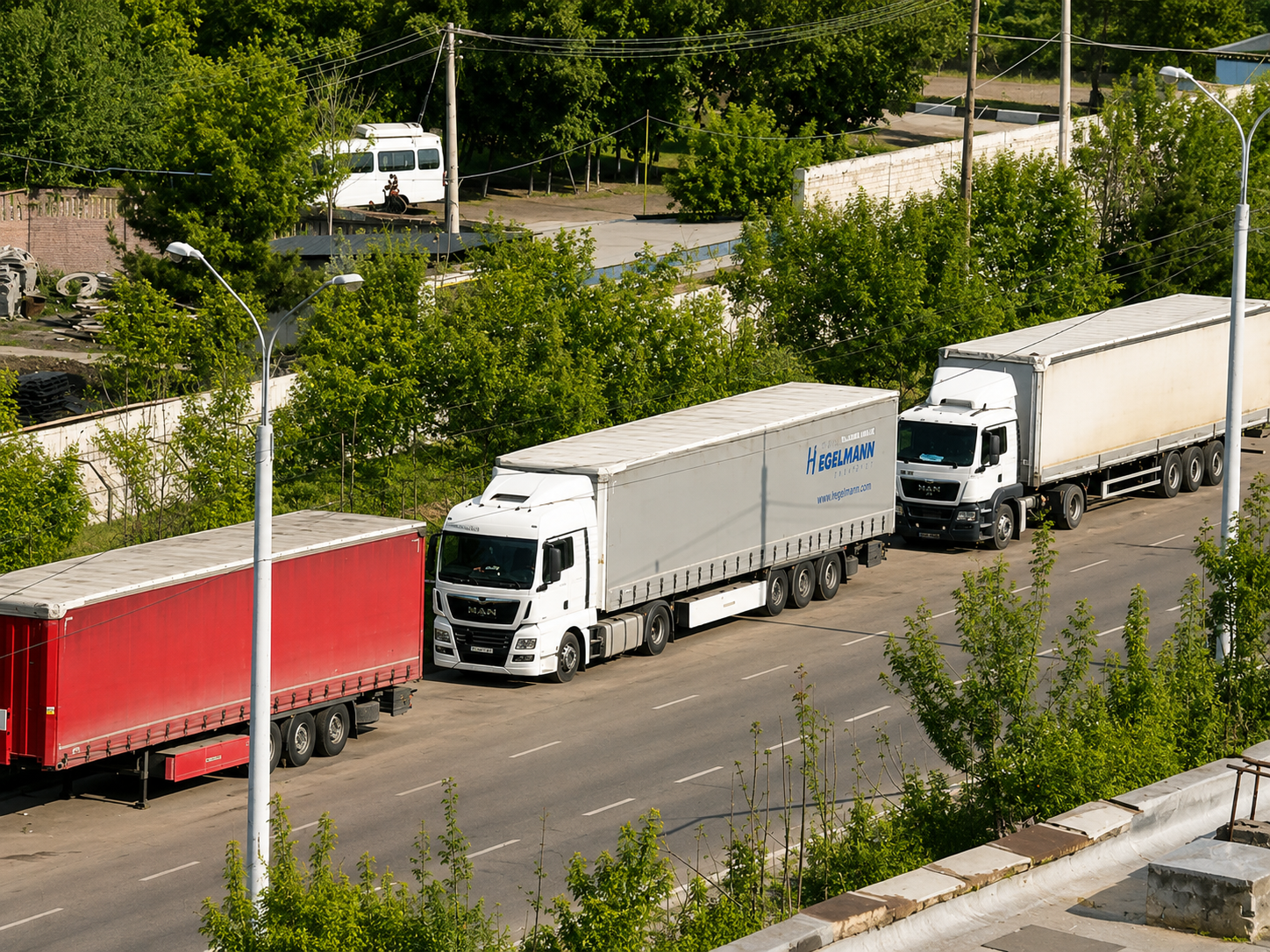
More Than 1,000 Trucks Are Waiting to Enter the EU
Around 1,300 trucks and passenger vehicles were waiting at the Belarusian border on July 29 to enter European Union countries.
According to figures from the Belarusian State Border Committee reported by BelTA, freight traffic alone accounts for approximately 1,020 vehicles waiting on the Polish and Lithuanian routes.
Another roughly 270 passenger cars are also in queues.
Poland has the largest number of waiting trucks, while the sharpest reduction in actual processing capacity has been recorded on the Lithuanian border.
610 Trucks Are Waiting at Kozlovichi
The largest single truck queue has formed in front of the Polish Kukuryki crossing, paired with Kozlovichi on the Belarusian side.
Around 610 trucks are currently waiting to enter Poland.
During the previous 24 hours, the Polish side processed approximately 43% of the established normal truck volume.
Another 90 trucks are waiting at the Bobrowniki–Berestovitsa crossing.
This means around 700 trucks are currently queued on the two Polish freight routes alone.
Kozlovichi–Kukuryki is particularly important for international road freight because it carries traffic from Belarus and countries further east into Poland and the wider European road network.
When processing rates fall, the delay quickly spreads through the supply chain as trucks miss unloading slots, subsequent trips are postponed and drivers’ working schedules have to be adjusted.
Medininkai Processed Only 17 of 500 Trucks
The most serious situation in terms of processing speed is currently on the Lithuanian route.
At the Medininkai–Kamenny Log border crossing, only 17 trucks were processed during the previous 24 hours out of a normal figure of 500.
That represents approximately 3%.
There are currently 110 trucks and 20 passenger cars waiting at the crossing.
The queue is much smaller than at Kozlovichi, but extremely low throughput creates a greater risk that vehicles will continue accumulating.
Even a relatively short queue becomes difficult to clear if new trucks arrive faster than customs and border services are able to process them.
Another 210 Trucks Are Waiting at Šalčininkai
The second operating route between Belarus and Lithuania is also experiencing congestion.
Around 210 trucks are waiting at the Šalčininkai crossing, paired with Benyakoni on the Belarusian side.
Together, the two Lithuanian routes have approximately 320 trucks waiting.
For carriers, simply switching from one crossing to another does not necessarily solve the problem.
A diversion is useful only if the alternative route has enough unused processing capacity. If both crossings are congested, changing route may increase mileage and fuel consumption without producing a meaningful time saving.
About 250 Cars Are Waiting to Enter Poland
Passenger traffic is also being affected.
At 12:00, around 250 passenger vehicles were waiting to enter Poland from Belarus.
According to the Belarusian side, Polish crossings processed approximately 33% of the normal passenger-vehicle volume during the previous 24 hours.
Adding the reported truck and car queues on the Polish and Lithuanian directions produces roughly 1,290 vehicles, explaining the rounded estimate of about 1,300.
Border Queues Are More Expensive for Freight Operators
For a passenger car, a long border queue primarily means lost time. For a commercial truck, the consequences are considerably wider.
A tractor and trailer generate costs even when they are barely moving.
Carriers still have driver costs, driving and rest-time requirements, refrigeration equipment to operate on temperature-controlled loads and subsequent customer bookings to manage.
If a driver reaches a legal driving-time limit while waiting at or shortly after the border, the truck may have to stop for mandatory rest even after customs procedures have been completed.
A delay of several hours at the crossing can therefore result in a substantially longer disruption to the original delivery schedule.
Time-Sensitive Cargo Faces the Greatest Risk
Border congestion is particularly problematic for freight with fixed delivery windows.
This includes industrial components, perishable products, retail distribution cargo, groupage shipments and consignments booked into specific warehouse time slots.
When the truck arrives late, the consignee may need to reorganise warehouse operations, while the carrier can lose the opportunity to use the same vehicle for its next scheduled job.
One delayed truck is normally manageable for a large fleet. When dozens of vehicles belonging to the same operator are stuck simultaneously, utilisation across the entire fleet can deteriorate.
This is why border throughput can be more important to logistics companies than the absolute queue length.
The 610 trucks waiting at Kukuryki represent the largest visible congestion, but Medininkai processing only 3% of normal capacity is a more serious signal when assessing how quickly traffic can return to normal.
Delays Raise the Cost of Belarus–EU Freight
Transport companies can respond by changing departure times, redistributing trucks between crossings and building additional buffer time into schedules.
None of these measures can fully remove the cost of an inefficient border.
Diversions add kilometres. Waiting increases driver and vehicle costs. Uncertainty forces carriers to build larger safety margins into contracts with customers.
Eventually, prolonged border delays either reduce the carrier’s margin or increase the price of transport.
Predictable border procedures are therefore almost as important to international trucking as road quality or fuel prices.
Similar concerns exist elsewhere in Europe. K2Cargo.News previously examined why the European Commission urged nine Schengen countries to end prolonged border controls.
Queue Conditions Can Change Quickly
Border queue data is highly dynamic and may change significantly within hours.
The number of waiting vehicles depends both on the arrival rate of new traffic and on processing speed on the other side of the border.
Carriers planning routes from Belarus into Poland or Lithuania should therefore check conditions shortly before departure and again before approaching the crossing.
As of July 29, Kozlovichi–Kukuryki remains the busiest individual freight route with 610 trucks waiting.
The sharpest throughput problem, however, is at Medininkai–Kamenny Log, where only 17 of the normal 500 trucks were processed during the previous 24 hours.
The combination of large queues and reduced border-processing capacity is currently the main operational risk for road freight moving from Belarus into the EU.
Read also: European Commission Urges Nine Schengen Countries to End Border Controls
