

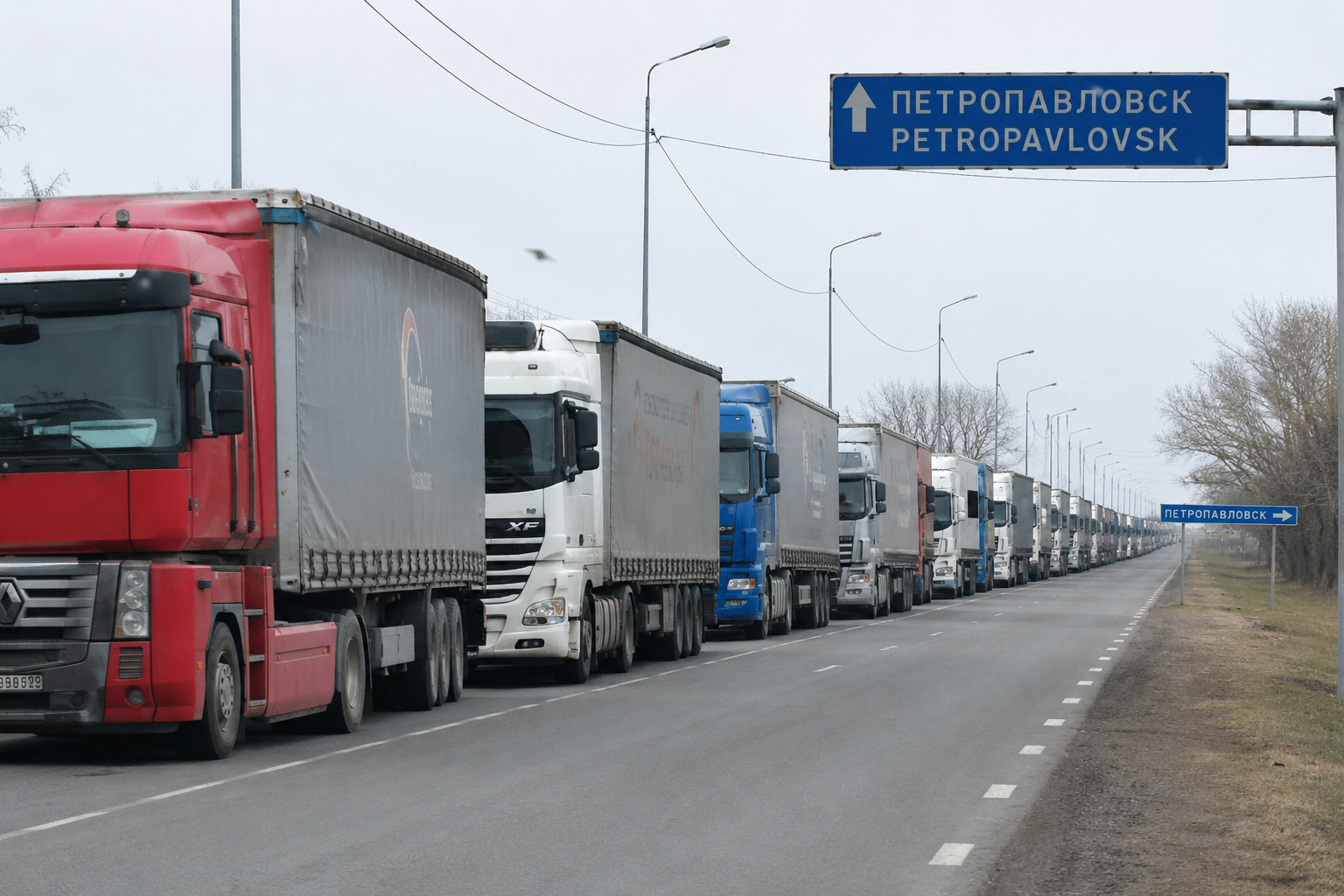
Trucks Stopped Before a Mobile Control Point
More than 30 heavy trucks remained on the roadside near the entrance to Petropavlovsk for approximately three days after their drivers learned that a mobile transport inspection point was operating ahead.
A total of 32 trucks stopped near the city. Regional authorities suspected that some of the vehicles were carrying loads above the permitted weight limits. The drivers left their vehicles and temporarily disappeared rather than proceed to the weighing point and face possible penalties.
The checkpoint was organized on a nationally significant highway as part of a road-safety enforcement operation. Transport inspectors worked together with police officers and a special-response unit.
The incident created an unusual roadside bottleneck. Traffic was not completely blocked, but dozens of heavy vehicles occupied the roadside near the regional capital for several days.
Authorities Said the Checks Were Needed to Protect Roads
Yerden Shortybayev, head of the North Kazakhstan Region’s passenger transport and roads department, said stronger controls were necessary to protect local infrastructure.
According to the regional administration, approximately 1,000 kilometres of roads are repaired in the region each year. During periods of high temperature, trucks exceeding the permitted weight can cause particularly serious damage to asphalt surfaces.
Hot pavement is more vulnerable to deformation. Excessive axle loads can contribute to rutting, cracking and subsidence, especially on roads regularly used by overloaded vehicles.
Regional authorities believe that operators should not only receive administrative fines but also compensate the government for damage caused to public roads. Officials intend to submit civil claims seeking reimbursement of material losses.
The issue is becoming more important as road freight activity expands. K2Cargo.News previously reported that Kazakhstan’s road freight market continues to grow, increasing pressure on infrastructure and enforcement systems.
Authorities Identified Every Vehicle and Driver
Although the drivers left the scene, the trucks did not remain unidentified.
Regional agencies established the ownership of all 32 vehicles and identified the people who had been driving them. Modern road-control systems can trace trucks through registration plates, camera records and transport documents.
Four automated weight-control arches currently operate on roads in the North Kazakhstan Region.
Such systems can record passing vehicles, recognize registration numbers and detect possible violations without requiring inspectors to stop every truck manually.
Cameras also make it more difficult to travel with covered or deliberately obscured registration plates. Authorities expect automated enforcement to make inspections more consistent and reduce reliance on individual mobile checkpoints.
Drivers Say Strict Limits Can Make Transport Unprofitable
Truck drivers argue that overloading is not always motivated solely by a desire for additional profit.
They say some types of freight transport become economically unviable when all weight limits are applied strictly. Dividing one large shipment between several vehicles increases spending on fuel, drivers, maintenance and road charges.
The economics are particularly difficult for low-value bulk cargoes. These may include certain construction materials, agricultural products and other goods for which transport represents a significant share of the final price.
Overloading allows an operator to complete a delivery with fewer vehicles and fewer trips. The resulting savings, however, transfer additional costs to the state, which must repair damaged roads.
The dispute therefore reflects a conflict between the carrier’s short-term commercial interests and the long-term cost of maintaining public infrastructure.
Mobile Checkpoints Remain Controversial
Drivers also criticized the decision to place the mobile weighing point directly at the entrance to Petropavlovsk.
By the time the vehicle reaches the checkpoint, it may already have travelled hundreds of kilometres. Truckers argue that this approach does not prevent the violation because the overloaded vehicle has already used and potentially damaged a substantial section of the road network.
Carriers believe weight controls should operate closer to loading sites, quarries, grain elevators, industrial facilities and other locations where freight flows begin.
This would allow authorities to identify excessive weight before a truck enters a major highway.
Drivers view checkpoints positioned near cities primarily as fine-collection tools. In their opinion, an effective system should focus not only on punishment but also on preventing violations before they occur.
The Three-Day Delay Increased Carrier Costs
The attempt to avoid inspection resulted in a prolonged interruption for all 32 trucks.
For three days, the vehicles could not complete commercial trips. Drivers and transport companies lost operating time, while cargo recipients faced possible delivery delays.
A heavy truck continues to generate expenses even while stationary. Operators must still cover leasing, insurance, wages, communications and contractual obligations to customers.
One delayed trip can also affect later assignments. When a truck is scheduled to collect another shipment after unloading, its entire operating schedule shifts.
For some companies, the cost of the three-day delay may have exceeded the original fine. Before weighing, however, drivers may not have known the exact extent of any violation or the amount of the potential penalty.
All 32 Trucks Eventually Passed the Weight Check
The situation returned to normal on July 19.
According to the North Kazakhstan Region police department, all 32 drivers returned to their vehicles at 2:30 p.m. after officers conducted preventive and explanatory discussions with them.
The trucks proceeded to the weight-control point and completed the weighing procedure. They were then allowed to continue along their routes.
Authorized government agencies applied the required measures against the identified offenders in accordance with Kazakh law.
The attempt to avoid inspection therefore did not prevent enforcement. It only extended the delivery time and attracted additional attention from police and transport inspectors.
Overloading Can Result in Significant Fines
Kazakhstan applies differentiated penalties depending on the amount by which a vehicle exceeds the permitted weight.
For individual entrepreneurs, exceeding the legal limit by between one and five tonnes can result in a fine of 40 monthly calculation indices. An excess of between five and ten tonnes increases the penalty to 80 indices.
When the overload exceeds ten tonnes, an individual entrepreneur can face a fine of 120 monthly calculation indices.
Higher penalties apply to medium-sized and large businesses. The final amount may depend on the operator’s legal status, the level of overloading and the circumstances of the shipment.
Additional costs may arise when part of the cargo must be unloaded, another vehicle must be dispatched or the operator must wait for authorization to continue.
Automated Enforcement Will Change Carrier Behaviour
The Petropavlovsk incident demonstrates the limitations of enforcement based only on mobile checkpoints.
When drivers learn where inspectors are operating, they can stop, change routes or wait for the inspection to end. This creates roadside congestion and does not provide continuous control across the road network.
Automated weight-control arches reduce opportunities for avoidance. They can operate around the clock without advance warning to drivers.
An effective system nevertheless requires more than cameras. Measurements must be reliable, appeal procedures transparent and enforcement rules understandable.
Transport companies need clear information about weight limits, axle-load calculations and the documents required for heavy or indivisible cargo.
Controls Near Loading Sites Could Be More Effective
The disagreement between authorities and carriers highlights the need to reconsider where weight checks are performed.
A checkpoint near a city can identify a violation, but it does not stop an overloaded vehicle from travelling most of its route.
A more effective system could combine fixed arches, mobile inspections and controls at major loading locations.
When a truck is already overloaded as it leaves an industrial facility, responsibility could extend beyond the carrier to the shipper that authorized the cargo.
This would distribute liability between the parties involved and reduce pressure on drivers, who do not always independently determine the weight of the goods they receive.
Authorities must also consider the industry’s economic arguments. When existing limits make certain transport operations structurally unprofitable, companies will continue looking for ways around the rules.
The solution does not necessarily require weaker safety standards. Kazakhstan could instead improve legal procedures for heavy transport, make permits more transparent and review how such operations are priced.
The Incident Is a Warning for the Freight Market
The three-day delay involving 32 trucks showed that attempting to avoid weight control can produce even greater losses.
Carriers lost operating time, customers faced potential delivery delays and the drivers were ultimately required to complete the weighing process.
For the authorities, the incident demonstrated the value of expanding automated enforcement. For transport companies, it showed that traditional methods of avoiding inspection are becoming less effective.
The central unresolved issue is how to balance road protection with the economics of freight transport.
Without enforcement, overloaded trucks accelerate infrastructure deterioration and increase publicly funded repair costs. But a rigid system that fails to consider the characteristics of individual cargoes and routes can increase business expenses and encourage further avoidance.
A sustainable approach will require Kazakhstan to combine automated weighing, controls at loading sites, shipper responsibility and clear legal procedures for moving heavy cargo.
Read also: Kazakhstan Strengthens Support for International Road Carriers