

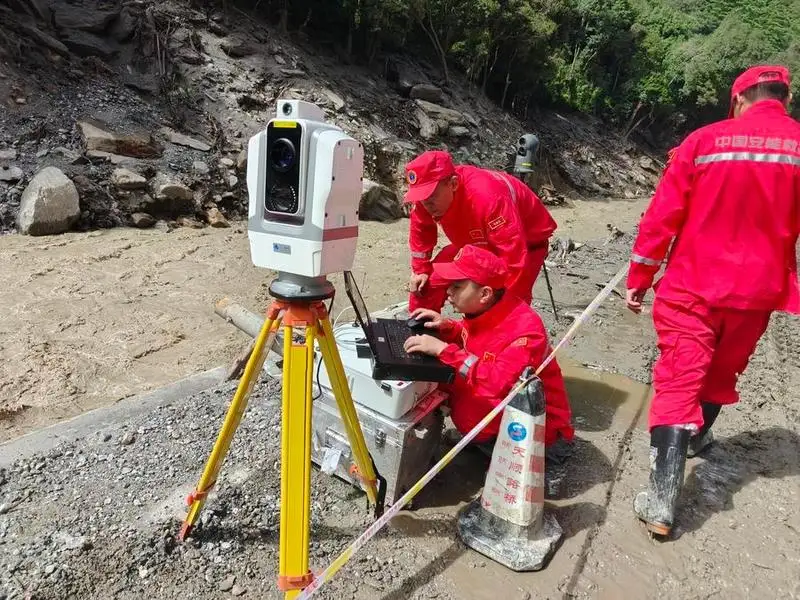
Following an ice avalanche that claimed numerous lives along the Chinese-Nepalese border, around 20 sets of equipment have been deployed in Gyirong to monitor geological hazards.
Following the ice avalanche in Gyirong that resulted in numerous casualties on both sides of the Chinese-Nepalese border, China has deployed approximately 20 sets of equipment to monitor geological risks. Specialists are tracking slope movements, ground deformation, debris flows and the potential for further rockfalls in real time.
According to Ge Daqing, deputy director of the China Center for Aerogeophysical Survey and Remote Sensing, the data collected so far indicate that the situation is stabilizing. No significant fluctuations have been detected, while the risk of a large-scale secondary disaster is currently considered low in the absence of external factors. However, the area’s complex terrain continues to pose potential hazards.
One of the main challenges is monitoring high-altitude areas, where clouds and fog significantly limit the capabilities of optical satellites. Chinese specialists are calling for greater development of synthetic aperture radar (SAR) satellites and drone-based monitoring technologies.
As reported by China Daily, the risk of glacial-rock avalanches in the Himalayas may increase due to a combination of the effects of the 2015 earthquake, glacial erosion and unstable mountain slopes. Given the cross-border nature of such hazards, specialists stress the need for stronger international cooperation on disaster monitoring and early warning systems.
Read also: Japan’s Foreign Minister to Visit Mongolia as a Like-Minded Partner
