

Major Freight Corridor Closed to Trucks
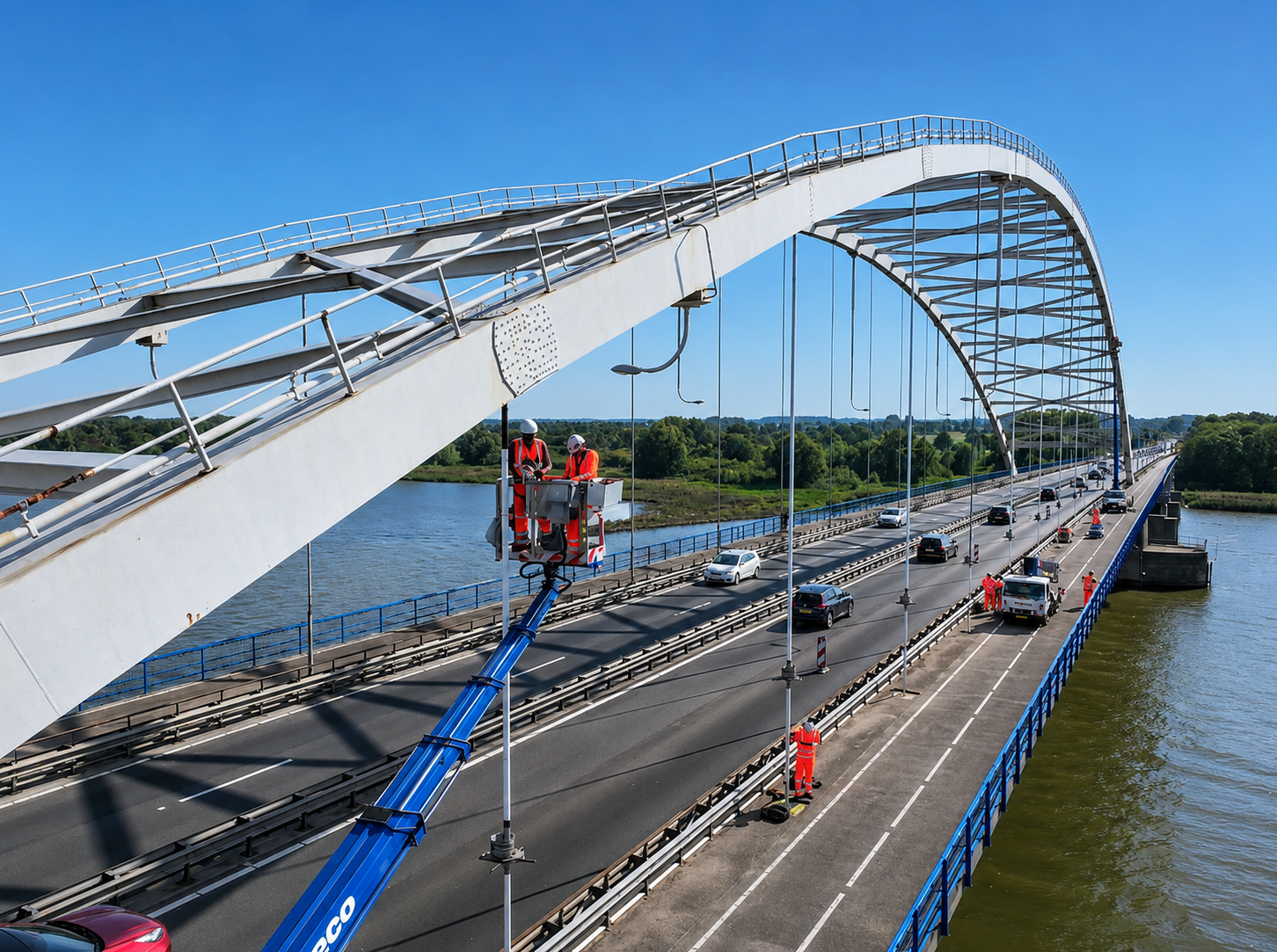
The Netherlands has imposed a complete ban on truck traffic across the Merwede Bridge on the A27 motorway near Gorinchem.
The restriction follows additional engineering studies showing that parts of the steel arch structure are weaker than previously believed.
The decision was taken by Rijkswaterstaat (RWS), the executive agency of the Dutch Ministry of Infrastructure and Water Management.
According to RWS, the bridge can no longer safely accommodate heavy truck traffic.
The restriction applies to all trucks, while passenger cars, vans, buses and other lighter vehicles may continue using the bridge.
Engineers Identified Reduced Structural Strength
The emergency measure followed detailed structural investigations.
Engineers found that several sections of the steel arch have lower strength than earlier assessments indicated.
According to Rijkswaterstaat, steel plates forming parts of the bridge may deform under heavy loading.
Removing trucks from the bridge immediately reduces structural stress and provides engineers with time to determine the most appropriate long-term solution.
Until further investigations are completed, only lighter traffic will continue using the crossing.
The Bridge Is Critical to Dutch Logistics
The Merwede Bridge carries the A27 motorway between Breda and Utrecht.
This route forms one of the Netherlands’ principal north-south transport corridors and handles heavy volumes of passenger and freight traffic every day.
For international logistics the motorway is particularly important because it connects the ports of Rotterdam and Antwerp with central Dutch industrial regions and onward routes into Germany.
Closing such a strategic crossing immediately affects the wider motorway network.
Heavy traffic must now redistribute across neighbouring motorways, increasing pressure on infrastructure that is already heavily used.
Freight Traffic Will Shift to Alternative Routes
Truck operators are now required to use alternative motorways.
The principal diversion routes include the A2, A15, A16 and A59.
For many international operators this means longer journeys through the centre of the Netherlands.
Even relatively small detours become significant when hundreds of daily trips are involved.
Additional kilometres increase fuel consumption, driver working hours, vehicle wear and route-planning complexity.
Just-in-time logistics operations will be particularly affected.
Restrictions Coincide with Major Roadworks
The situation has become even more complicated because the region is already experiencing extensive infrastructure maintenance.
At almost the same time, long-term repairs began on the Papendrecht Bridge on the N3 road.
As a result, the number of practical diversion options has been further reduced.
Transport companies must therefore manage multiple major infrastructure disruptions simultaneously.
Dispatchers are expected to adjust routes continuously according to changing traffic conditions.
Carriers Warn of Higher Operating Costs
Transport en Logistiek Nederland (TLN) strongly criticized the timing of the closure.
According to the industry association, the restriction comes at an especially difficult moment.
Road freight operators are already facing higher diesel prices, new truck tolls and increasing operating expenses.
Mandatory diversions now add further costs by extending journey distances and travel times.
Even relatively small delays may require additional rest breaks under European driving-time legislation.
Every Additional Kilometre Increases Transport Costs
The financial impact extends well beyond fuel consumption.
Longer routes increase tyre wear, maintenance costs and vehicle depreciation.
At the same time, trucks complete fewer trips during each working day.
A vehicle previously capable of making two deliveries may only complete one after route extensions.
Small infrastructure disruptions therefore reduce the productivity of entire fleets.
Parking Capacity Could Come Under Pressure
Longer journeys also affect truck parking.
Drivers will reach rest areas later than usual.
As more vehicles follow identical diversion routes, parking demand may become concentrated on the same motorway corridors.
Official truck parks could therefore reach full capacity earlier in the evening.
This creates additional challenges for compliance with European driving and rest-time rules.
K2Cargo.News recently reported that Germany is investing €500 million in motorway rest areas and secure truck parking, although parking shortages remain a major European logistics issue.
Authorities Continue Evaluating Repair Options
Rijkswaterstaat has not yet announced when trucks may return to the bridge.
Engineers continue assessing the structure and evaluating possible technical solutions.
Potential options include reinforcing structural elements, replacing weakened steel components or carrying out a more extensive reconstruction.
Until inspections are completed, authorities cannot provide even a preliminary reopening date.
Transport companies should therefore prepare for a prolonged period of diversion.
Europe’s Aging Bridges Present Growing Challenges
The Merwede Bridge reflects a wider European infrastructure issue.
Many motorway bridges were built decades ago when freight traffic volumes were considerably lower.
Today’s heavier traffic places significantly greater demands on structures that operate almost continuously.
Modern engineering assessments sometimes reveal lower structural capacity than originally calculated.
For this reason, emergency restrictions are increasingly introduced after updated inspections identify previously unknown weaknesses.
Logistics Networks Depend on Individual Structures
Modern supply chains are highly sensitive to the closure of even one important bridge.
When thousands of trucks cross a structure every day, closing it immediately redistributes traffic across surrounding regions.
Congestion spreads not only to major diversion routes but also to regional roads that were never designed for such heavy freight volumes.
This accelerates pavement wear and increases maintenance costs.
Infrastructure availability has therefore become another critical variable alongside weather, border delays and construction work.
Dispatchers Must Adapt Quickly
Transport companies operating through the central Netherlands will need to monitor conditions closely.
Planning should consider both official diversion routes and likely congestion on neighbouring motorways.
Navigation systems will gradually incorporate the restrictions, but dispatchers should continue following Rijkswaterstaat traffic updates.
International operators serving Rotterdam, Belgium, Germany and northern Dutch destinations will be particularly affected.
Even relatively small route changes can influence unloading schedules and fleet utilization.
The Closure Will Test Dutch Logistics
The complete truck ban on the Merwede Bridge represents one of the Netherlands’ most significant recent freight restrictions.
For the authorities, structural safety remains the overriding priority.
For carriers, the measure brings higher operating costs, longer delivery times and more complicated route planning.
With engineers still assessing the bridge, there is currently no indication of when heavy traffic will be allowed to return.
Freight operators must therefore adapt their planning while one of Europe’s busiest transport corridors continues operating under significant restrictions.
Read also: Germany Invests €500 Million in Motorway Rest Areas and Secure Truck Parking