

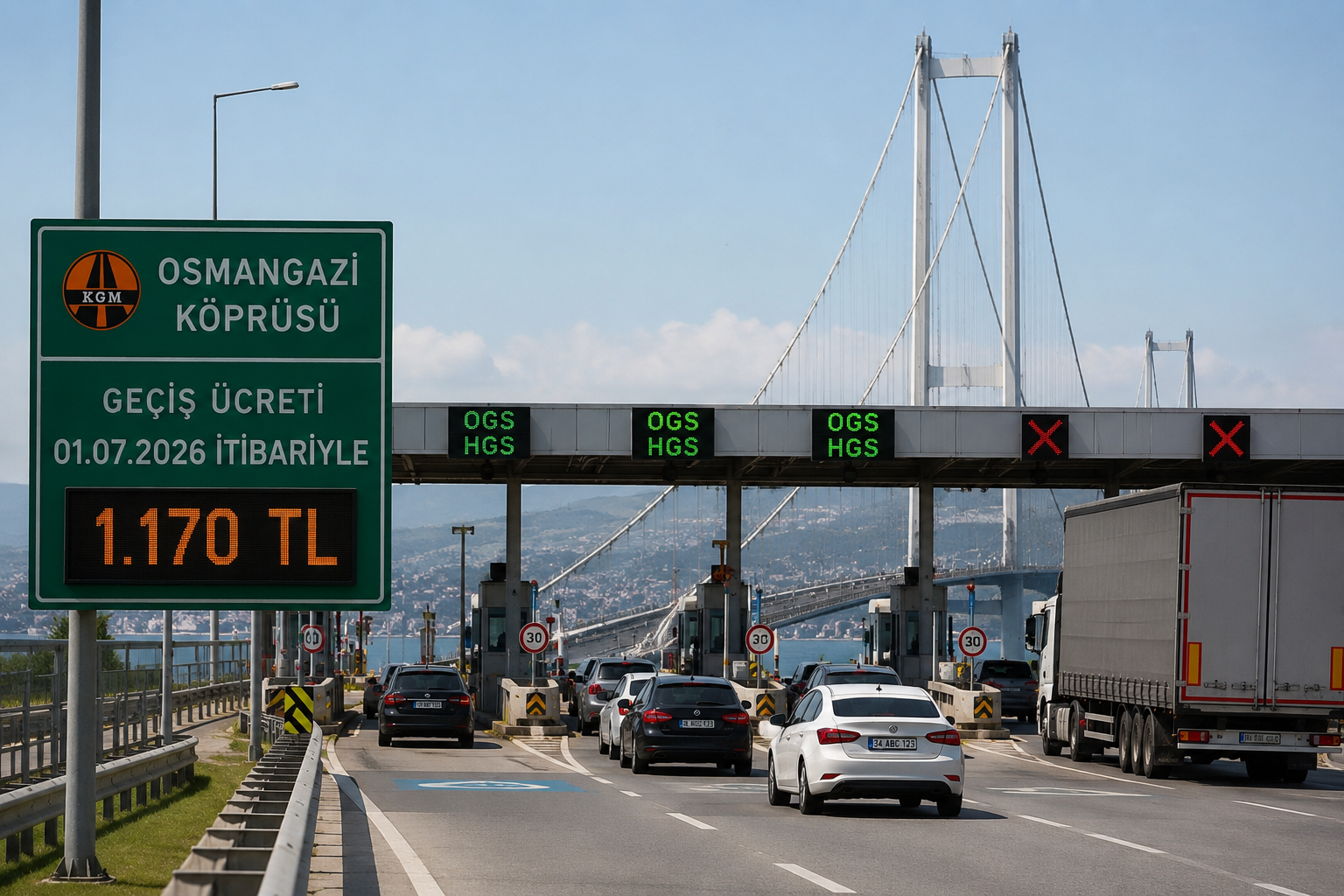
Turkey has introduced new toll rates on a number of strategic bridges and motorways from July 1, 2026. The updated tariffs were published by the General Directorate of Highways of Turkey (KGM) and affect some of the country’s most important paid transport corridors.
For passenger cars, the toll on the Osmangazi Bridge increased from 995 to 1,170 Turkish lira. The Yavuz Sultan Selim Bridge rose from 95 to 110 lira, while the 1915 Çanakkale Bridge also increased from 995 to 1,170 lira. The Ankara–Niğde Motorway tariff was raised from 740 to 925 lira.
At first glance, the change may look like a consumer transport issue. However, toll pricing on key national routes matters far beyond private travel. In a country that connects Europe, the Black Sea, the Caucasus, the Middle East and Central Asia, road infrastructure costs are closely linked to the wider performance of supply chains.
As K2Cargo News recently reported in Turkey Raises Bosphorus and Dardanelles Transit Fees by 15% from July 1, Ankara has been adjusting transport-related charges across different parts of its infrastructure network. The latest road toll increase fits into the same broader trend: users of strategic transport assets are paying more for access to routes that are essential for national and international mobility.
Key Routes Become More Expensive
The affected bridges and motorways are not ordinary road sections. They are part of Turkey’s strategic transport geography.
The Osmangazi Bridge is a critical link across the Gulf of İzmit, reducing travel times between Istanbul, Bursa and İzmir. The Yavuz Sultan Selim Bridge supports traffic across the Bosphorus and is especially important for northern Marmara connectivity. The 1915 Çanakkale Bridge provides a major crossing over the Dardanelles, while the Ankara–Niğde Motorway strengthens the road connection between central Anatolia and southern corridors.
Even if the newly announced examples focus on passenger cars, the importance of these routes extends to commercial mobility. Logistics networks depend not only on heavy trucks, but also on service vehicles, courier operations, company fleets, technical teams, spare parts distribution and regional business travel.
In modern supply chains, every road corridor is part of a larger system. When the cost of using high-speed infrastructure rises, companies begin reassessing route planning, delivery frequency, fleet allocation and the total cost of serving specific regions.
Why Toll Changes Matter for Supply Chains
Supply chains are increasingly shaped by small cost changes across many links.
A single toll increase may not transform the price of a product. But when higher road charges are combined with fuel prices, driver wages, vehicle maintenance, insurance, warehouse rent and last-mile delivery costs, the cumulative effect becomes more visible.
This is especially relevant in Turkey, where domestic and international logistics are closely connected. Goods arriving through ports, airports, industrial zones and border crossings often depend on fast road links to reach consumers, factories and distribution centers.
For retailers and manufacturers, predictable road costs are important because delivery promises are becoming stricter. In e-commerce, for example, consumers increasingly expect fast delivery, while sellers face pressure to dispatch goods more quickly.
K2Cargo News previously wrote that Turkish marketplaces are tightening seller rules to speed up deliveries. That trend increases the importance of reliable road transport. If delivery windows become shorter while infrastructure costs rise, logistics providers must improve efficiency to protect margins.
Passenger Car Tariffs Still Affect Business Mobility
Because the new tariff examples concern passenger cars, the direct effect on heavy freight transport should not be overstated. Commercial trucks are charged under separate vehicle classes, and logistics companies must rely on the current KGM tariff tables for exact route planning.
However, passenger car and light vehicle tolls still matter for business operations.
Many companies use passenger cars and light commercial vehicles for sales visits, technical support, urgent documents, small spare parts, regional supervision and warehouse-to-office mobility. In some sectors, these movements are essential for keeping supply chains running smoothly.
Higher tolls may also affect subcontractors and small service providers that support logistics infrastructure, including maintenance teams, inspection services, customs brokers and regional distributors.
Large freight companies usually have more tools to absorb or redistribute cost increases. Smaller operators often have less flexibility. For them, even moderate increases in road access costs can influence daily routing decisions.
Turkey’s Infrastructure Remains Strategically Important
Turkey’s road infrastructure plays a central role in Eurasian trade.
The country connects European markets with the Middle East, the Caucasus and Central Asia. It also serves as a bridge between maritime, road and rail corridors. Istanbul and the Marmara region remain among the most important transport and industrial zones in the wider region.
This is why toll policy in Turkey is watched closely by logistics companies. Road charges are not only a domestic matter. They influence the cost of moving goods through one of the most important transport crossroads between Europe and Asia.
For international supply chains, Turkey offers several advantages: strong manufacturing capacity, access to ports, road connections to Europe and the Middle East, and a growing role in regional distribution. But these advantages depend on the ability to keep transport costs predictable.
If toll increases continue, logistics companies may place more emphasis on route optimization, consolidation, multimodal transport and digital cost control tools.
Companies Will Need Better Cost Visibility
The latest toll increases reinforce a wider logistics trend: supply chain managers need better visibility over transport costs.
In the past, route planning often focused mainly on distance and transit time. Today, cost modeling is more complex. Companies must consider tolls, fuel, emissions rules, driver availability, waiting times, road restrictions and delivery reliability.
For Turkey, this means that logistics operators may increasingly compare paid high-speed routes with alternative roads. In some cases, paying a higher toll may still be more efficient if it reduces travel time, fuel consumption and delays. In other cases, companies may choose lower-cost routes when delivery deadlines are less strict.
The key question is not simply whether tolls are higher. It is whether the total logistics cost remains competitive.
This is particularly important for sectors with tight margins, including retail, food distribution, construction materials, automotive components and e-commerce fulfillment.
What This Means for Logistics Operators
The toll increase should encourage logistics companies operating in Turkey to review their transport cost assumptions.
Even when tariff changes directly concern passenger cars, they create a broader signal: infrastructure access costs are rising, and companies need to prepare for a more expensive operating environment.
For large supply chains, the response will likely involve better route planning, improved load consolidation and stronger coordination between warehouses, suppliers and carriers. For smaller companies, the priority may be more practical: choosing routes carefully, reducing unnecessary trips and passing part of the cost into service pricing where possible.
Turkey’s logistics market remains highly important for regional trade, but cost discipline is becoming more important. As customers demand faster delivery and governments continue investing in major infrastructure, the balance between speed, price and reliability will define the next stage of supply chain competition.
The latest toll adjustment is therefore more than a change in road pricing. It is another reminder that modern supply chains are vulnerable not only to global disruptions, but also to local infrastructure costs that gradually reshape transport economics.
Read also: Turkey Raises Bosphorus and Dardanelles Transit Fees by 15% from July 1
