

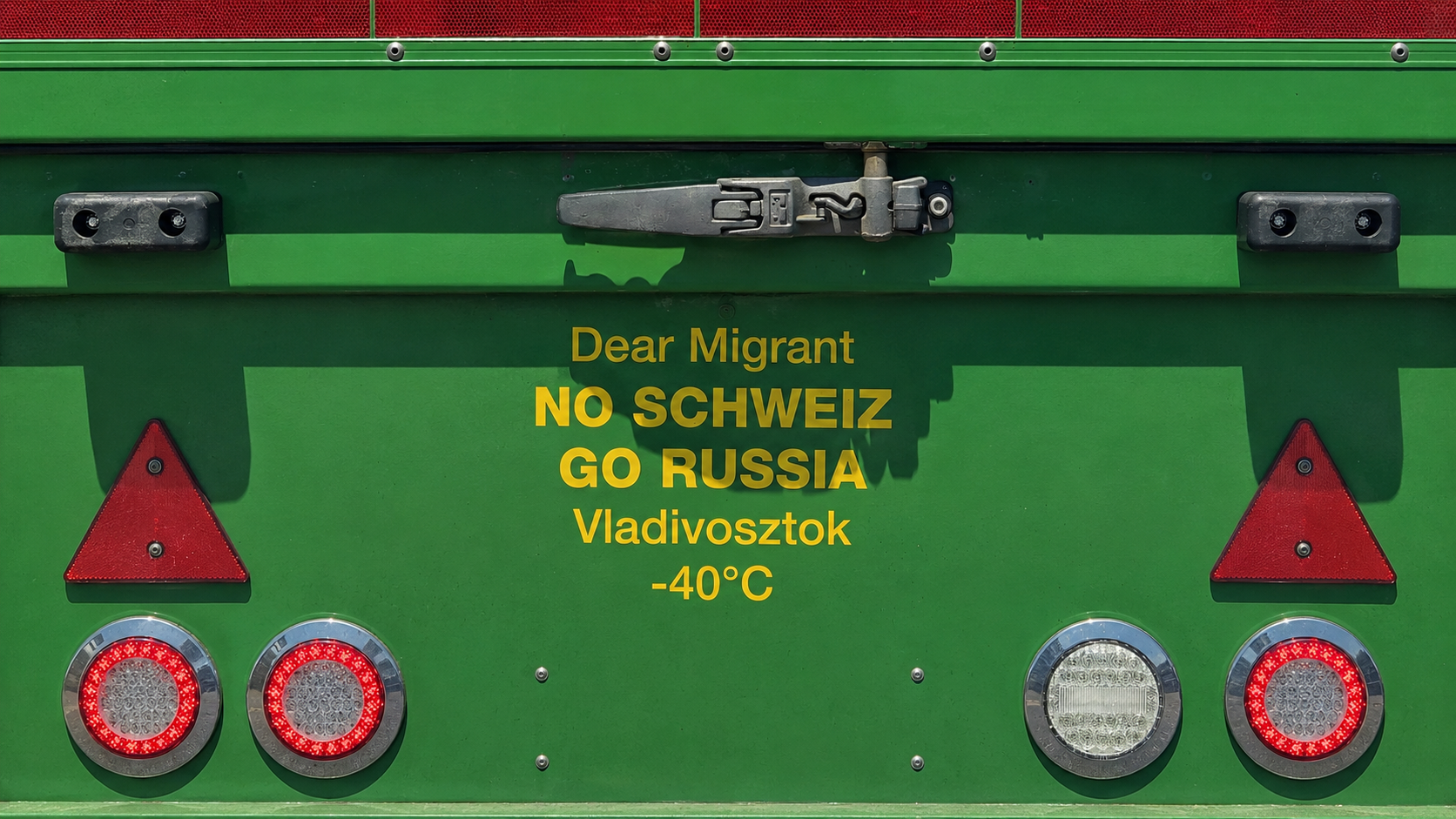
A small sticker on a truck has turned into a public controversy in Switzerland. The vehicle belonged to Raschle AG, a transport company from Bazenheid in the canton of St. Gallen, and carried a message addressed to migrants. After the image was noticed by a reader and reported by Swiss media, the company faced accusations of spreading anti-foreigner sentiment.
The sticker read: “Dear Migrant, No Schweiz, Go Russia, Vladivosztok -40°C.” The wording is grammatically awkward, but the message was interpreted by critics as a demand that migrants leave Switzerland or not come there at all.
The story quickly moved beyond a simple photo of a truck. Swiss media reported on the case, the SP Toggenburg political group reacted publicly, and the Foundation Against Racism and Antisemitism was asked to comment on whether such wording could fall under Swiss anti-discrimination rules.
For the road transport sector, however, the case is more complicated than a single offensive slogan. Similar stickers appeared on trucks years ago during the migration crisis, when drivers and carriers were dealing with attempts by people to enter trailers and reach another country irregularly. That background does not make the sticker harmless, but it explains why some in the industry read it differently from the general public.
As K2Cargo News previously reported in New Report Reveals Widespread Problems in Europe’s International Road Transport Sector, road freight companies face pressure not only from costs and regulation, but also from security, enforcement and operational risks.
Why the Sticker Caused Outrage
The public reaction was sharp because the message was visible on a company truck operating on public roads.
Critics argued that a business vehicle is not a private notebook or a closed workplace. It represents the company in public space. When a transport operator displays a political or social message on its fleet, that message becomes part of the company’s public image.
SP Toggenburg described the wording as an attack on democratic values and said it excluded a whole group of people from society. According to Swiss reports, the Foundation Against Racism and Antisemitism considered the wording xenophobic, although not necessarily criminal under Swiss law because “migrant” is not a specifically protected category in the relevant anti-racism provision.
That distinction matters. Something may be legal and still damage a company’s reputation. For carriers, brand trust is important: clients, drivers, partners and authorities all see the fleet. A slogan that some drivers may view as industry humor can be received by the public as open hostility.
The Transport Context Behind Such Stickers
The transport industry has its own memory of the migration crisis.
In the mid-2010s, especially around Calais and other Channel routes, European truck drivers often faced attempts by people to hide inside trailers or climb onto vehicles. Carriers had to deal with damaged cargo, delays, inspections, security procedures and financial penalties.
The UK’s clandestine entrant civil penalty scheme places responsibility on drivers, owners, hirers and operators to secure vehicles against unauthorized access. Industry organizations have repeatedly argued that the penalty system can place heavy burdens on hauliers, especially when drivers report hidden passengers after doing security checks.
This background helps explain why stickers warning that a truck was “not going to Switzerland” or was heading to a far colder destination appeared on some European vehicles. They were often meant as a crude attempt to discourage people from entering trailers.
But context is not the same as justification. A slogan created inside a stressful operational environment can still become unacceptable when displayed broadly, especially if it targets “migrants” as a whole rather than a specific security risk.
Why the Meaning Was Misread
Part of the scandal comes from a gap between industry language and public interpretation.
Inside road freight, many people understood such stickers as a reaction to forced entry into trailers and to penalties imposed on transport companies. Outside the industry, the same phrase can look like a general anti-migrant statement.
That gap is important. The public does not automatically know the history of border checks, trailer seals, clandestine entry penalties or the stress drivers faced on certain routes. A short slogan on a truck has no room to explain that background.
This is why companies need to be especially careful with visual messages. What may have started as a rough protest against unfair enforcement can easily be read as hostility toward people based on origin or migration status.
A Real Problem Needs Better Language
The underlying transport problem is real.
Carriers need protection against unauthorized entry into trailers. Drivers should not be left alone to manage security risks at border areas. Penalty systems should distinguish between negligent operators and companies that take reasonable precautions. Authorities also need to protect both freight operations and vulnerable people who may be exploited by smugglers.
But none of that requires slogans that appear to reject migrants as a group.
A better industry response would focus on specific problems: trailer security, border protection, fair enforcement, smuggling networks, safe parking and liability rules. These are legitimate freight issues. They can be discussed without turning company vehicles into political posters.
For transport companies, this case is a reminder that public communication matters. A truck is a moving billboard. A poorly worded sticker can create reputational damage far beyond its original intention.
A Lesson for Carriers and Media
The controversy also shows that media coverage of transport issues often misses operational context.
If the story is reduced only to xenophobia, the real problems faced by drivers during migration pressure on freight routes disappear from view. If the story is reduced only to “industry humor,” the social impact of the wording is ignored. Both approaches are incomplete.
The more useful lesson is that road freight operates at the intersection of logistics, border control, labor pressure and public politics. Carriers need clearer, more responsible ways to describe their problems. Media outlets need a better understanding of the conditions under which drivers work.
The Raschle AG sticker became a scandal because it touched both issues at once: a real freight-security grievance and a public message that many people found degrading.
For the industry, the conclusion should be practical. Security concerns are legitimate. Hostile slogans are not a good way to express them.
Read also: New Report Reveals Widespread Problems in Europe’s International Road Transport Sector