

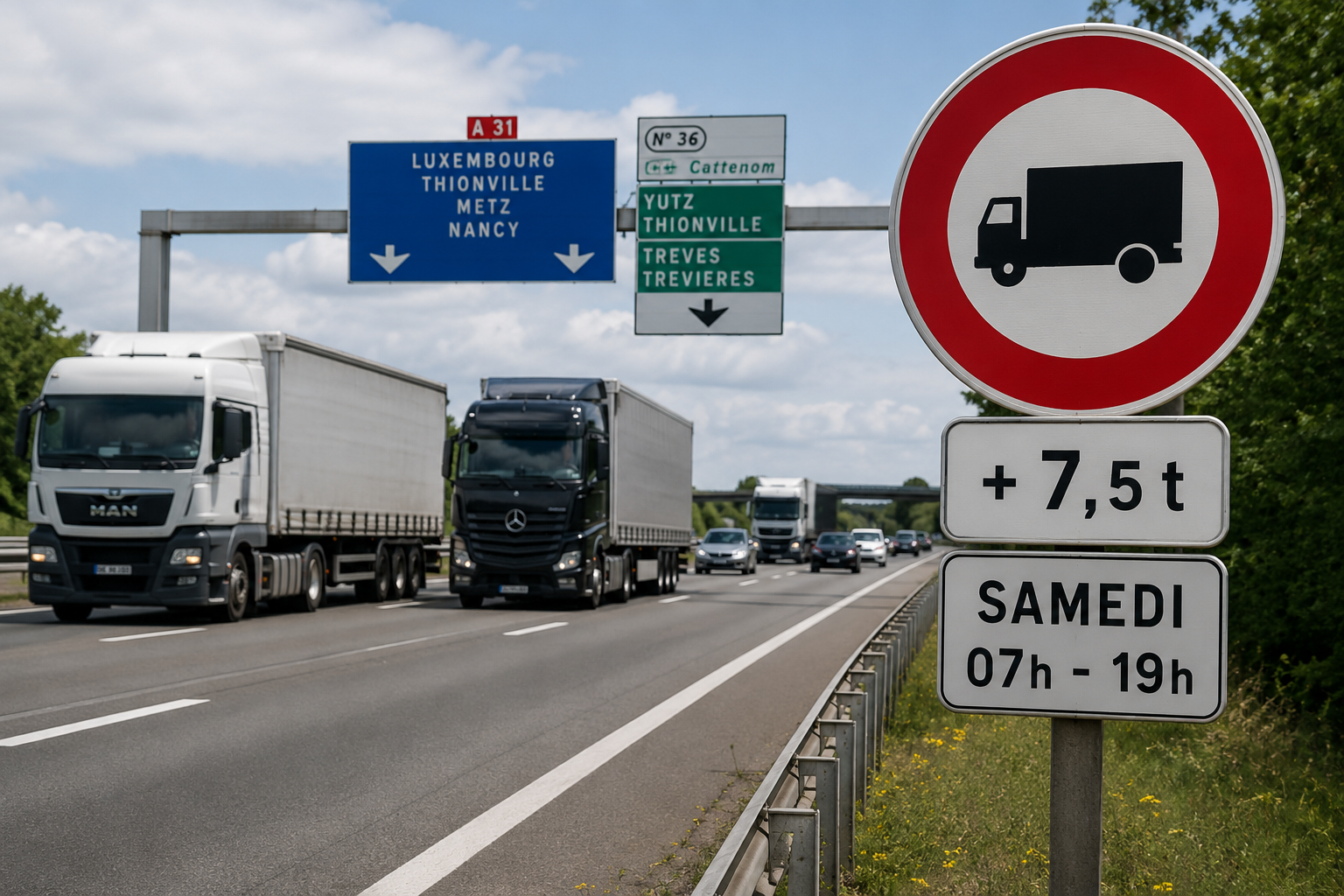
Road freight companies operating in France and Luxembourg face a difficult planning window in mid-July. From July 11, France will introduce additional Saturday restrictions for heavy goods vehicles, followed by the usual weekend bans and limits linked to the French National Day on July 14.
The restrictions apply to vehicles and vehicle combinations with a gross weight above 7.5 tonnes. They will affect both domestic and international transport, including vehicles transiting through Luxembourg toward France.
For carriers, the main issue is timing. A truck that misses a delivery window or reaches the border too late may be forced to wait for many hours before continuing. This can affect driver schedules, delivery promises, parking availability and compliance with driving and rest-time rules.
The French restrictions come during a period when many European countries already apply summer traffic limits for trucks. Holiday traffic, roadworks and higher passenger-car volumes make July especially sensitive for heavy goods transport.
As K2Cargo News previously reported in Europe Introduces Summer Truck Driving Restrictions for 2026, summer truck bans are becoming a major operational factor for European road freight. The France-Luxembourg restrictions are another example of how seasonal rules can reshape route planning.
France: July 11 Starts the Restriction Period
The first key date is Saturday, July 11.
On that day, vehicles and combinations above 7.5 tonnes will be banned from French roads from 07:00 to 19:00. This is one of the additional summer Saturday restrictions used in France during the holiday season, when passenger traffic is especially heavy.
After that, the standard weekend ban will follow. It will begin on Saturday at 22:00 and continue until Sunday, July 12, at 22:00.
This creates a narrow operating window between 19:00 and 22:00 on Saturday. For many carriers, this window may not be enough to complete a route, reach a loading point or cross a long section of France. Dispatchers will therefore need to decide in advance whether a truck should move before the ban, wait, or be routed differently.
The restriction period then continues ahead of the French National Day. On July 13, the ban will apply from 22:00 to 24:00. On July 14, it will continue from 00:00 to 22:00.
In practice, this means that operators may face restrictions across four calendar days: July 11, July 12, July 13 and July 14.
Luxembourg Also Restricts Traffic Toward France
Luxembourg will also apply additional restrictions for heavy goods vehicles heading toward France.
In addition to normal weekend rules, trucks above 7.5 tonnes traveling in the direction of France will be restricted from 21:30 on July 13 until 21:45 on July 14.
This is important because Luxembourg is a key transit country between Germany, Belgium and France. Many carriers use Luxembourg routes for cross-border movements, fuel stops and access to French destinations. If a vehicle is heading toward France, the Luxembourg restriction must be included in route planning.
The timing is slightly different from France’s own rules, which creates another planning detail for dispatchers. A route that appears possible under one country’s timetable may still be blocked by the neighboring country’s direction-specific ban.
Exceptions Will Apply
Both France and Luxembourg provide exemptions from truck bans, but carriers should not assume that every urgent shipment qualifies.
Exceptions usually cover specific categories such as certain perishable goods, emergency transport, vehicles supporting public safety, infrastructure maintenance, fuel or other essential services. The scope may differ depending on the country, cargo type and route.
For carriers, the safest approach is to verify the applicable exemption before departure and prepare documentation. Drivers should be able to prove why the vehicle is allowed to move during the restricted period.
This is especially important for international transport. A shipment that qualifies for an exception in one country may not automatically qualify in another. Misunderstanding the rules can lead to fines, delays or forced parking.
Germany Adds Another Planning Challenge
The French and Luxembourg restrictions are not the only issue for carriers in the region.
In Germany, the A4 motorway toward Olpe will be fully closed between the Köln-West interchange and the Köln-Eifeltor exit. The closure is linked to the installation of a special barrier system intended to reduce stress on the Eifeltor structure and allow safer movement of heavy goods vehicles in the future.
For carriers moving between Germany, Luxembourg and France, this creates a more complex network situation. A route that avoids French restrictions may still be affected by German roadworks. A diversion around Cologne may add time, increase fuel costs and change driver rest planning.
This is why mid-July requires coordinated planning rather than last-minute dispatching. Carriers should check truck bans, road closures, border routes, parking availability and customer time windows together.
What Carriers Should Do
The most important action is early route planning.
Transport companies should identify which vehicles will be in France or Luxembourg between July 11 and July 14, check whether they fall under the 7.5-tonne threshold, and decide where they can legally stop if a ban begins before the destination is reached.
Parking will be a key issue. When truck bans start, many drivers look for rest areas at the same time. This can quickly reduce available spaces, especially near borders, logistics hubs and major motorways.
Dispatchers should also communicate with customers. Delivery slots may need to be moved, and loading or unloading points should be aware that restrictions can delay arrival times. If a customer expects delivery during a ban period, the carrier must clarify whether an exemption applies.
For international carriers, the July 11–14 period is a reminder that European road freight is not controlled only by distance and driving time. National calendars, public holidays, weekend bans and infrastructure works can be just as important as the route itself.
The coming restrictions in France and Luxembourg are manageable, but only for companies that plan ahead. Those that do not may face delays, extra costs and unnecessary driver downtime.
Read also: Europe Introduces Summer Truck Driving Restrictions for 2026
