

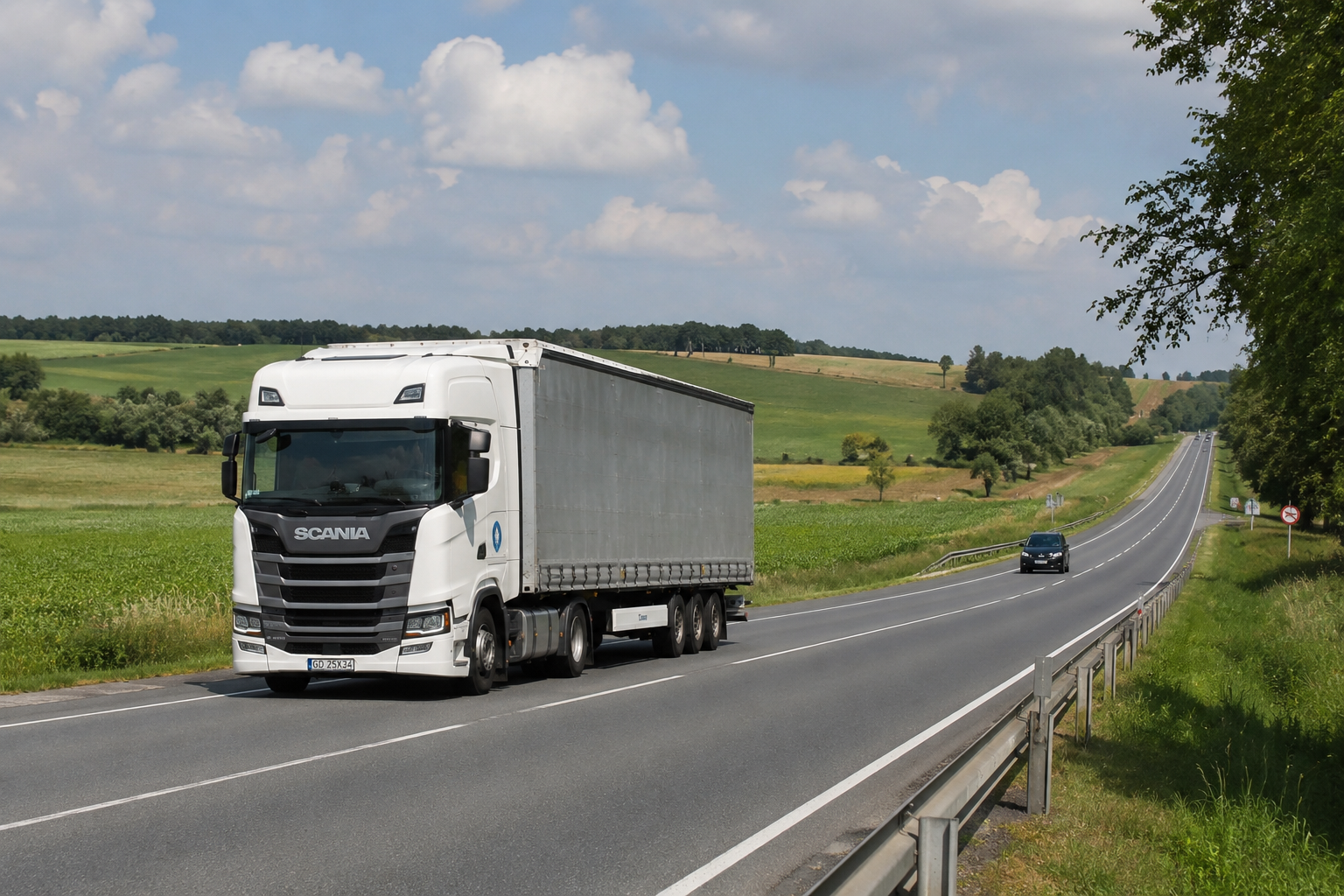
The German labor rights organization Faire Mobilität (“Fair Mobility”) has released a comprehensive new report examining the state of international road freight transport in Europe. The publication analyzes the industry’s business model, drivers’ working conditions, subcontracting practices, the implementation of the EU Mobility Package, and the impact of Germany’s Supply Chain Due Diligence Act on the logistics sector.
Driver Shortage Persists Across Germany
According to the report, Germany continues to face a severe shortage of professional truck drivers. Industry associations estimate the current deficit at around 100,000 drivers. To address the labor shortage, truck driving has been included on Germany’s shortage occupation list since 2019, making it easier for qualified drivers from non-EU countries to obtain work permits.
However, the report emphasizes that labor shortages continue to coexist with widespread violations of drivers’ employment rights.
Complex Subcontracting Model Dominates the Industry
The study explains that international road freight transport in Europe largely operates through multi-level subcontracting chains. Manufacturers and shippers typically contract freight forwarders, who then outsource transport operations to carriers, many of which are registered in Eastern European countries.
While this model significantly reduces transport costs, it also complicates oversight and weakens the enforcement of labor standards and social protections. According to the report, the subcontracting system has become one of the primary drivers of social dumping within the European road transport market.
Driver Exploitation Remains a Major Concern
Faire Mobilität reports that many international truck drivers continue to spend weeks or even months living inside their vehicles. The study documents numerous cases of unpaid overtime, non-transparent salary structures, excessively long working days of up to 15 hours, and a lack of adequate rest facilities and roadside infrastructure.
The report also highlights Germany’s ongoing shortage of truck parking spaces. According to the Federal Highway Research Institute (BASt), the country currently lacks approximately 20,000 truck parking spaces, forcing drivers to spend valuable driving time searching for safe parking and increasing the risk of violations of driving and rest time regulations.
Growing Reliance on Non-EU Drivers
The report identifies a significant shift in the industry’s workforce. While Polish, Romanian, and other Eastern European drivers have traditionally dominated cross-border transport, companies are increasingly recruiting drivers from Ukraine, Moldova, Georgia, Uzbekistan, Tajikistan, Serbia, India, the Philippines, Zimbabwe, and other non-EU countries.
According to Faire Mobilität, these workers often face the most difficult employment conditions because their legal residence status within the EU is directly linked to their employment contracts.
Mobility Package Improved Rules, But Enforcement Remains Weak
Since the introduction of the EU Mobility Package, several important reforms have come into force, including the prohibition on taking regular weekly rest periods inside truck cabins, mandatory installation of smart tachographs, and updated posting rules for international drivers.
Nevertheless, Faire Mobilität argues that the industry’s biggest challenge is no longer the absence of legislation but the lack of effective enforcement. According to the organization, many transport companies continue to circumvent the rules through falsified documentation, fake hotel invoices, manipulated tachograph records, and other practices designed to conceal labor law violations.
Supply Chain Due Diligence Law Becomes an Important Enforcement Tool
The report also highlights the growing importance of Germany’s Supply Chain Due Diligence Act (LkSG), which requires large companies to monitor human rights compliance throughout their supply chains, including transport operations.
Faire Mobilität notes that it has already supported several truck drivers in filing complaints related to labor exploitation under the law. In many cases, companies agreed to out-of-court settlements after customers initiated investigations into alleged human rights violations within their supply chains.
At the same time, the organization warns that both Germany’s Supply Chain Due Diligence Act and the EU Corporate Sustainability Due Diligence Directive (CSDDD) are currently facing increasing political pressure, which could limit the effectiveness of these enforcement mechanisms in the future.
