

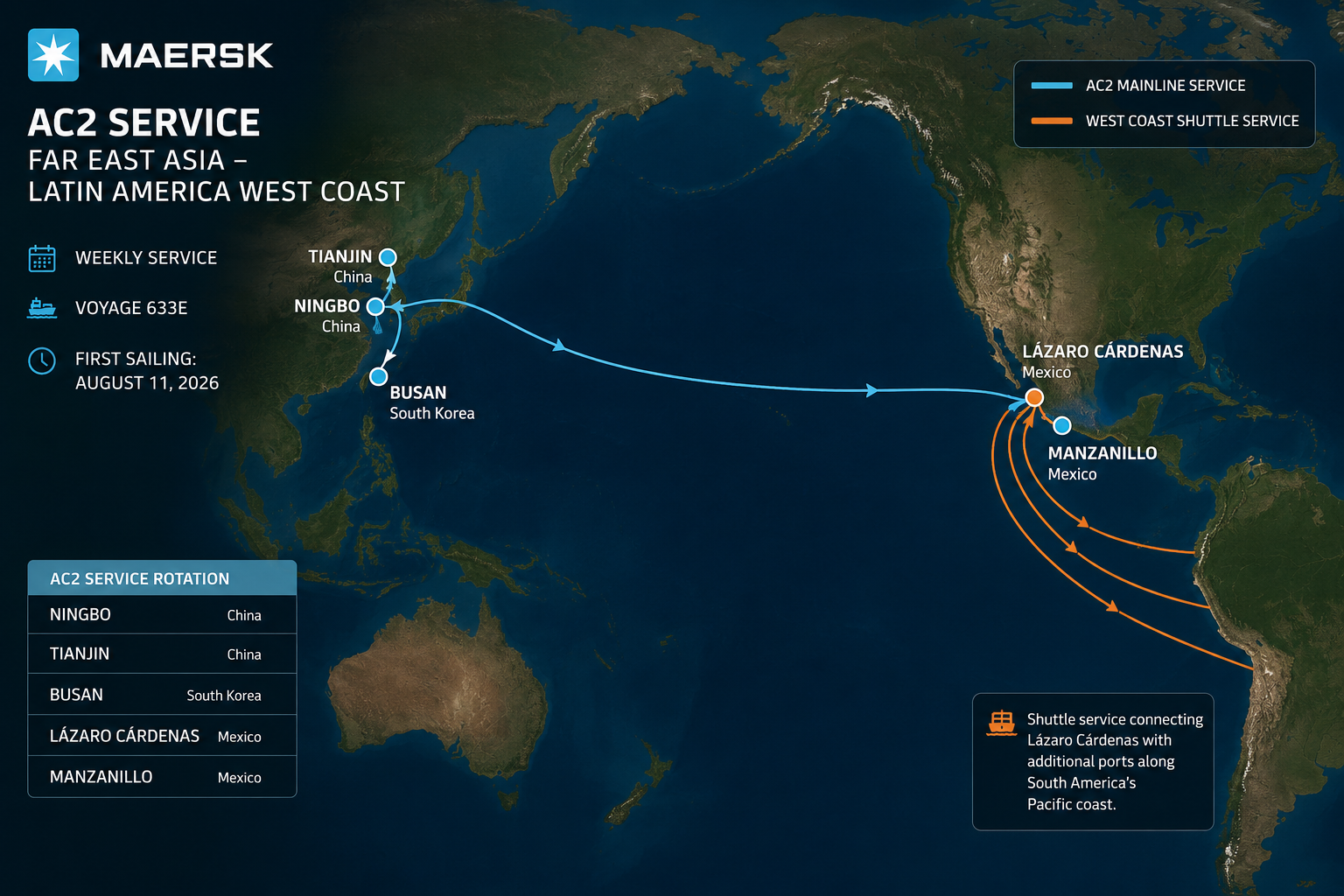
That is precisely what Maersk is doing with the launch of its newly configured AC2 service, connecting Far East Asia with Latin America’s West Coast. The redesigned route forms part of the company’s modular network architecture and is scheduled to begin operations in August 2026.
For shippers, the announcement represents more than a schedule adjustment. It signals greater network resilience, improved cargo connectivity, and more reliable transit times along one of the fastest-growing trade corridors across the Pacific.
What’s Changing
The upgraded AC2 service will operate on a weekly basis.
Its inaugural voyage, 633E, is scheduled to depart from Ningbo, China, on August 11, 2026.
The new service rotation includes:
- Ningbo, China
- Tianjin, China
- Busan, South Korea
- Lázaro Cárdenas, Mexico
- Manzanillo, Mexico
At the same time, Maersk will introduce a dedicated West Coast shuttle service, connecting Lázaro Cárdenas with additional ports along South America’s Pacific coast.
Rather than relying on a single long-haul loop, the company is implementing a modular network in which the mainline trans-Pacific service feeds regional shuttle operations, improving flexibility and operational efficiency.
Why Maersk Is Redesigning Its Network
Over the past several years, global container carriers have increasingly shifted toward modular service networks.
The reason is straightforward: long, multi-port liner services have become increasingly vulnerable to operational disruptions.
A delay at one port can quickly cascade across an entire voyage, disrupting schedules in multiple countries and reducing overall schedule reliability.
By separating ocean services into interconnected modules, carriers can isolate disruptions instead of allowing them to affect the entire network.
This approach delivers several advantages:
- Reduced schedule disruption across multiple ports
- Higher schedule reliability
- Greater flexibility in cargo routing
- Faster recovery from weather events, congestion, or operational delays
For shipping lines, this means better fleet utilization. For cargo owners, it translates into more predictable supply chains.
A Strategic Pacific Trade Lane
The Asia–Latin America West Coast corridor has become one of the fastest-growing segments of global container shipping.
Imports into Latin America continue to expand across several industries, including:
- Industrial machinery
- Consumer electronics
- Automotive vehicles and components
- Construction materials
- Household appliances
- E-commerce merchandise
Eastbound cargo from Latin America to Asia includes:
- Copper
- Lithium
- Agricultural commodities
- Seafood
- Forest products
- Chemical products
The rapid growth of critical mineral exports—particularly lithium and copper used in electric vehicle batteries and energy storage systems—has made reliable Pacific shipping services increasingly important.
Lázaro Cárdenas Continues to Grow as a Strategic Gateway
A key element of the redesigned network is the Mexican port of Lázaro Cárdenas.
Over the past decade, it has evolved into one of the largest deep-water container gateways on the Pacific coast of the Americas.
Its strategic advantages include:
- The ability to accommodate ultra-large container vessels
- Extensive rail connections into central Mexico
- Direct access to major manufacturing clusters
- An increasingly attractive alternative to congested U.S. West Coast ports
The continued expansion of nearshoring in Mexico is further increasing the port’s importance.
As more global manufacturers establish production facilities in Mexico to shorten supply chains and reduce dependence on Asian manufacturing, Lázaro Cárdenas is becoming an increasingly important logistics hub for North American trade.
Shuttle Services Improve Regional Connectivity
Another significant feature of Maersk’s announcement is the introduction of a dedicated regional shuttle service.
Instead of having large ocean vessels call at numerous smaller South American ports, containers will be transferred to specialized regional feeder vessels.
This strategy provides several operational benefits:
- Faster turnaround for large mainline vessels
- More frequent service to regional ports
- Lower risk of schedule disruption
- More efficient cargo distribution throughout the Pacific coast of South America
The hub-and-shuttle model has already proven highly successful in Europe and Southeast Asia and is now becoming increasingly common across Latin America.
What It Means for Cargo Owners
For importers and exporters, the redesigned AC2 service offers several practical advantages:
- Improved schedule reliability
- Better connectivity between Asia and South America’s West Coast
- Lower exposure to cascading delays
- More efficient access to regional markets through feeder services
- Greater flexibility when planning supply chains
Companies operating in the automotive, electronics, mining, agriculture, and retail sectors are likely to benefit the most from more dependable ocean transportation.
A Broader Shift in Global Shipping
Maersk’s decision reflects a broader transformation taking place across the container shipping industry.
Following years of unprecedented disruption—including the pandemic, the Red Sea security crisis, Panama Canal restrictions, and persistent supply chain volatility—carriers are placing greater emphasis not only on transit speed but also on network resilience.
Modular shipping networks are rapidly becoming the industry’s new operating model. Rather than relying on long, complex service loops with numerous port calls, carriers are increasingly building interconnected systems of mainline and regional services that can adapt more quickly to changing market conditions, weather disruptions, and port congestion.
Against that backdrop, the redesigned AC2 service is far more than a revised sailing schedule. It represents another step in Maersk’s long-term strategy to build a more resilient, flexible, and efficient global shipping network.
For businesses trading between Asia and Latin America, the changes should provide stronger regional connectivity, improved schedule reliability, and a supply chain better equipped to handle the uncertainties of modern global commerce.