

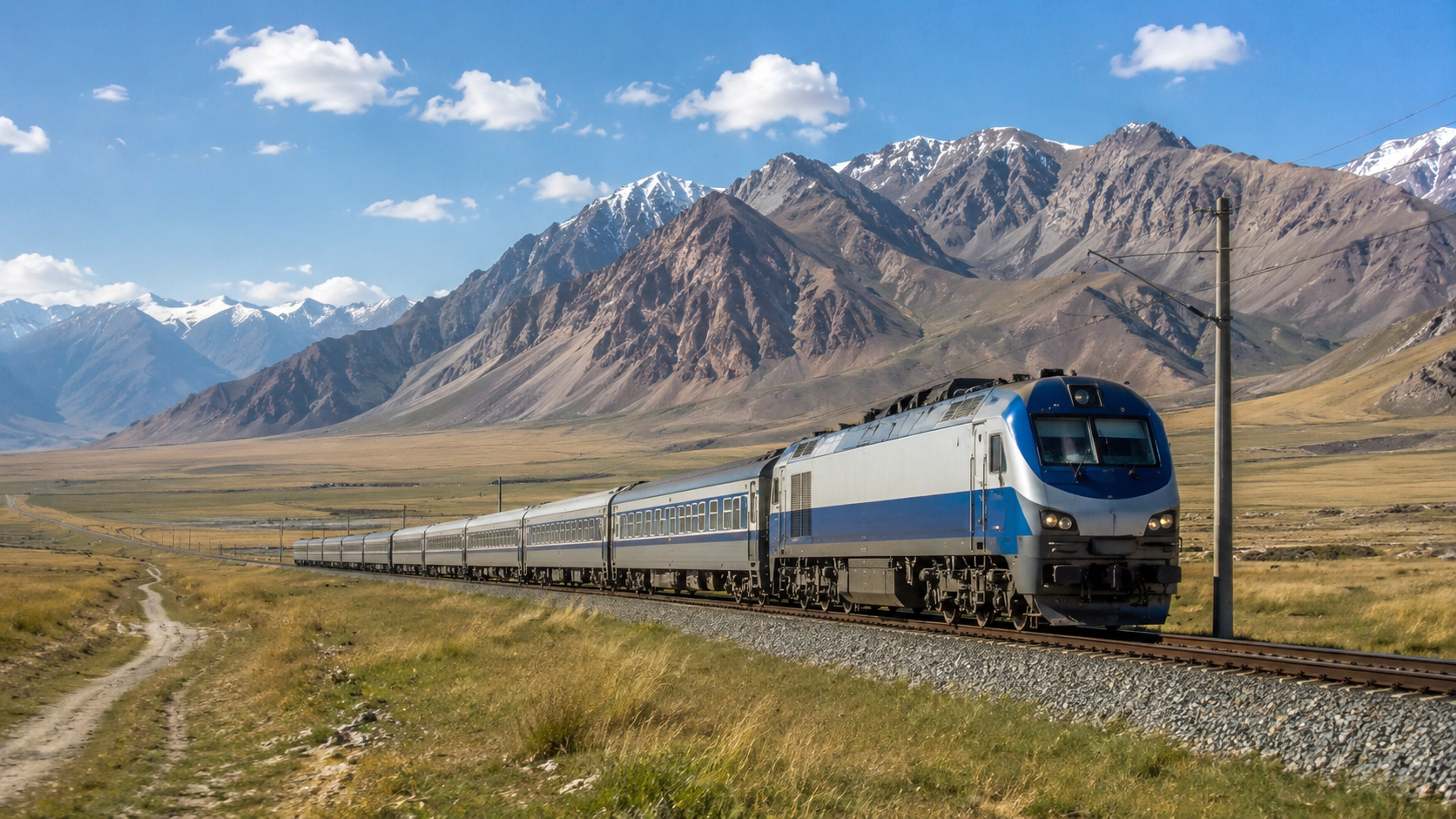
Bishkek–Balykchy Journey Could Be Cut by 20 Minutes
Kyrgyz Temir Zholu is continuing to modernise the passenger route between Bishkek and Balykchy, connecting the capital with the western shore of Issyk-Kul.
Company Director General Azamat Sakiev said the operator plans to reduce the journey to approximately three hours and 40 minutes.
The current summer timetable provides a journey of around four hours and six minutes from Bishkek-2 station to Balykchy station. The train continues to the Balykchy Beach stop, reaching it after approximately four hours and 31 minutes.
In 2026, the service departs Bishkek at 8:06 a.m., arrives at Balykchy station at 12:12 p.m. and reaches the beach stop at 12:37 p.m. It operates daily from late June until the middle of September.
Five years ago, the journey took approximately five hours. Reaching the new target would therefore make the trip more than one hour shorter than it was at that time.
Infrastructure Modernisation Is Already Delivering Results
The shorter journey is not simply a timetable adjustment.
Kyrgyz Temir Zholu has been renewing tracks, rolling stock and other railway infrastructure that determines the safe operating speed of passenger trains.
The route includes mountainous terrain, curves, level crossings and station stops. Increasing speed therefore requires improvements across the wider system rather than simply reducing the time spent at individual stations.
Modernised higher-comfort carriages were added to the Bishkek–Balykchy train in 2026. The operator can also add further vehicles when passenger demand increases during the Issyk-Kul tourist season.
The Railway Journey Is Part of the Tourist Experience
Sakiev said the Issyk-Kul train should not become so fast that passengers are unable to appreciate the landscape.
The route passes through the Boom Gorge and alongside mountains, rivers and panoramic valleys. For foreign visitors and domestic tourists, the railway journey can be part of the holiday rather than merely a transfer between two locations.
This approach could support a dedicated tourism product involving panoramic carriages, guided information, travel packages, improved catering and special excursion services.
The operator must balance two objectives. The train needs to be fast and reliable enough for regular transport while retaining the appeal of a scenic railway journey.
The Main Ambition Is a 6–8 Hour Bishkek–Osh Train
The more significant proposal involves creating a direct rail service between Bishkek and Osh.
According to Sakiev, the company is considering a route that could allow passengers to travel between northern and southern Kyrgyzstan in six to eight hours.
At this stage, it remains a strategic concept rather than an approved construction programme. A final alignment, budget, completion date, financing structure and rolling-stock specification have not been announced.
The term “high-speed train” should also be treated carefully. The proposal does not necessarily involve a conventional high-speed railway operating at 250–350 km/h.
For Kyrgyzstan, the principal achievement would be the creation of a continuous national railway and a substantial reduction in travel time between its two largest cities.
Northern and Southern Networks Remain Disconnected
Kyrgyzstan’s railway system has historically consisted of two separate networks.
The northern system serves Bishkek, the Chüy region and Balykchy and connects with Kazakhstan’s railway network. Southern lines operate around Osh and Jalal-Abad and connect with Uzbekistan.
There is currently no direct railway between Bishkek and Osh. Passenger and freight movements between the country’s largest cities depend primarily on road transport and aviation.
The proposed north–south railway would connect Balykchy, Kochkor, Kara-Keche, Makmal and Jalal-Abad, creating a unified domestic network. The Eurasian Economic Commission has previously included the wider route among priority regional transport infrastructure projects.
Balykchy–Kochkor Is the First Completed Section
The opening of the Balykchy–Kochkor railway represents a major step toward connecting the country.
The first 63-kilometre section and the new Kochkor station were officially opened in late July 2026. President Sadyr Japarov travelled to the ceremony by train and inspected the newly completed infrastructure.
The line is intended to become the first stage of a wider Balykchy–Kara-Keche–Makmal route. Extending it further could eventually bring the northern and southern railway systems closer together.
Kyrgyzstan built the section using domestic resources. Construction involved approximately one million cubic metres of blasting work and the clearance of eight kilometres of difficult mountainous terrain.
The Kyrgyz authorities said the cost was approximately $955,000 per kilometre, compared with foreign contractor estimates of between $4.8 million and $6.8 million per kilometre.
The New Line Is Also a Freight Project
Balykchy–Kochkor is important for more than passenger transport.
Extending the railway toward Kara-Keche would support more efficient movement of coal required by the energy and municipal sectors. It could also carry construction materials, agricultural products, fuel, equipment and containerised cargo.
Rail is often more economical than road for large and heavy shipments over longer distances. One freight train can replace dozens of trucks, reducing road traffic, vehicle movements and demand for drivers.
Road freight would nevertheless remain essential. Trucks would continue to handle the first and last mile between stations, warehouses, factories, shops and final customers.
The Bishkek–Osh Highway Would Gain an Alternative
Most surface transport between northern and southern Kyrgyzstan currently depends on the Bishkek–Osh highway.
The road crosses mountain passes and is exposed to snow, avalanches, rockfalls, maintenance work, traffic restrictions and congestion.
A direct railway would create an alternative for both passengers and freight. When part of the highway is disrupted, some cargo could be transferred to trains.
Such resilience would be particularly important for fuel, food, coal, construction materials and other essential supplies.
However, building through mountainous terrain will require tunnels, bridges, retaining structures and extensive protection against natural hazards. Engineering complexity will be one of the main factors affecting the project’s cost and timetable.
Osh Could Become a Major Domestic Logistics Hub
A direct line to Osh could change the internal distribution of cargo.
Osh is a major commercial, industrial and agricultural centre in southern Kyrgyzstan. It is located close to Kara-Suu, large markets, manufacturing sites and routes leading toward Uzbekistan, Tajikistan and China.
Once the northern and southern networks are connected, cargo could move between regions without relying entirely on trucks.
Railway stations could attract container terminals, warehouses, cold-storage facilities and agricultural processing centres. Businesses would be able to consolidate larger shipments before sending them to other parts of Kyrgyzstan or neighbouring markets.
Kyrgyzstan Could Integrate With International Corridors
Domestic railway development is also important in the context of the China–Kyrgyzstan–Uzbekistan railway.
Connecting the national network with an international corridor would allow Kyrgyzstan to use the route for domestic distribution rather than serving only as a transit country.
Manufacturers and agricultural businesses will require access to railway stations, container terminals and warehouses. Without domestic branches, an international line may carry cargo across the country without delivering its full economic benefit to individual regions.
K2Cargo News has also covered China’s new rail route to Turkmenistan, which runs through Kazakhstan and Uzbekistan. The service illustrates how rapidly Central Asian countries are developing new overland links and competing for international freight flows.
Expanding its own internal network will be essential if Kyrgyzstan intends to participate fully in that transformation.
Rail Could Reduce Pressure on Congested Roads
Railway expansion could reduce the burden on Kyrgyzstan’s highways.
The greatest impact would come from transferring coal, cement, aggregates, metals, grain and other bulk cargo from trucks to trains. These heavy shipments place significant pressure on road surfaces and require large numbers of vehicles.
Moving part of that freight by rail could reduce road damage and government maintenance costs.
Road carriers could then focus on shorter and more flexible services where trucks have a clear advantage.
Rather than competing directly, rail and road transport could form a coordinated multimodal system.
Tourism and Freight Will Require Different Timetables
The railway will have to accommodate different operating requirements.
A tourist service should run during convenient daytime hours, make appropriate stops and give passengers access to scenic views. Freight trains require reliable paths, sufficient line capacity and limited delays.
These needs can conflict on single-track lines. The operator will therefore require passing loops, modern signalling, effective dispatching and carefully planned schedules.
If freight volumes increase substantially, some sections may eventually require a second track or longer station loops capable of handling larger trains.
Tracks Alone Will Not Transform Logistics
Building the railway is only part of the challenge.
A functioning north–south corridor will require freight stations, container yards, locomotives, passenger carriages, maintenance depots and modern safety systems.
Securing cargo in both directions will also be critical. Empty wagon returns would weaken the commercial performance of the route.
Businesses and authorities will need to identify potential volumes of coal, agricultural goods, building materials, fuel and containerised cargo. These forecasts will determine the required wagon fleet, terminal capacity and train frequency.
Bishkek–Osh Remains a Long-Term Objective
The prospect of travelling from Bishkek to Osh in six to eight hours is attractive, but delivering it will require a long programme of work.
Detailed design, geological surveys, environmental assessment and financial planning must be completed before the most difficult mountain sections can be built.
Sakiev’s comments should therefore be understood as a strategic direction rather than a promise of an immediate passenger service.
The most important shift has already occurred. Completion of the Balykchy–Kochkor line demonstrated that Kyrgyzstan has begun constructing new railway infrastructure using its own capabilities.
Extending the route toward Kara-Keche, Makmal and Jalal-Abad could eventually create the country’s first unified national railway network.
That would mark the beginning of a genuinely new transport era, strengthening domestic logistics, providing an alternative to mountain highways and making it possible to cross Kyrgyzstan by train within a single day.
Read also: Kyrgyzstan Moves Ahead With Balykchy Bypass Road Project in 2026