

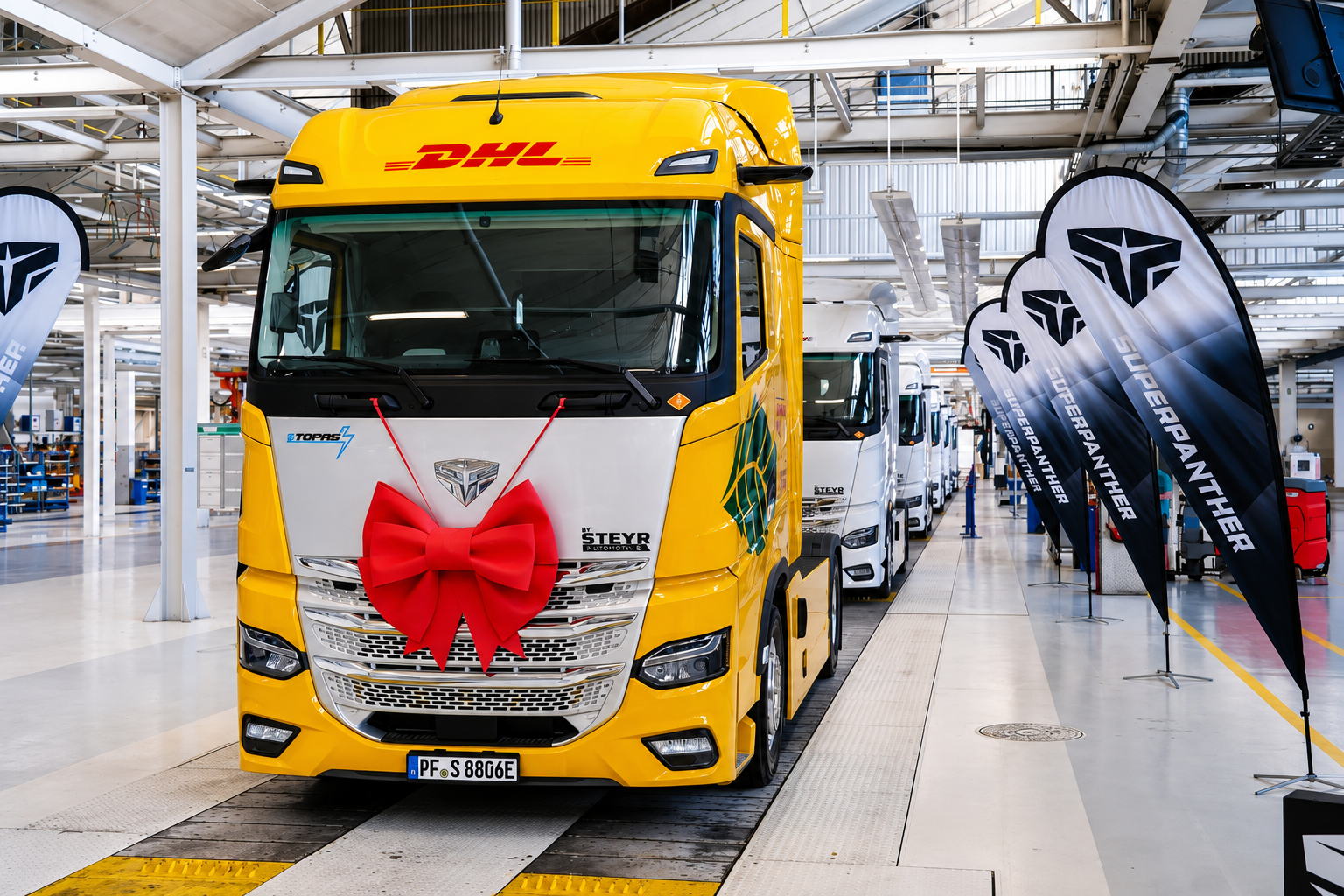
Series Production Started on July 27
Steyr Automotive has started series production of the SuperPanther eTopas 600 electric tractor at its plant in Steyr, Austria.
The first regular 4×2 production vehicle left the final assembly line on July 27, 2026. The initial trucks were handed over to DHL Freight, Germany’s Gress Speditions, Austria’s Temmel and the LONTEX Group, which operates in Poland and the Czech Republic.
The programme has therefore moved beyond testing and pre-series construction into regular commercial operations. The first eTopas 600 vehicles are expected to operate in Germany, the Netherlands, Austria, Poland and the Czech Republic.
This Is Not a Revival of the Historic Steyr Truck Brand
Claims that trucks have returned under the Steyr brand after a 20-year absence require clarification.
The vehicle is marketed as the SuperPanther eTopas 600. Steyr Automotive acts as the industrial and contract-manufacturing partner, and the vehicle carries the manufacturing designation by Steyr Automotive.
It is not a newly revived independent range of historic Steyr-branded trucks.
The plant itself did not experience a 20-year break in truck production. It continued assembling MAN light- and medium-duty series, including the TGL and TGM families, until autumn 2023.
The significant development is that a facility long associated with MAN is now becoming a European production base for Chinese commercial-vehicle developers.
Steyr Has Shifted Toward Contract Manufacturing
The Steyr site contains approximately 218,000 m² of production and logistics space and employs around 1,000 people.
After production of the principal MAN series ended, Steyr Automotive expanded its contract-manufacturing model. The site produces specialist municipal equipment, paints and pre-assembles components, and manufactures vehicles for Palfinger, Sinotruk and other customers.
The industrial production agreement with SuperPanther was signed in June 2025. The project provides a way to retain vehicle-manufacturing expertise, employees and industrial capacity following the change in the plant’s relationship with MAN.
Production Uses the SKD Method
The first eTopas 600 vehicles are being produced through a semi-knocked-down manufacturing process.
Large modules and pre-assembled systems are delivered to the plant before final assembly, commissioning and quality inspection are completed in Austria.
SuperPanther supplies key electric-platform technologies, including:
- the dual-motor electric drive axle;
- high-voltage power electronics;
- the thermal-management system;
- energy and powertrain-control software.
Steyr Automotive is responsible for final assembly, commissioning and quality acceptance before the truck is delivered to the customer.
The SKD approach allows production to begin without immediately establishing a complete European manufacturing chain for the cab, frame and every powertrain component.
European Components Remain Important
Although the technology platform was developed by a Chinese company, SuperPanther presents the eTopas 600 as a vehicle adapted and localised for Europe.
ZF, Schaeffler, Aumovio, Infineon, Michelin, Continental, Goodyear and Castrol contribute systems, electronics, tyres, technical fluids and other components.
This supplier structure reduces dependence on one country and supports European certification, maintenance and spare-parts availability. SuperPanther nevertheless retains control over the main electric-drive and energy-management technologies.
The programme creates an international manufacturing supply chain. Core electric modules must reach Austria from China, while European parts are delivered from suppliers across several EU countries.
The Truck Has Approval for All 27 EU Countries
Before series production began, the eTopas 600 received EU Whole Vehicle Type Approval under Regulation 2018/858.
WVTA enables the model to be registered throughout all 27 European Union member states without undergoing a complete separate national approval process in every market.
Certification was an essential step in moving from customer trials to regular commercial deliveries and confirms compliance with mandatory European safety, design and environmental requirements.
Type approval does not guarantee commercial success. Operators still need evidence covering reliability at high mileage, service costs and residual value after several years of use.
Battery Capacity Is 621 kWh
The SuperPanther eTopas 600 uses a 621 kWh CATL lithium iron phosphate battery.
The manufacturer states that the pack is designed for up to 4,500 full charging cycles and a service life of up to 1.2 million kilometres or eight years.
Those figures remain design targets. Actual longevity will depend on temperature, charging power, depth of discharge and operational intensity.
The high-voltage system operates at approximately 876 volts. Its dual-motor e-axle delivers 394 kW of continuous power and up to 692 kW at peak output.
The tractor is designed for a gross combination weight of up to 42 tonnes and has an unladen weight of approximately 10.8 tonnes.
The relatively low weight for a large-battery electric tractor helps preserve payload, although a comparable diesel vehicle will generally remain lighter.
Published Range Varies Between 560 and 600 km
Material released for the start of series production gives the eTopas 600 a range of around 600 km under mixed-load European operating conditions.
The detailed product specification separately lists a range of up to 560 km on one charge. The difference reflects changes in route, speed, terrain, payload and test procedure.
The 600 km figure should therefore not be treated as a guaranteed result for every journey.
Real range will depend on cargo weight, ambient temperature, motorway speed, gradients, heating or air conditioning, regenerative braking and the energy reserve maintained before charging.
Reliable international planning will require operators to build their own performance data for specific routes.
Trial Vehicles Covered More Than 70,000 km
Customer trials started in March 2026.
Before the production launch, test vehicles accumulated more than 70,000 km in real freight operations across several European markets.
The manufacturer reports average energy consumption of approximately 0.94–0.95 kWh per kilometre.
A 621 kWh battery theoretically provides substantial range at that consumption rate.
Operators cannot normally use the full nominal battery capacity in everyday work. A reserve is required for diversions, congestion, cold weather or an occupied charging site.
The more important test will be repeated fully loaded operation over several years rather than a single demonstration journey.
Two Charging Ports Reduce Charging Time
One of the most distinctive eTopas 600 features is the presence of two CCS2 charging inlets on opposite sides of the cab.
The vehicle can connect to two compatible chargers simultaneously. During testing, charging peaked at 646.7 kW and maintained a stable average of approximately 635 kW.
With two suitable charging points available, the battery can be charged from 20% to 80% in less than 38 minutes.
That period is close to a driver’s mandatory break and could allow charging to fit into an operating schedule without a separate multi-hour stop.
However, achieving the advertised rate requires two high-power connections at the same time.
Not every charging hub permits this arrangement, and the site’s electricity connection must support more than 600 kW for one truck.
Charging will take longer when only a single 350 or 400 kW point is available.
Dual Charging Creates an Infrastructure Challenge
Using two CCS2 connections provides high power before the Megawatt Charging System becomes widely available.
Operationally, however, one truck may occupy two chargers and reduce the number of vehicles a site can serve simultaneously.
A fleet of ten or twenty electric tractors will need carefully controlled connection schedules and peak-power management.
Operators will require energy-management systems that consider departure times, battery state, available grid capacity, hourly electricity prices, urgent journeys and possible on-site renewable generation or battery storage.
Without this coordination, even a powerful charging installation can create queues inside a private depot.
Europe’s Charging Network Remains Incomplete
EU legislation requires member states to develop high-power charging infrastructure for electric trucks along the TEN-T network.
By the end of 2030, charging pools on core routes must be available in both directions at intervals of no more than 60 km. Each location must provide at least 3,600 kW of combined power and contain at least two charging points rated at 350 kW or more.
The European Commission nevertheless estimates that mandatory AFIR deployment targets will provide only around half of the charging infrastructure that heavy-duty transport may actually require by 2030.
K2Cargo News previously reported how Milence opened its first dedicated truck charging station in Denmark. Such hubs are gradually creating a European network, but major gaps remain between individual markets and freight corridors.
Service Will Be Supported by Alltrucks
SuperPanther is working with the independent Alltrucks workshop network.
The arrangement is intended to provide maintenance, repairs and 24-hour breakdown support.
The manufacturer is also developing technician-training programmes, spare-parts logistics, remote diagnostics and over-the-air software updates.
Service coverage is critical for a new commercial-vehicle brand.
Operators consider not only range and electricity costs but also how quickly a truck returns to work following a failure. An efficient tractor becomes uneconomic when a replacement component takes several weeks to arrive.
Technicians will also require high-voltage qualifications, while damaged battery packs need specialised handling and storage procedures.
Chinese Manufacturers Are Choosing European Assembly
SuperPanther is not the only Chinese manufacturer using a European plant to enter the EU market.
Steyr Automotive has also assembled Sinotruk diesel and electric vehicles since March 2026.
That programme initially uses SKD production, with the possibility of moving toward deeper CKD manufacturing, including cab production and painting, if volumes increase.
European assembly offers Chinese companies several advantages: adaptation to EU standards, shorter customer delivery times, easier warranty support, local value creation, access to European suppliers and lower political and trade exposure than direct imports of finished vehicles.
For Austria, contract manufacturing retains industrial employment and provides work for a plant that needed new orders after the main MAN programmes ended.
Chinese Electric Trucks Are Entering Commercial Fleets
Until recently, many new Chinese heavy electric trucks in Europe remained limited to demonstrations, roadshows and pilot trials.
During 2026, vehicles began entering regular commercial fleets.
K2Cargo News previously covered how the Windrose R700 entered commercial fleet service in Europe. SuperPanther is now adding series deliveries through Austrian production.
The development increases competitive pressure on Volvo Trucks, Mercedes-Benz Trucks, MAN, Scania, Renault Trucks, DAF and other established manufacturers.
Chinese brands are seeking to compete through battery capacity, charging performance and rapidly developed digital vehicle architectures as well as price.
European Manufacturers Will Have to Accelerate
Heavy-truck purchasing differs from the passenger-car market.
Transport companies make decisions based on total cost of ownership, uptime, residual value and service availability. A large battery alone will not establish an unfamiliar brand.
European assembly removes one important barrier by providing a vehicle approved for EU use and manufactured at a plant with extensive truck-production experience.
Established manufacturers will nevertheless face pressure to improve range, payload and charging power while controlling acquisition costs.
EU rules require average CO₂ emissions from new heavy-duty vehicles to fall by 45% by 2030, 65% by 2035 and 90% from 2040 compared with the reference level. This creates a long-term market for electric tractors regardless of brand origin.
Europe Could Have Up to 600,000 Zero-Emission Heavy Vehicles
The European Commission estimates that the EU could have between 410,000 and 600,000 zero-emission heavy-duty vehicles by 2030.
Battery-electric vehicles may account for up to 90% of that total, with hydrogen and other zero-emission technologies providing the remainder.
Such a market would provide space for both established European manufacturers and new Chinese competitors.
The principal constraint may shift from vehicle availability to grid connections, charging-site construction and access to sufficient electricity capacity.
Payload Remains a Major Consideration
Electric tractors often weigh more than diesel vehicles because of their batteries.
SuperPanther lists the eTopas 600 at approximately 10.8 tonnes, around 800 kg lighter than some comparable electric models.
Every additional kilogram matters to operators carrying weight-limited cargo because a heavier tractor reduces the commercial payload available in the trailer.
European rules provide certain weight allowances for alternatively powered and zero-emission vehicles. Road, bridge, national and axle-load restrictions nevertheless continue to influence actual operating capacity.
The model may be particularly attractive for freight that reaches its volume limit before reaching maximum permitted weight.
Cold Weather Will Be an Important Test
The eTopas 600 includes integrated thermal management with a low-temperature heat pump.
The manufacturer claims reliable operation between −35°C and +40°C. The system manages the temperature of the battery, power electronics and cab.
Winter performance matters in Germany, Austria, Poland, the Czech Republic and northern European markets.
Low temperatures reduce charging acceptance, while cab heating increases electricity consumption.
Operators will therefore need separate winter range data rather than relying on summer test results.
Battery preconditioning before arrival at a charger can reduce charging time, but the vehicle’s software must know the planned route and charging location in advance.
The European Price Has Not Been Published
SuperPanther has not released a single standard European price for the eTopas 600.
Commercial terms may vary by market, order size, service agreement, charging package and financing structure.
Operators will have to compare more than the purchase price with a diesel tractor. Relevant factors include electricity costs, depot-grid upgrades, road tolls, subsidies, maintenance, battery insurance, residual value, payload loss and charging downtime.
An electric truck may be commercially attractive on predictable routes with low-cost depot charging, while dependence on expensive public charging can produce a very different result.
SKD Production Will Test the Depth of Localisation
The initial manufacturing arrangement creates jobs in Austria, but a significant share of technological value remains connected to Chinese systems.
Deeper European localisation will depend on production volume.
Large ready-made modules are economical for limited series. Higher sales could justify moving additional assembly, component production and cab operations to Europe.
For Steyr Automotive, deeper localisation would bring more employment and more stable factory utilisation.
For SuperPanther, it could reduce freight costs, shorten response times and limit dependence on long maritime supply chains from China.
Moving from SKD to more complete production would nevertheless require substantial investment and a reliable order pipeline.
Initial Deliveries Will Reveal Real Competitiveness
Starting eTopas 600 series production is an important milestone, but the decisive phase has only begun.
DHL Freight, Gress, Temmel and LONTEX will demonstrate how the truck performs in real schedules, with commercial payloads, winter conditions and imperfect charging availability.
The market will focus on actual energy consumption, uptime, repair speed and battery condition after the first several hundred thousand kilometres.
If the claimed 560–600 km range and sub-38-minute charging are confirmed in daily operations, the vehicle could compete in regional and selected international transport.
If those figures require ideal weather, light payloads and two permanently available chargers, its operational scope will be much narrower.
Austrian assembly gives the Chinese-developed truck access to Europe’s industrial system. Its future will now depend less on the origin of its components than on whether it can perform daily freight work more reliably and economically than competing models.
Read also: Milence Opens Its First Truck Charging Station in Denmark