

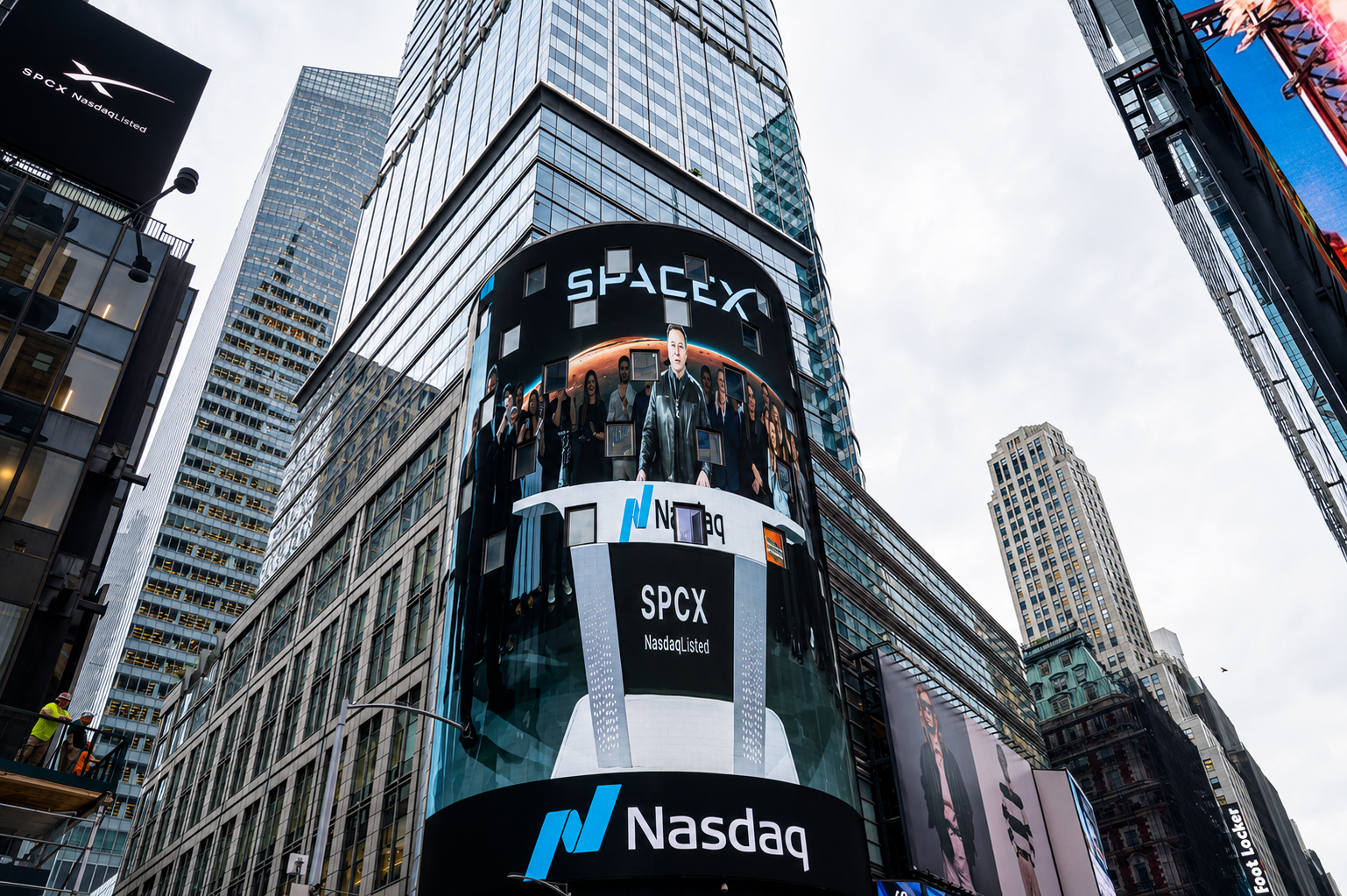
SpaceX Revenue Jumps 92%
SpaceX delivered significantly stronger revenue growth than Wall Street expected in its first quarterly results since becoming a publicly traded company.
For the second quarter of 2026 ended June 30, revenue reached $7.814 billion, up from $4.071 billion a year earlier, representing growth of 92%. This corrects one point in some initial reports: the figures cover April through June, not the first calendar quarter of 2026.
Wall Street’s consensus estimate was approximately $6.9 billion, meaning SpaceX beat expectations by roughly $900 million.
Starlink remains the company’s largest source of revenue, although the combination with xAI has transformed SpaceX into a broader group operating across three main segments: Space, Connectivity and AI.
Starlink Generates $4.3 Billion in Quarterly Revenue
SpaceX’s Connectivity division, which includes Starlink, generated $4.291 billion in second-quarter revenue, up 66% from $2.588 billion a year earlier. The segment accounted for about 55% of total company revenue.
Connectivity operating income increased 79% to $1.656 billion.
Starlink therefore remains SpaceX’s most dependable profit engine and provides much of the financial foundation supporting more capital-intensive projects including Starship, artificial intelligence and computing infrastructure.
The growth of satellite infrastructure is part of a much broader global trend. K2Cargo.News previously reported that China is deploying a 120-satellite commercial constellation to monitor space debris, highlighting the accelerating competition in near-Earth space.
Starlink Subscribers Double to 12 Million
Starlink had 12 million subscribers at the end of June, compared with 6 million a year earlier and 10.3 million at the end of the first quarter of 2026.
That means SpaceX added another 1.7 million Starlink users in only three months.
The growth has come with lower average revenue per user.
Starlink’s monthly ARPU stood at $66, down from $85 a year earlier, a decline of roughly 22%. SpaceX has attributed the change to international expansion and the introduction of lower-priced service plans.
Starlink is therefore increasingly relying on scale: each subscriber generates less revenue on average, but the customer base is expanding fast enough to keep overall revenue growing strongly.
Enterprise and Government Revenue Jumps 108%
The expansion beyond household broadband is particularly important for transport and logistics.
Enterprise and government connectivity revenue reached $1.806 billion, up 108% year over year, while consumer revenue totaled $2.485 billion.
SpaceX has been expanding Starlink aggressively in aviation. During the quarter, it signed a major agreement with American Airlines and activated service with carriers including Southwest, Virgin Atlantic, Iberia and Aer Lingus.
Starlink is also expanding across maritime transport, enterprise networks and government communications.
For airlines and shipping companies, satellite connectivity can provide high-speed communications where terrestrial mobile infrastructure is unavailable, turning systems such as Starlink into an increasingly important part of transport digitalization.
Net Loss Narrows to $541 Million
Despite strong revenue growth, SpaceX remains loss-making under GAAP accounting.
The company reported a $541 million net loss, or $0.09 per share, compared with a $1.008 billion loss and $0.34 per share a year earlier. The absolute quarterly loss therefore narrowed by 46%.
The result was also substantially better than Wall Street expected. Analysts had forecast a loss of approximately $0.26 per share, nearly three times the actual figure.
Total operating losses narrowed from $970 million to just $143 million.
Adjusted EBITDA increased 191%, from $1.214 billion to $3.538 billion. SpaceX notes that adjusted EBITDA is a non-GAAP measure and should not be treated as a substitute for net income or loss.
SpaceX Did Not Spend $18 Billion Solely on AI
Another widely repeated figure requires clarification.
Some reports describe SpaceX as increasing “AI investment from $3 billion to $18 billion.” The company’s official figures show a more precise breakdown.
Total SpaceX capital expenditure increased from $2.825 billion in the second quarter of 2025 to $18.369 billion in Q2 2026.
AI-specific capital expenditure, meanwhile, rose from just $749 million to $15.828 billion.
The remaining capital spending included $1.367 billion for Connectivity and $1.174 billion for the Space segment.
The correct comparison is therefore that AI capex surged from roughly $0.75 billion to $15.83 billion, while the wider company’s total capital expenditure increased from about $2.8 billion to $18.4 billion.
AI Business Already Generates $2.56 Billion
The scale of that spending reflects SpaceX’s transformation from primarily a rocket-and-satellite company into a broader technology group.
The AI segment, which includes xAI, Grok, X and rapidly expanding computing infrastructure, generated $2.561 billion in quarterly revenue, compared with $737 million a year earlier — growth of 247%.
AI solutions and infrastructure accounted for $2.194 billion of the total.
SpaceX also reported Cloud Services Agreements representing $14.1 billion in contracted sales. Reuters has identified customers including Anthropic, Google and Reflection AI.
The AI segment still posted a $1.257 billion operating loss. However, that was sharply better than the $2.469 billion loss in the previous quarter, while segment adjusted EBITDA turned positive at $1.146 billion.
Computing Capacity Reaches 1.4 GW
SpaceX’s installed AI computing capacity reached 1.4 GW by the end of the second quarter, up from 1 GW in March and 0.4 GW a year earlier.
The company continues to expand its data-center infrastructure and says computing capacity could approach 10 GW by the end of 2027. Musk has also said SpaceX plans to rely exclusively on Nvidia hardware for its next phase of data-center development.
In the longer term, SpaceX has also discussed placing computing infrastructure in orbit.
Energy systems capable of supporting large orbital platforms are becoming an increasingly important technology field. K2Cargo.News previously reported that China is investing in next-generation solar technologies for satellite constellations and future space infrastructure.
Space Business Grows More Slowly
SpaceX’s traditional Space segment generated $962 million in revenue, up 29% from $746 million a year earlier.
The company completed 38 launches during the quarter: 10 for external customers and 28 internal missions, many supporting its own satellite infrastructure.
Across the first six months of 2026, SpaceX completed 78 launches and placed 1,041 metric tons of payload into orbit.
The segment nevertheless remained loss-making, posting an operating loss of $542 million as SpaceX continued heavy investment in Starship development.
SpaceX increasingly uses its own rockets to launch its own communications infrastructure, making the economics of the launch and Starlink businesses progressively more interconnected.
At Least 1,000 Starlink V3 Satellites Planned
One of SpaceX’s biggest near-term projects is the next generation of Starlink.
The company expects to launch at least 1,000 V3 satellites within a year. The upgraded spacecraft are designed to significantly increase network capacity and support continued expansion in broadband and mobile connectivity.
Starship is central to that strategy because its payload capacity is intended to support the mass deployment of much larger next-generation satellites.
SpaceX continued Starship V3 testing during the second quarter, while Flight 13 in July successfully deployed 20 production V3 satellites.
If regular Starship operations can be established, SpaceX could potentially reduce the cost of deploying large satellite constellations even further.
SpaceX Now Depends on Three Interconnected Businesses
The second-quarter results show how dramatically SpaceX has changed.
Starlink remains the primary financial engine and the company’s strongest operating business. The Space segment provides launch infrastructure but still requires heavy Starship investment. AI is growing fastest by revenue while consuming the overwhelming majority of capital expenditure.
At the end of June, SpaceX held approximately $100 billion in cash, cash equivalents and marketable securities, while its backlog stood at $47.5 billion. That gives the company substantial capacity to continue funding Starship, Starlink and AI infrastructure.
Investors, however, remain focused on whether that spending can eventually generate sufficient returns. SpaceX shares fell about 7% in late trading after the results: strong Starlink growth and a better-than-expected loss were offset by concern over the scale of AI capital expenditure.
For transport and logistics, the most important development may still be Starlink’s expansion. A doubling of subscribers to 12 million, rapid growth in enterprise contracts and increasing airline adoption suggest satellite connectivity is becoming an increasingly important layer of global transport infrastructure.
Read also: China to Deploy Its First Commercial Satellite Constellation for Space Debris Monitoring