

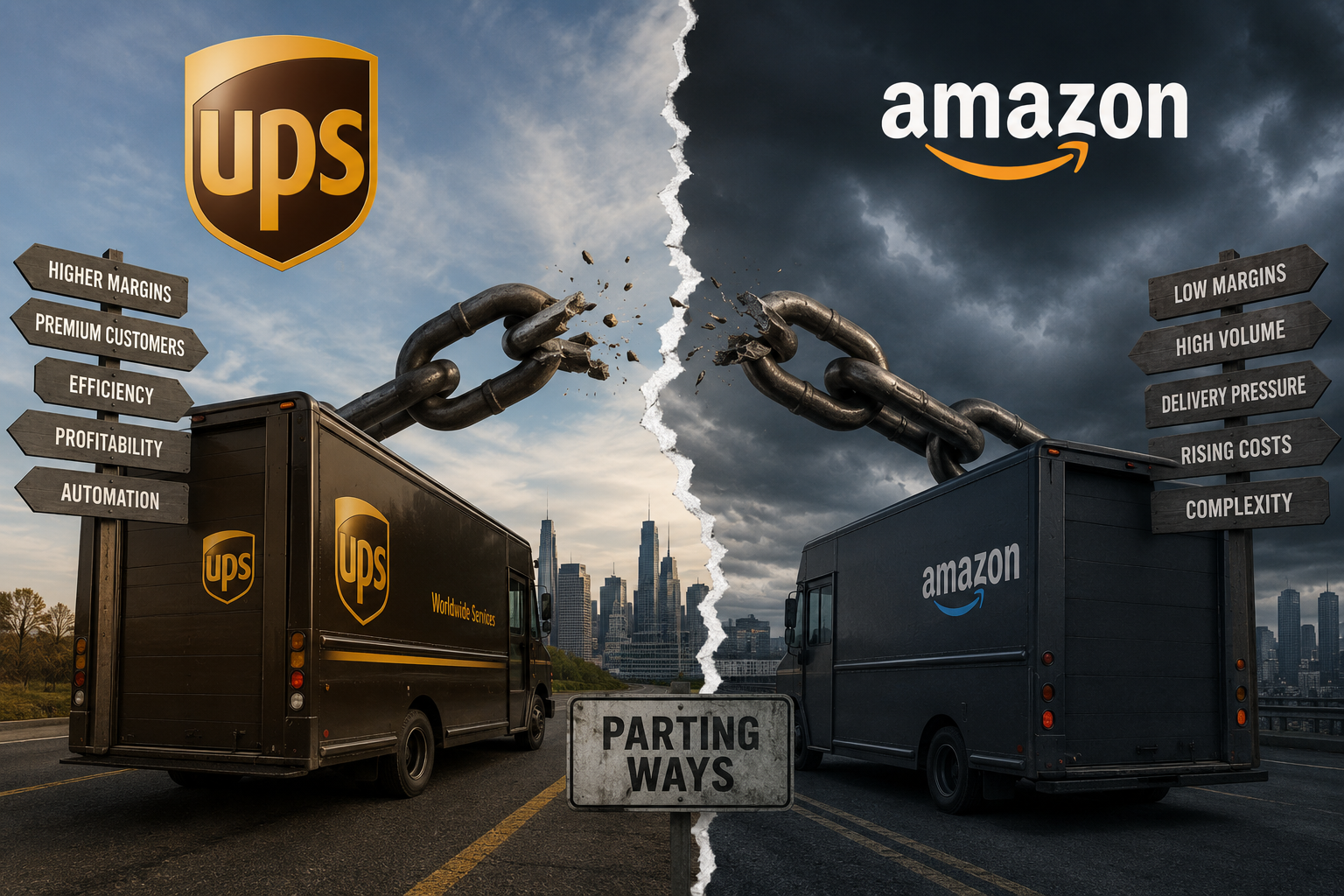
UPS is beginning to see significant financial benefits from scaling back its business with Amazon, its largest customer. Although parcel volumes declined during the second quarter, the company increased revenue and operating profit through network restructuring, higher pricing, and a greater focus on premium logistics services.
UPS reported second-quarter revenue of $22.8 billion, up 7.6% from a year earlier. Adjusted operating profit increased 12% to $2.1 billion, while adjusted earnings reached $1.76 per share, slightly exceeding analysts’ expectations.
The company also raised its full-year outlook. UPS now expects annual revenue of approximately $91.2 billion and adjusted operating profit of about $8.6 billion.
UPS Cuts Low-Margin Amazon Shipments
Over the past 18 months, UPS has worked with Amazon to remove millions of low-margin parcels from its network. The company reduced Amazon-related volume by approximately 2 million packages per day and cut associated expenses by an estimated $4.5 billion.
The reduction in Amazon shipments, combined with weaker overall parcel demand, prompted UPS to launch a broad network restructuring program designed to better align capacity with market conditions.
The initiative has included plans to close sorting facilities, eliminate approximately 30,000 jobs, reduce 50 million labor hours, and introduce new technologies to increase the productivity of the company’s remaining distribution centers.
UPS identified 51 facilities for closure during the year. By the end of June, 68.5% of the company’s U.S. parcel volume was moving through automated facilities, compared with 64% a year earlier.
According to the company, processing a package at an automated facility costs approximately 28% less than handling it at a conventional site equipped with traditional mechanical systems.
“The restructuring was never the final destination. It was the foundation. We now have a more efficient, automated, and flexible network that will create operating leverage as volumes grow,” UPS CEO Carol Tomé said.
Amazon still represents approximately 9% of UPS revenue, down from about 10% a year earlier and 13% during the COVID-19 e-commerce boom. UPS is now working to optimize the remaining Amazon volume across both its ground and air networks.
UPS Shifts Toward Premium Logistics
UPS is moving away from low-yield residential deliveries and concentrating on customers that require more complex logistics services and generate higher margins.
The company is targeting small and midsize businesses, healthcare providers, manufacturers, industrial companies, and automotive customers. These segments typically place greater value on reliability, shipment visibility, controlled delivery times, returns management, and specialized handling.
Revenue from U.S. domestic package operations increased 6%, supported by a 9.3% rise in revenue per package. Domestic volume declined 3.3%, largely because of the Amazon pullback and the elimination of other lower-revenue shipments.
UPS said average daily volume increased when the discontinued Amazon and other low-yield shipments were excluded.
Business-to-business shipments represented approximately 44% of total U.S. volume during the quarter.
Small-Business Revenue Continues to Grow
UPS reported a 4.3% increase in small-business shipment volume during the quarter.
The company’s Digital Access Program generated $1.4 billion in global revenue, marking the third consecutive quarter in which the platform produced more than $1 billion.
The program connects UPS with digital shipping platforms such as Shopify and EasyPost. It allows businesses of all sizes to access discounted UPS rates that were traditionally available only to large-volume shippers with complex contracts and major monthly shipping commitments.
Healthcare Logistics Exceeds $12 Billion Annually
Healthcare logistics remains one of the company’s fastest-growing and most profitable business areas.
UPS healthcare-related revenue exceeded $3 billion for the second consecutive quarter, bringing the segment’s annualized revenue to approximately $12 billion.
For comparison, FedEx generated roughly $10 billion in healthcare-related revenue during its fiscal year ended May 31.
Over the past two years, UPS has invested $48 million in opening 27 temperature-controlled transfer facilities around the world. The company is responding to growing demand from pharmaceutical manufacturers, medical laboratories, and biotechnology companies for the transportation and storage of temperature-sensitive products.
International Revenue Rises, but Costs Pressure Profit
UPS international package revenue increased 12.5%, while revenue per package rose 19%. International volume declined 5.8%.
Despite the revenue growth, international operating profit fell 7.2% to $623 million.
Higher fuel prices and additional aviation expenses weighed on profitability. UPS was forced to adjust its air network to avoid conflict zones in the Middle East and contract with cargo airlines holding the necessary operating permits for newly designated destinations in the region.
Fuel costs had a particularly significant effect on international margins because of the growing use of long-haul aircraft, which increased fuel’s share of total operating expenses.
International volume weakness was primarily driven by the European domestic market, where cross-border shipment volume declined 4.2% year over year.
UPS Chief Financial Officer Brian Dykes said China-to-U.S. trade-lane volumes showed improvement as the market continued to adjust to changes in U.S. duty-free treatment for low-value e-commerce shipments.
UPS Expands Its Taiwan Logistics Network
UPS recently opened a new operations center in Kaohsiung to meet growing demand for premium international logistics services in southern Taiwan.
The facility doubles the size and processing capacity of the company’s local parcel operations. It gives manufacturers located in the Gangshan Industrial Park, Gangshan Beizhou Industrial Park, Nanzih Technology Industrial Park, and Renwu Industrial Park greater access to the UPS global logistics network.
These industrial areas are home to semiconductor, electronics, and technology-equipment manufacturers. The new center also extends package pickup times by as much as three hours for exports to the United States.
In March, UPS opened its largest Asia-Pacific logistics hub in Taiwan. The facility features advanced automation, modern warehousing systems, and technology designed to improve inventory and distribution management.
RFID Becomes a Competitive Advantage
UPS continues to invest in radio-frequency identification technology and artificial intelligence as central components of its future growth strategy.
The company completed the installation of RFID sensors across its U.S. delivery fleet after introducing the technology at last-mile terminals and UPS Store locations.
UPS is now installing RFID technology at regional sorting centers and international facilities. The system reduces the need for employees to use handheld scanners to record the movement of individual packages.
“We believe RFID is the most significant advancement in package tracking in the last decade,” Tomé said.
Customers with compatible RFID printers can also create RFID-enabled shipping labels before packages enter the UPS network.
According to Tomé, the technology helped UPS win the business of a luxury retailer from a competitor. At the retailer’s previous shipping location, security personnel had to observe each package scan as goods were loaded onto delivery vehicles.
UPS was able to eliminate that requirement by providing continuous package visibility from origin to destination.
In addition to RFID tracking, UPS is using artificial intelligence to analyze sensor data and connect it with digital twins of trucks, aircraft, facilities, and cargo flows. The technology is intended to help managers respond more quickly to weather disruptions, changes in volume forecasts, and other operating conditions.
Supply Chain Solutions Revenue Increases
UPS Supply Chain Solutions reported a 7.8% increase in revenue to $2.86 billion, highlighting continued demand for contract logistics and supply chain management services.
The growth comes as rival FedEx prepares to sell its supply chain management business to CEVA Logistics.
UPS is also expanding differentiated services such as cold-chain transportation, time-definite delivery, and returns management through its Happy Returns subsidiary and UPS Store network.
Restructuring Charges Weigh on Reported Results
The quarterly results included an $891 million charge related to employee separation expenses under a voluntary departure program.
The initiative encouraged approximately 7,500 drivers to leave the company as part of its network optimization strategy. About 80% of the participating drivers departed during the second quarter.
Investors Remain Cautious
UPS shares closed at $105.53, down approximately 6.5% following the earnings release.
The decline reflected investor concerns about the company’s second-half outlook, weaker-than-expected parcel volumes, and potential pressure on domestic margins ahead of the peak holiday shipping season. The stock recovered slightly in after-hours trading.
Analysts said longer-term risks include growing competition from Amazon and other delivery providers, further reductions in Amazon’s remaining UPS volume, and labor negotiations with the Teamsters over a new contract expected in 2028.
UPS Chooses Profitability Over Parcel Volume
UPS expects its full-year U.S. domestic operating margin to reach approximately 8.8%, supported by stronger profitability during the second half of the year.
The international segment is projected to deliver mid-single-digit revenue growth and an operating margin of about 15%. Supply Chain Solutions is expected to post low-double-digit revenue growth and an operating margin of approximately 10.5%.
The company’s strategy is becoming increasingly clear. UPS is no longer competing simply to handle the largest possible number of packages.
Instead, it is building a more automated and technologically advanced logistics network focused on higher-value shipments, specialized services, and customers willing to pay for reliability, visibility, and operational expertise.
Lower parcel volumes may therefore be the price UPS is willing to pay for a more profitable and resilient logistics business.
