

Kuryk Project Is Valued at Around $1 Billion
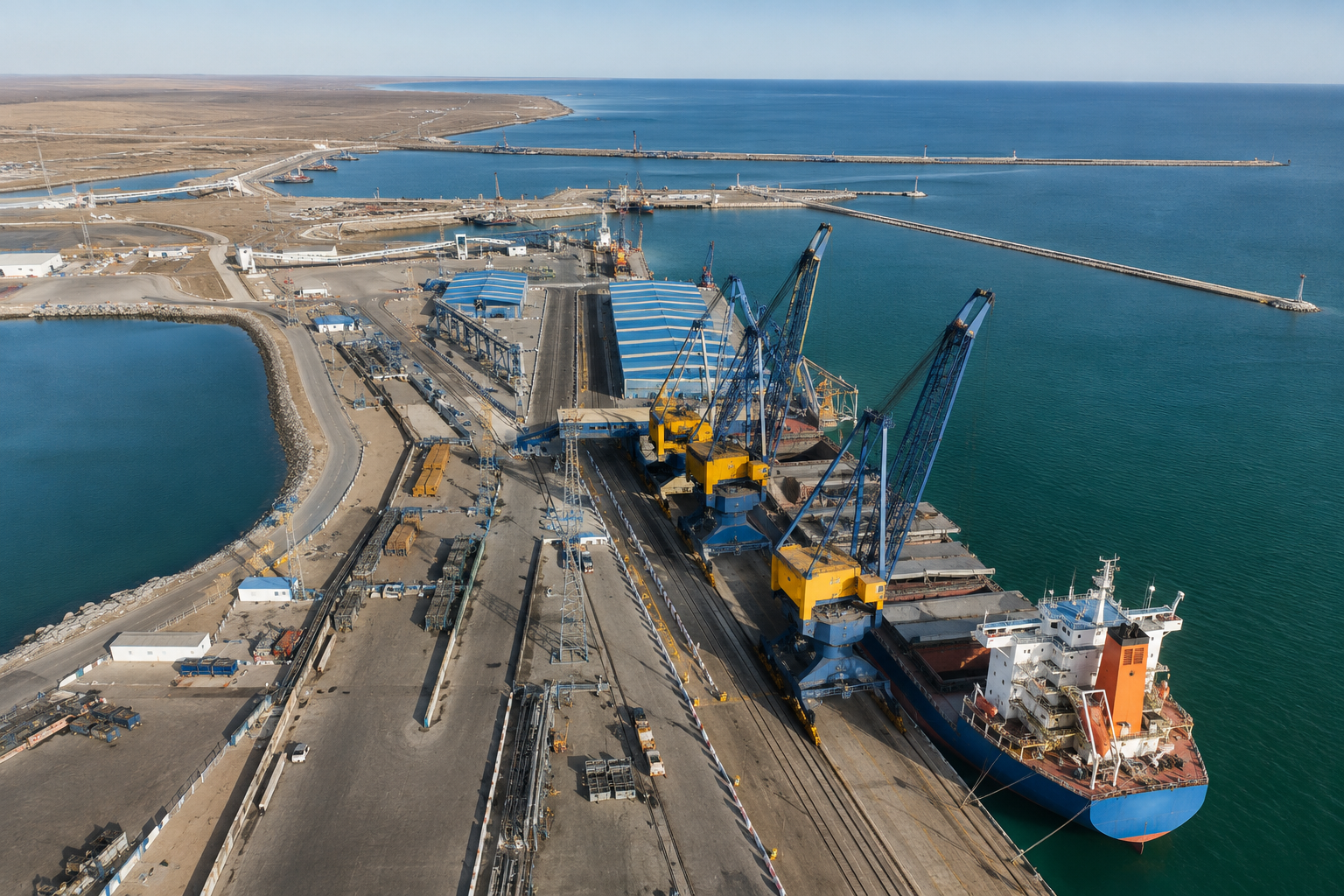
Kazakhstan is preparing one of the largest infrastructure developments on the eastern coast of the Caspian Sea — a new multifunctional terminal at Kuryk Port.
On July 23, 2026, the government said China’s Guoyou Materials Group planned to invest 470 billion tenge in the project, equivalent to roughly $1 billion depending on exchange rates.
The first phase is scheduled for construction in 2026–2028. A second stage is planned for 2029–2031, with the full complex expected to enter service in 2032.
The current proposal extends well beyond a conventional container terminal. It includes an automated container facility, a new railway connection to the national network, and the supply of container vessels and ferries.
The first phase is expected to handle up to 15 million tonnes of cargo annually. Once the entire development is completed, capacity is planned to reach around 25 million tonnes, with further expansion possible.
This change in project scale is critical when assessing the price.
$500 per TEU Is a Benchmark, Not a Universal Price
Alexey Bezborodov, managing partner of Infra Projects and an associate professor at HSE University, estimates that building a modern container terminal from scratch can start at around $500 per TEU of annual capacity.
Such a calculation can include berths, container yards, utilities, internal rail infrastructure, cranes, terminal equipment, digital systems and operational preparation.
Applying the benchmark mechanically to $1 billion would imply approximately 2 million TEU of annual capacity.
Against this measure, the earlier version of the Kuryk proposal appeared expensive. At the beginning of 2026, plans referred to first-stage capacity of around 180,000 TEU, 180,000 vehicles and 3 million tonnes of bulk cargo annually.
The figures cannot, however, be compared directly.
First, $500 per TEU is an expert benchmark rather than a fixed international construction rate. Terminal costs vary considerably depending on dredging, breakwaters, rail access, land conditions, power infrastructure and the equipment required.
Second, the current Kuryk proposal covers much more than a container terminal. It includes infrastructure for several cargo categories, a railway connection and additional maritime assets.
Third, the government no longer describes the first phase primarily in TEU. Its main benchmark is total freight capacity of up to 15 million tonnes annually.
Assessing the entire development purely through the cost of container capacity would therefore be misleading.
Kuryk Already Has Major Infrastructure
The key question is not only how much construction costs, but how much additional capacity is actually required.
Kuryk already has a ferry complex that entered operation in 2016, with designed handling capacity of around 6 million tonnes per year.
Other facilities are being developed for general and bulk cargo, containers, vehicles and rail ferry operations.
This is why Bezborodov argues that Kazakhstan first needs to establish the realistic scale of future demand.
In his assessment, a terminal with capacity of roughly 200,000–300,000 TEU could meet Kuryk’s current container requirements. Building significantly larger infrastructure becomes economically justified only if strong Middle Corridor growth materialises.
This creates the central dilemma: ports must be expanded before congestion appears, but building enormous reserve capacity too early can leave expensive infrastructure underused for many years.
Container Traffic Is Growing From a Relatively Low Base
Kazakhstan’s case for investment is based largely on the rapid development of the Trans-Caspian International Transport Route.
Container transit through Kazakhstan’s seaports has increased 3.8-fold over the past three years to around 42,000 TEU, while growth has continued in 2026.
The country is also expanding Aktau, upgrading its railways and adding vessels to its Caspian fleet.
K2Cargo.News previously examined why Kazakhstan and Georgia are becoming key hubs in Eurasia’s changing logistics network.
Middle Corridor expansion requires infrastructure to develop simultaneously at both ends of the Caspian and across the Black Sea section. For example, Georgia is expanding the Port of Poti to increase capacity on the western side of the route.
Rapid percentage growth alone, however, does not guarantee the near-term utilisation of a very large terminal.
That requires sustainable cargo flows from China and Central Asia, sufficient Caspian shipping capacity and corresponding infrastructure in Azerbaijan and Georgia.
Filling a Huge Terminal Is Harder Than Building It
Bezborodov estimates that capacity measured in millions of TEU could take around 15 years to reach high utilisation, even if containerisation of the regional economy continues.
That estimate concerns the development of the cargo base, not the financial payback period.
Commercial payback depends on terminal tariffs, cargo mix, operating costs, financing costs, equipment utilisation and the division of investment between government and private capital.
A terminal can technically handle millions of tonnes while remaining commercially weak if much of its capacity sits idle.
At the same time, port infrastructure is normally developed over horizons measured in decades. Kazakhstan may view Kuryk not simply as a commercial terminal but as a strategic investment in the China–Central Asia–Caspian–Caucasus–Europe route.
Kuryk Cannot Generate Returns Alone
The Caspian creates another important constraint: a terminal by itself does not create a transport corridor.
For Kuryk to increase throughput, cargo must arrive efficiently by rail, transfer quickly to vessels and be handled without delays on the western side of the Caspian.
A shortage of ferries creates queues. Limited railway capacity in Azerbaijan or Georgia can neutralise additional port capacity in Kazakhstan.
The economic return therefore depends on the entire Middle Corridor rather than on Kuryk alone.
This helps explain the growing interest from international port operators. K2Cargo.News previously reported that AD Ports confirmed its strategic interest in Kazakhstan, including discussions around cargo and grain terminal infrastructure.
International participation could also reduce the risk of Kazakhstan developing large national assets without a sufficiently international cargo base.
Aktau Plans to Combine Sea, Air and Rail Logistics
Another major project is being developed around Aktau International Airport.
Together with Türkiye’s YDA Holding, Kazakhstan plans to establish a multimodal aviation and logistics hub integrating air, road, rail and maritime transport.
The complex is expected to include cargo aviation, aircraft maintenance and repair, specialist training and logistics infrastructure.
Once completed, passenger capacity is expected to reach 2.5 million people annually, while freight volumes are targeted at up to 100,000 tonnes. Full commissioning is planned for 2030.
The commercial model is particularly important here.
Multimodality does not create cargo by itself. Shippers will transfer goods from sea or rail to aircraft only when the time saving justifies the much higher cost of air freight.
Aktau’s success will therefore depend on attracting high-value, urgent and time-sensitive cargo rather than simply connecting four modes of transport in one location.
A $250 Million Shipyard Also Looks Expensive
Kazakhstan is also planning a modern shipbuilding complex on the Caspian coast.
Investment is estimated at no less than 125 billion tenge, or roughly a quarter of a billion dollars.
The YDA Group project is designed to build up to eight new vessels and carry out as many as 24 major repair operations annually.
At first glance, the investment appears high relative to the number of ships.
The official concept, however, is broader than a conventional repair yard. The facility is expected to provide a full cycle from vessel design and construction to maintenance and major repairs.
It also includes production of uncrewed surface vessels, technology transfer, international standards and a training centre for Kazakh specialists.
The project is expected to create around 1,500 permanent jobs.
Comparing its cost directly with that of a basic ship-repair facility would therefore overlook much of the proposed scope.
Kazakhstan Has a Strategic Case for Domestic Shipbuilding
There is also a strategic argument for the shipyard.
Expanding Aktau and Kuryk cannot increase Caspian freight volumes without additional ferries, dry cargo vessels, container ships and support craft.
If construction and major repairs must always be performed abroad, Kazakhstan remains dependent on foreign shipyards.
Domestic capacity could reduce maintenance times and develop a local supply chain of equipment, engineering and maritime services.
Its commercial success will nevertheless depend on utilisation. Eight newbuildings and 24 repairs annually require a stable order book, ideally not only from Kazakhstan’s state-linked operators but also from other Caspian shipping companies.
Can Kazakhstan Recover the $1 Billion Investment?
There is not yet enough public information to answer this conclusively.
A proper payback calculation requires the financing structure, future terminal tariffs, cargo forecasts, operating costs, government guarantees and the exact terms of Guoyou Materials Group’s participation.
A full financial model has not been made public.
If cargo volumes grow more slowly than expected, Kazakhstan could end up with expensive infrastructure carrying a large amount of unused capacity.
If the Middle Corridor continues to expand rapidly and bottlenecks in Azerbaijan, Georgia and the Caspian fleet are addressed at the same time, what looks like excess capacity today could become necessary infrastructure within the next decade.
The main question is therefore not simply whether $1 billion is too much for a terminal. It is whether the scale of construction matches a realistic freight forecast.
In Kuryk’s case, that calculation has become more complicated because the current development can no longer be described simply as a 180,000-TEU container terminal. The government now presents it as a much broader multimodal port, rail and maritime complex.
Only detailed technical specifications, capital expenditure breakdowns and future tariff assumptions will show whether the billion-dollar price represents overinvestment or reflects the true scale of the infrastructure being proposed.
Read also: AD Ports Confirms Strategic Interest in Kazakhstan