

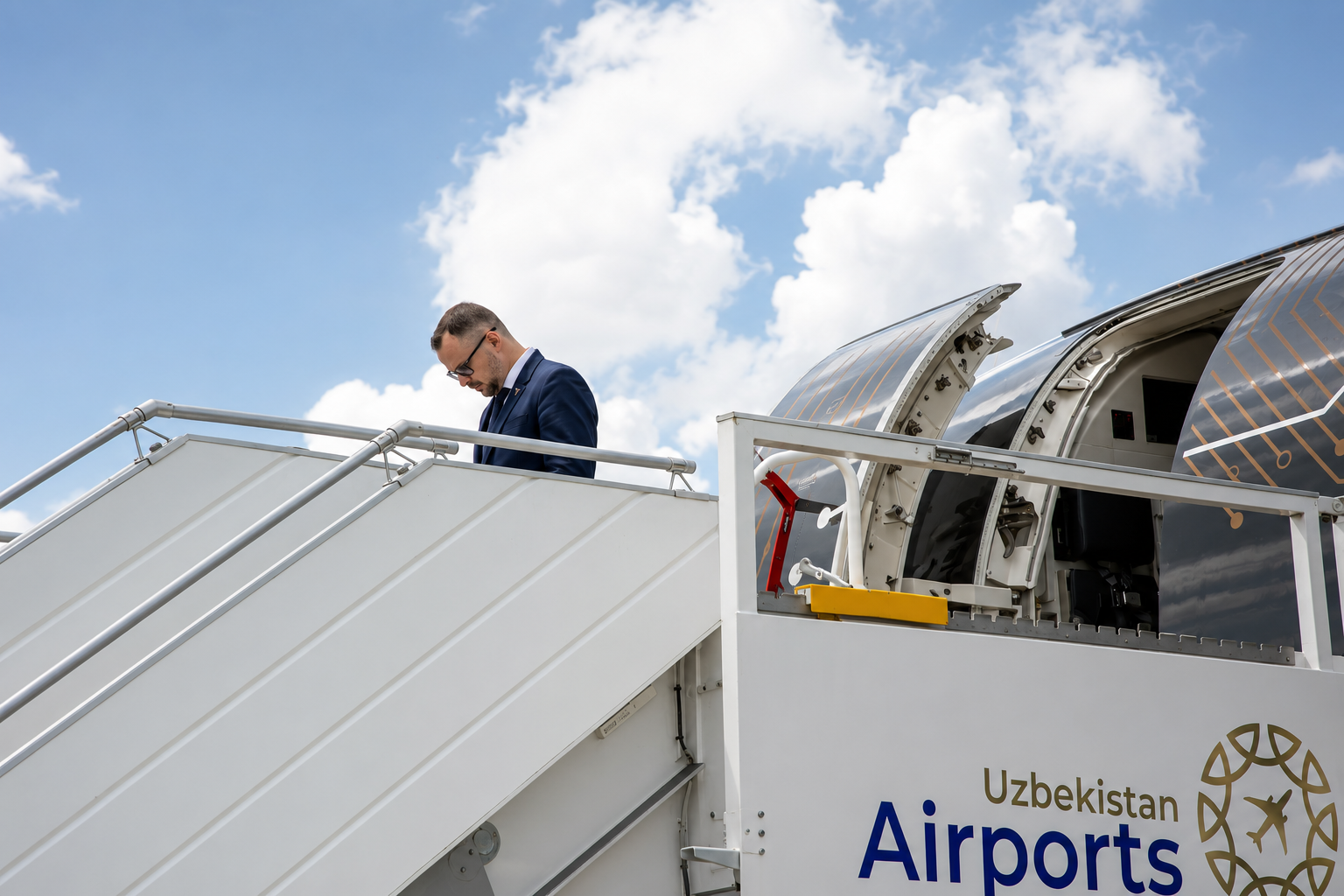
Rating Affirmed at ‘BB’
Fitch Ratings has revised the outlook on Uzbekistan Airports’ Long-Term Issuer Default Rating from Stable to Positive while affirming the rating at ‘BB’.
The decision followed a similar change to Uzbekistan’s sovereign outlook. Fitch affirmed the country’s rating at ‘BB’ in June 2026 and changed the outlook to Positive, citing progress on structural reform, stronger macroeconomic policy and growing foreign-exchange reserves.
Uzbekistan Airports’ rating is equalized with the sovereign because the company is fully state-controlled and performs a strategic role in the national transport system.
Fitch assesses the operator’s Standalone Credit Profile at ‘bb’. The score reflects its monopoly position, low leverage, adequate liquidity and expected revenue from infrastructure projects, including public-private partnerships.
State Retains Control of the Airport Network
Uzbekistan Airports owns and operates the country’s civil airports.
The Ministry of Economy and Finance is the company’s sole shareholder and retains decisive influence over strategic planning, financial policy, major investments and aviation tariffs.
Fitch does not expect the ownership structure to change. Airport infrastructure remains a strategic state asset supporting tourism, international trade and regional connectivity.
Replacing Uzbekistan Airports as the owner and operator of the national network would be extremely difficult and would require a broad restructuring of the aviation sector.
Government Support Underpins the Rating
The company has a history of receiving direct financial support.
Between 2022 and 2024, the state budget allocated UZS513.5 billion to Uzbekistan Airports’ capital projects.
At the end of 2025, state guarantees covered approximately 11.6% of senior debt. A further 9.6% consisted of a senior unsecured, interest-free loan from the Ministry of Economy and Finance.
The figures show that the government is willing to support airport investment without directly guaranteeing every company obligation.
Monopoly Reduces Competitive Pressure
Uzbekistan Airports benefits from exclusive control over domestic airport infrastructure.
The company receives revenue from passenger and cargo airlines, terminal operations, aircraft services and the use of airport facilities.
This provides a stable operating base because airlines serving Uzbekistan cannot transfer their operations to a competing airport operator within the same city.
The monopoly does not eliminate exposure to lower travel demand, weaker tourism or changes in airline route networks.
Because the company operates only in Uzbekistan, it has limited geographical diversification.
Passenger Volumes Continue to Grow
Fitch views Uzbekistan’s aviation market as a fast-growing sector supported by tourism, stronger economic activity and expanding international connections.
Air cargo is also becoming more important. K2Cargo.News previously reported that Uzbekistan’s air freight volumes increased by 70% in early 2026.
Growing passenger and cargo traffic should improve airport utilization and create demand for warehouses, customs facilities and ground-handling services.
However, traffic growth does not automatically result in a proportional increase in revenue. Financial performance also depends on tariffs, passenger composition and commercial spending.
Aeronautical Revenue Remains Dominant
One of the operator’s main weaknesses is its dependence on aeronautical services.
Retail, rental, parking, food, advertising and other non-aeronautical activities account for less than 7% of total revenue.
This is significantly below the level recorded by large international airport groups. Spanish operator Aena generated about 31% of its 2025 revenue from commercial operations, while Mexico’s OMA reached approximately 25%.
The comparison demonstrates that Uzbekistan’s airports have not yet fully developed the commercial value of their passenger traffic.
Expanding retail and service revenue would reduce dependence on regulated airline charges.
Several Airlines Account for Significant Revenue
Uzbekistan Airways was the airport operator’s largest customer in 2025, accounting for approximately 10% of revenue.
Turkish Airlines contributed around 7%, while cargo carrier Maersk Air generated about 6%.
No single customer represents a critically high share, reducing the effect of the possible departure of one airline.
Domestic carriers nevertheless accounted for approximately 68% of passenger volumes in 2025.
This makes Uzbekistan Airports sensitive to the condition of the domestic aviation sector and government decisions on airline tariffs.
Tariff Regulation Limits Predictability
Charges for resident airlines are set in Uzbek soums by the Ministry of Economy and Finance based on proposals from Uzbekistan Airports.
Fitch says the absence of clearly defined regulatory guidelines limits long-term tariff predictability.
Fees may reflect government priorities as well as the operator’s commercial requirements.
Authorities may keep airport charges low to support national airlines, encourage new routes or limit passenger ticket prices.
For Uzbekistan Airports, this creates a risk that higher operating costs will not be fully or promptly recovered through tariff increases.
Tashkent Airport Is Being Expanded
Uzbekistan Airports is implementing a programme to modernize and expand capacity at Tashkent International Airport.
The capital’s airport is the country’s main passenger and cargo gateway and handles much of its international traffic.
Growing flight numbers require additional check-in capacity, security areas, boarding gates, baggage systems and apron infrastructure.
Modernization should improve throughput and passenger service while creating new commercial areas.
The financial effect will depend on whether additional capacity leads to more routes, higher transit traffic and greater passenger spending.
Regional Airports May Attract Private Partners
The operator is considering public-private partnerships for airports in Bukhara, Namangan and Urgench.
Private investors could finance terminal construction, introduce commercial management and share project risks with the state.
Bukhara and Urgench are important tourism gateways, while Namangan serves the densely populated Fergana Valley.
Fitch views expected PPP-related revenue as a supportive factor for the operator’s Standalone Credit Profile.
Flexible Investment Plans Limit Debt Growth
A large part of planned capital expenditure has not yet been contractually committed.
This gives Uzbekistan Airports the ability to reduce, postpone or phase projects if market conditions deteriorate.
Fitch views capex flexibility positively because the company does not need to finance every proposed project simultaneously.
Investment is primarily funded through operating cash flow and available credit facilities.
This approach limits leverage but could slow infrastructure expansion.
Liquidity Remains Adequate
At the end of 2025, Uzbekistan Airports held UZS393 billion in cash.
The company also had undrawn long-term credit facilities of $23 million and €25.9 million for future capital expenditure.
Available liquidity allows the operator to continue investment without relying excessively on short-term borrowing.
Its debt consists mainly of secured and unsecured amortizing loans, reducing refinancing concentration.
Foreign-Currency Debt Creates Exposure
Part of the company’s debt is denominated in US dollars, euros and Japanese yen, while a substantial portion of revenue is generated in Uzbek soums.
A depreciation of the local currency would increase debt-service costs when converted into soums.
Foreign-currency-linked income may provide some protection, but the company does not have a complete natural hedge.
Approximately 20% of floating-rate debt was also unhedged at the end of 2025.
Higher international interest rates could therefore increase financing costs.
Tashkent’s Hub Ambitions Face Competition
Uzbekistan’s geographical position gives it the potential to become a hub between Europe and Asia.
However, transit traffic currently accounts for only about 3% of the country’s passenger market.
Developing a hub requires more than airport expansion. Airlines need coordinated arrival and departure schedules, short connection times, competitive charges and a broad international network.
Neighbouring airports in Central Asia and the Caucasus are also expanding, meaning Tashkent faces growing regional competition.
Restrictions on open-skies access may protect Uzbekistan Airways but could limit new airline entry and the growth of transfer traffic.
Positive Outlook Is Not an Automatic Upgrade
The Positive Outlook indicates that Fitch sees a possible rating upgrade over the medium term.
An upgrade would most likely require an improvement in Uzbekistan’s sovereign rating while Uzbekistan Airports preserves a resilient standalone financial profile.
The operator must maintain low leverage, adequate liquidity and disciplined investment.
A weaker sovereign position, rapid debt growth or deterioration in operating performance could prevent an upgrade or lead to a return to a Stable Outlook.
Commercial Revenue Is the Main Growth Opportunity
Uzbekistan Airports combines strong state backing with several structural weaknesses.
Its monopoly position and low leverage provide stability, while regulated tariffs and foreign-currency debt reduce flexibility.
The clearest opportunity lies in increasing non-aeronautical revenue beyond the current level of less than 7%.
Retail, restaurants, parking, hotels, advertising and rental income could make the company less dependent on airline charges.
If modernization projects increase capacity, transfer traffic and passenger spending, Uzbekistan Airports could build a more diversified and resilient financial model.
Read also: Uzbekistan Air Cargo Volumes Surge 70%
